
What if remote working, not AI, is to blame for weak junior hiring?
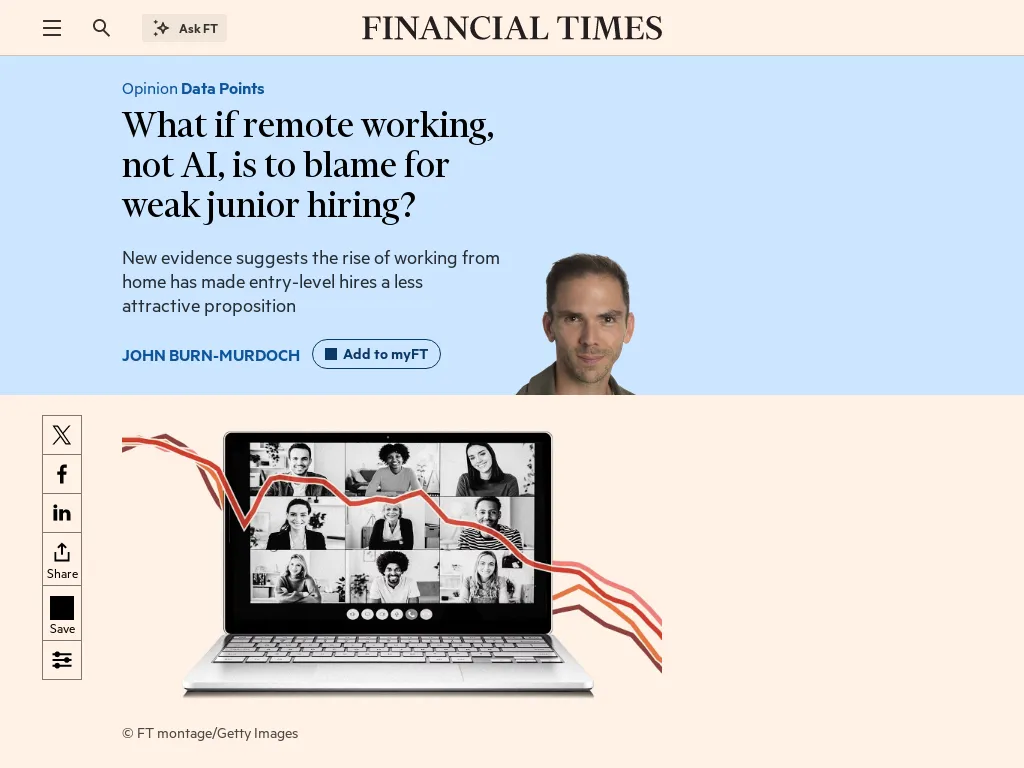

John Burn-Murdoch’s Data Points column on a new paper by Peter John Lambert and Yannick Schindler: analysing hundreds of millions of hires and job postings, they find the apparent link between AI exposure and the junior-hiring crunch evaporates once you account for whether a role is remote — junior hiring in remote-friendly but low-AI-exposure roles (lawyers) has also been weak, while high-AI-exposure in-person roles (receptionists) have held up. The proposed mechanism is that remote work worsened the trade-off for entry-level hires specifically: juniors need supervision and build skills and social capital by working alongside seniors, all of which WFH makes costlier, while the calculus for senior hires is unchanged. None of it exonerates AI — remote work may even be a risk factor for displacement, since managers who only see reports over Slack may judge their work more automatable — but it recasts the youngest workers as hit twice by a shift that most benefits the mid-career, consistent with Gen Z being the generation most opposed to fully remote roles. Unpaywalled here; discussion on HN.
Was this useful?