
Towards a science of scaling agent systems: When and why agent systems work
2026-01-31
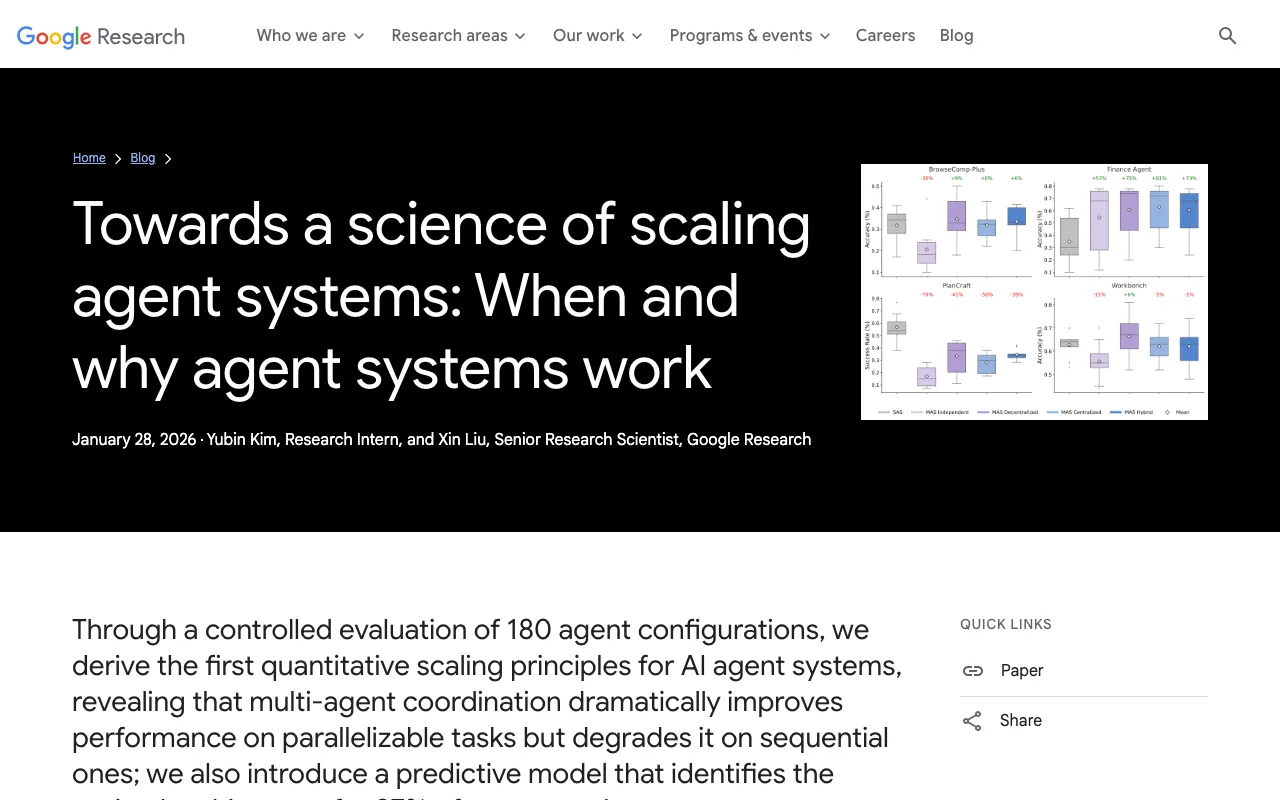

This Google Research blog post presents results from a controlled evaluation of 180 agent configurations across five canonical architectures on four benchmarks, deriving the first quantitative scaling principles for AI agent systems. The key finding is that multi-agent coordination dramatically improves performance on parallelisable tasks but severely degrades it on sequential ones, and independent multi-agent systems without coordination amplify errors by 17.2x compared to 4.4x for centralised orchestrator-based systems.
Was this useful?