
Rich Sutton on "AI creativity & discovery"
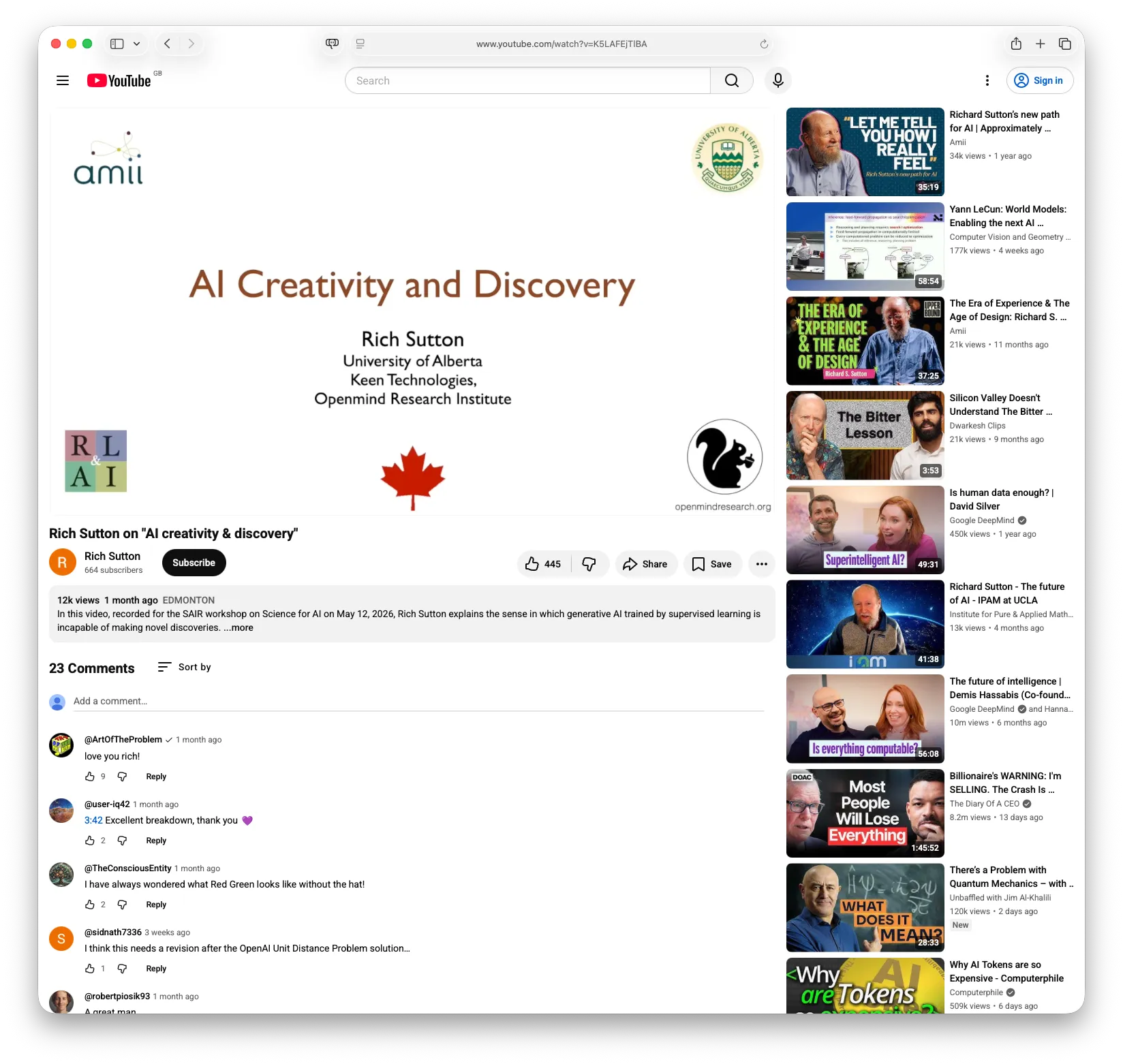

Recorded for the SAIR workshop on Science for AI (May 2026), Rich Sutton opens with the old reviewer’s joke — the parts that are good are not novel and the parts that are novel are not good — and argues it applies exactly to generative AI: a generated trajectory is grounded either in the training data (good) or in stochastic variation (novel), never both at once, which is fine for a mimic but devastating for science and mathematics. True discovery takes three steps — variation, evaluation, selective retention (the Campbell/Dennett lineage) — and supervised learning has no runtime evaluation, hence no retention and no discovery; AlphaGo’s Move 37, AlphaZero, and AlphaFold create precisely because their evaluation comes from an explicit objective rather than from mimicking examples. His closing call to arms: share goals with AI systems so they can generate, evaluate, and retain — ‘let’s automate creativity and discovery.’
Was this useful?