
QFM102: Elixir Reading List - February 2026
 Source: Photo by Jakub Żerdzicki on Unsplash
This month's Elixir Reading List covers practical Phoenix patterns, workflow orchestration, and the BEAM's relevance to the AI agent era. On the practical side, Yellow Duck walks through making Phoenix flash messages disappear automatically — a simple JS hook solution to a problem that had gone unanswered on the Elixir Forum since 2020. James Harton demonstrates how Reactor, his dependency-resolving saga orchestrator, can dramatically improve application startup times by parallelising tasks like migrations and secret provisioning.
The standout piece this month is George Guimaraes arguing that your agent framework is just a bad clone of Elixir — every pattern the Python AI agent ecosystem is building in 2026 (isolated state, message passing, supervision hierarchies, fault recovery) already exists in the BEAM and has been running telecom switches, WhatsApp, and Discord at scale for decades.
As always, the Quantum Fax Machine Propeller Hat Key will guide your browsing. Enjoy!
Propeller Hat Key
- 1 of 5:
- Mentions Elixir and related technologies
- 2 of 5:
- Talks about the Elixir ecosystem in real-world use cases
- 3 of 5:
- Talks about technical details of Elixir ecosystem components
- 4 of 5:
- Using and working with Elixir ecosystem technologies in software
- 5 of 5:
- Programming new Elixir technology concepts and implementations
Links
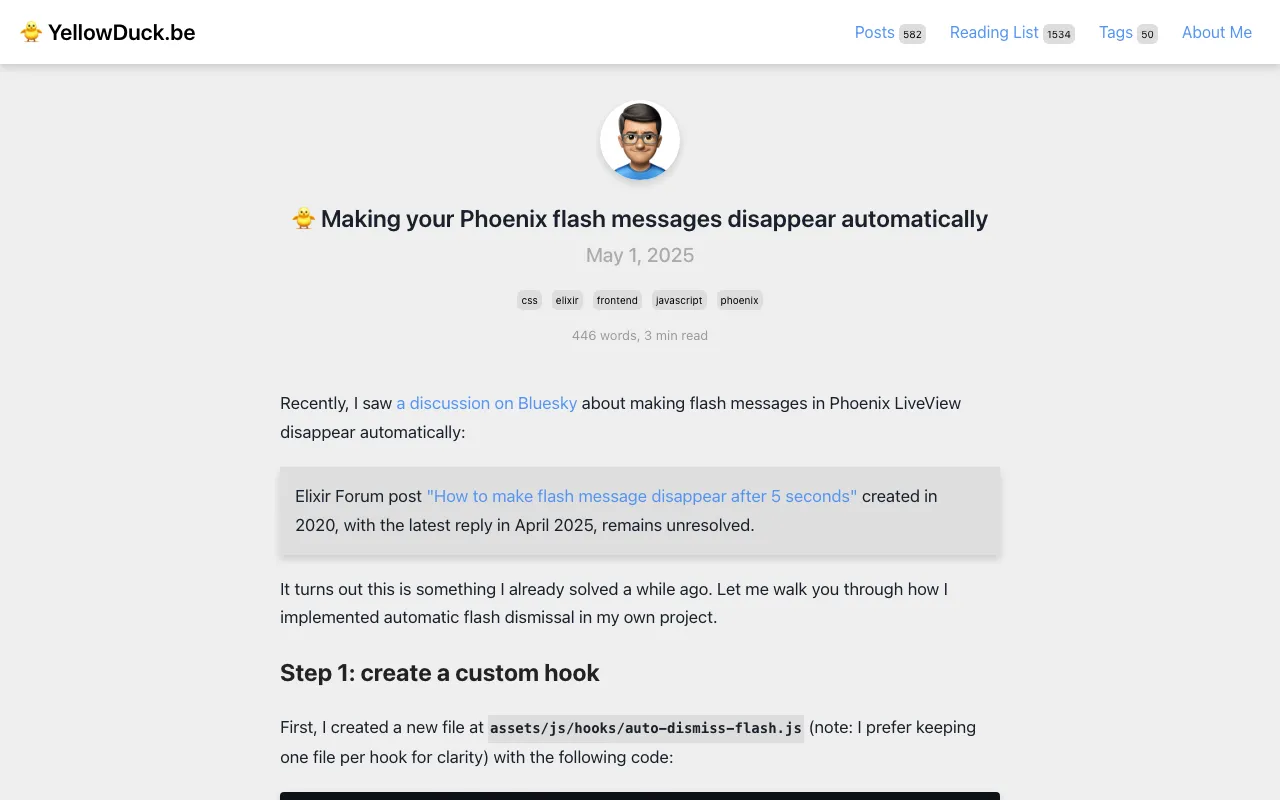
This article walks through implementing auto-dismissing flash messages in Phoenix LiveView using a custom JavaScript hook. The technique involves creating an AutoDismissFlash hook that triggers a fade-out and removal after a set timeout, wiring it up in app.js, and adding the phx-hook attribute to the flash component.

This talk introduces Reactor, a framework-independent Elixir library (extracted from Ash.Engine) that serves as a dynamic, concurrent, dependency-resolving saga orchestrator. Users define workflow steps and their dependencies via arguments, and Reactor automatically calculates the dependency graph, runs steps concurrently as their inputs become available, and supports compensation (rollback) when failures occur.
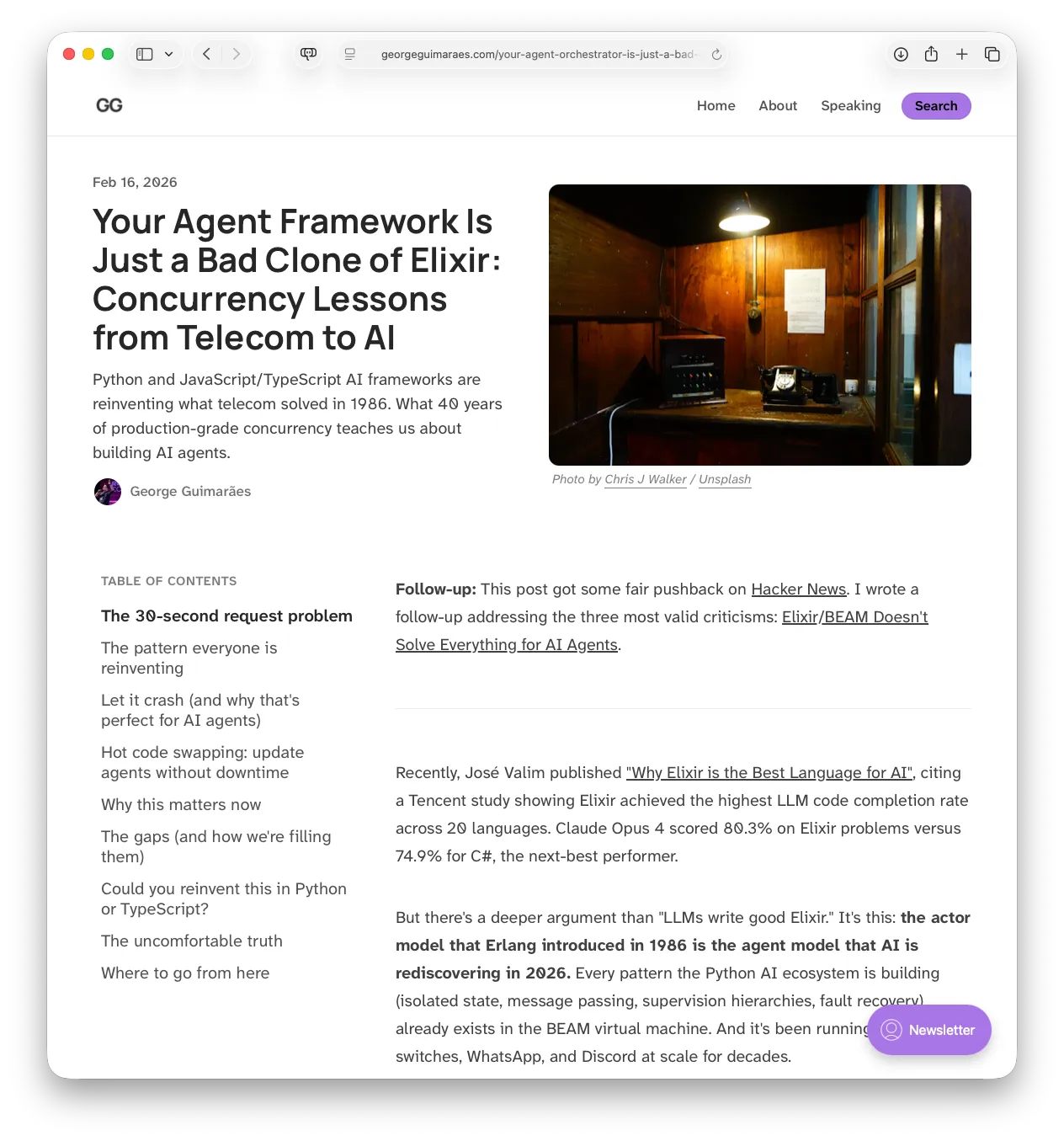
The article argues that Python-based AI agent frameworks are independently reinventing concurrency primitives -- isolated state, message passing, supervision trees, and fault recovery -- that the BEAM virtual machine has provided since Erlang's introduction in 1986. The author draws direct parallels between patterns in frameworks like Langroid and what Elixir/OTP already offers out of the box, battle-tested at scale by WhatsApp, Discord, and telecom infrastructure.
Regards,
M@
[ED: If you'd like to sign up for this content as an email, click here to join the mailing list.]
Originally published on quantumfaxmachine.com and cross-posted on Medium.
hello@matthewsinclair.com | matthewsinclair.com | bsky.app/@matthewsinclair.com | masto.ai/@matthewsinclair | medium.com/@matthewsinclair | xitter/@matthewsinclair
Was this useful?