
QFM111: Engineering Leadership Reading List - April 2026
 Source: Photo by Dylan Gillis on Unsplash
Five voices on what AI is doing to engineering practice and management. The ladder is missing rungs (Negroni Venture Studios) argues that the junior-to-senior career path is being eroded by AI taking the work that used to teach craft. Martin Fowler answers the same problem from inside engineering with Structured-Prompt-Driven Development: when prompting becomes the bottleneck, structure it like you'd structure code. Andy Matuschak's classic "Work with the garage door up" gets new relevance — working in public is one of the few ways to keep cognitive surrender at bay.
German Velasco's What managerial economics can tell us about AI and software development drags the management lens onto it: the firm's boundary, transaction costs, the make-vs-buy decision — all of it is shifting now that the marginal cost of a competent engineer has collapsed. Meanwhile The beginning of programming as we'll know it (bitsplitting.org) takes a longer view, and Nebula on building with no team is the most candid public log we have of what AI-augmented solo building actually feels like — including its honest failure modes.
As always, the Quantum Fax Machine Propeller Hat Key will guide your browsing. Enjoy!
Propeller Hat Key
- 0 of 5:
- Unrelated to technology, management, or leadership
- 1 of 5:
- Suitable for management and leadership novices
- 2 of 5:
- Topics of interest for the new manager or leader
- 3 of 5:
- Technology management and leadership in real-world use cases
- 4 of 5:
- Topics for experienced managers and leaders
- 5 of 5:
- Advanced topics in management and leadership
Links
Managerial economics provides a framework for understanding how AI and software developers interact through isoquant and isocost curves—tools that model how firms trade off capital (LLMs) and labor (developers) to maintain output levels. The Marginal Rate of Technical Substitution reveals that neither input can be eliminated entirely; diminishing returns mean you need both AI and human developers working together, similar to how a single person with multiple shovels won't dig more holes than necessary. This framework helps answer critical questions about whether AI will replace developers, complement them, or how cost changes in LLMs will reshape software development economics.
Alexander Grosse, building the Nebula AI assistant solo, documents the experiment in two parts. Part one — written after three decades in software — describes what he calls the "Dark Factory pattern": AI handles coding, product management, design review, and QA, while the human handles direction, user research, and the design decisions that need taste. Part two, three weeks later, is the honest look-back: the headline finding is "addiction to velocity" — when generating features is cheap, the urge to skip user testing, validation, and product discipline is overwhelming, and managing a dark factory of agents is itself a substantial engineering job (architecture, quality gates, manual review of user-facing surfaces). A candid two-part log of what AI-augmented solo building looks like in practice.
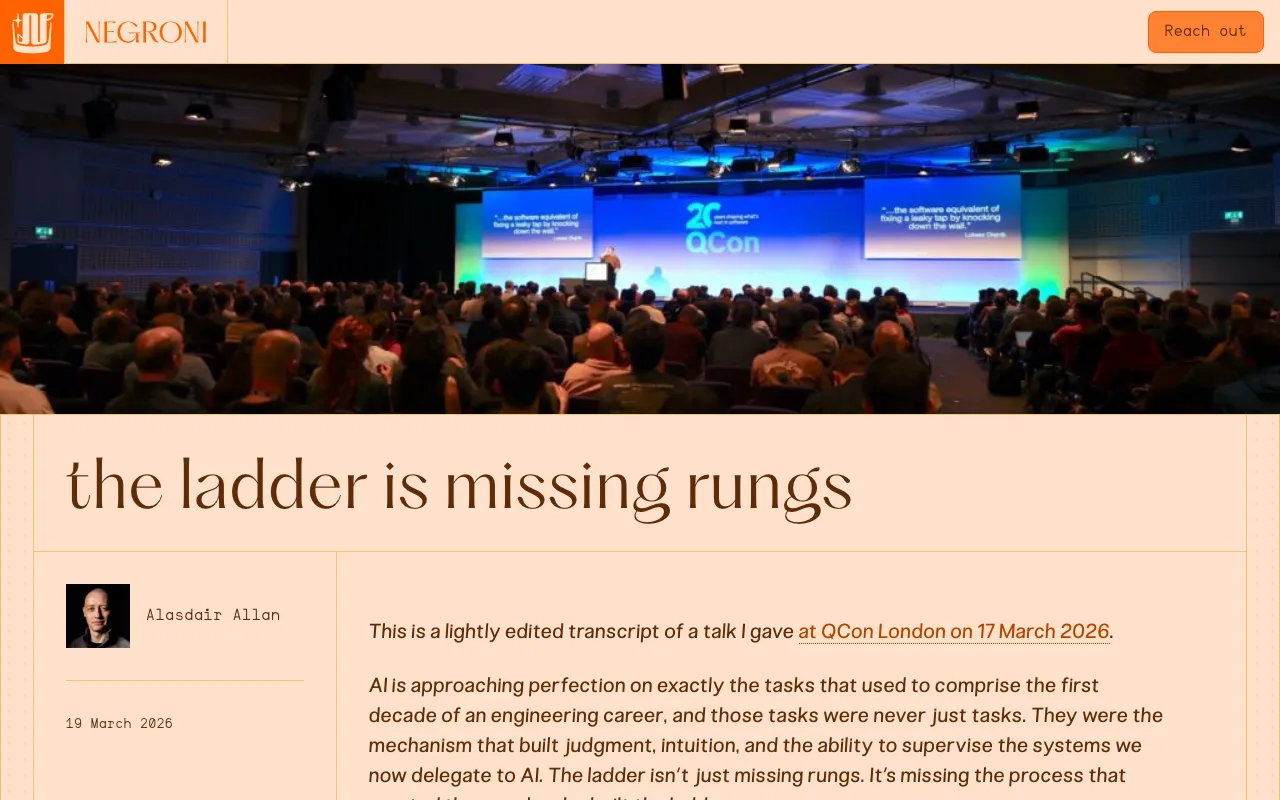
AI is automating the entry-level coding tasks that historically trained junior engineers in design judgment and system oversight, creating a structural gap where the next generation lacks the foundational experience to supervise these AI systems. While AI-assisted coding is genuinely productive in certain contexts (around 30-50% of code generation), experienced developers using these tools paradoxically work slower while perceiving themselves as faster, revealing a fundamental mismatch between efficiency metrics and actual learning outcomes in software engineering.
Structured-Prompt-Driven Development (SPDD) treats prompts as version-controlled, first-class artifacts alongside code to make LLM-assisted changes governable, reviewable, and reusable at the team level. While individual developers gain local speed from AI coding assistants, system-level throughput requires addressing ambiguous requirements, review complexity, and alignment issues—which SPDD solves by embedding structured prompts in the development workflow to scale AI assistance across organizations. The method requires three core developer skills: abstraction-first thinking, alignment with business needs, and iterative review practices.
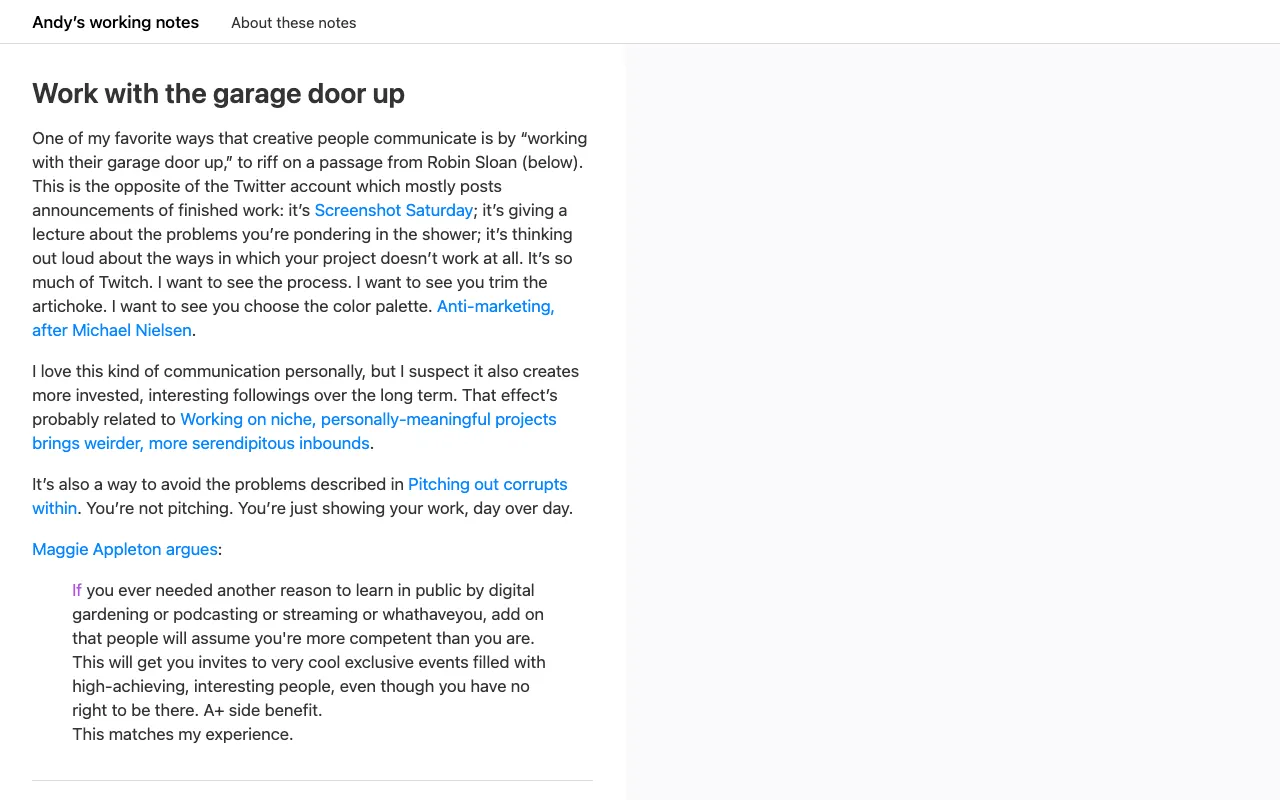
Working with the "garage door up" means sharing your creative process publicly—not just finished products—through screenshots, lectures, live streams, and thinking out loud about problems, which builds more invested followings and attracts serendipitous opportunities while avoiding the pitfalls of promotional "pitching." The internet's fundamental asymmetry, where visibility requires constant speaking unlike physical spaces where open doors quietly signal "I am here working," creates a distorted perception of what people are actually doing; most human effort happens invisibly while only the loudest voices get noticed.
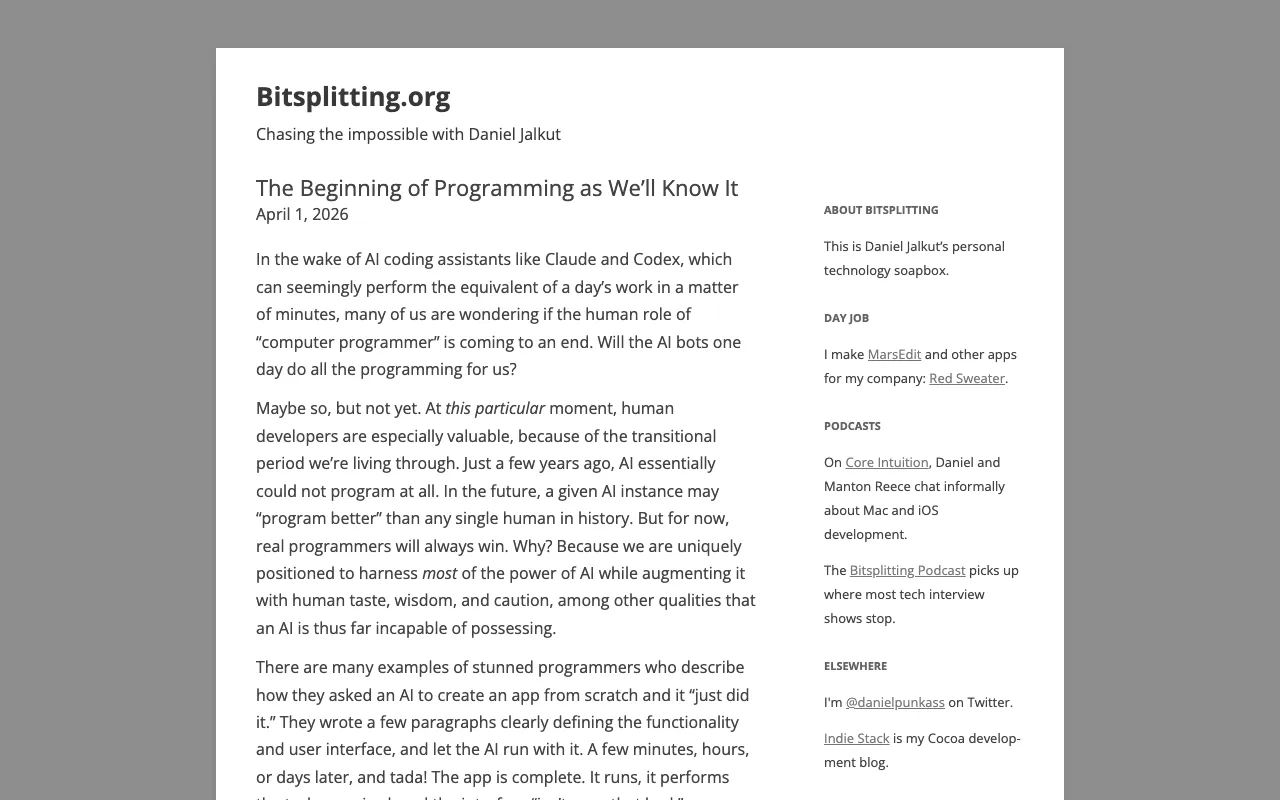
AI coding assistants generate substantial code quickly, but current systems require significant human oversight—correction, rewriting, and steering—to produce reliable results, meaning programmers remain essential during this transitional period where AI excels at quantity over quality. The proliferation of successful AI coding stories reflects confirmation bias, as developers rarely share failures where AI produces inscrutable code or demonstrates fundamental knowledge gaps, creating a distorted perception of AI's actual capabilities.
Regards,
M@
[ED: If you'd like to sign up for this content as an email, click here to join the mailing list.]
Originally published on quantumfaxmachine.com and cross-posted on Medium.
hello@matthewsinclair.com | matthewsinclair.com | bsky.app/@matthewsinclair.com | masto.ai/@matthewsinclair | medium.com/@matthewsinclair | xitter/@matthewsinclair
Was this useful?