
QFM123: Engineering Leadership Reading List - July 2026
 Source: Photo by Vitaly Gariev on Unsplash
Three reads this month, and they argue with each other about one question: if the machine writes the code, what is left that is hard? Senko Rašić takes the slogan on directly in Code was never the hard part is an insult to all programmers, which reads as a defence of craft against a line that has become a way of not thinking. Jeremy Osborn answers with evidence in CACM: AI Didn't Make Programming Easier. It Just Made It Differently Difficult walks four decades of research on programming as memory work, then shows where an assistant that remembers the syntax for you actually moves the load — from recall to judgment, from how do I write this to does this make sense. His paradox is the keeper: the barrier to producing code has fallen while the barrier to producing good code has risen.
Underneath both sits the ordinary question of what a manager is accountable for while this settles. The Four Core Areas of Responsibility for an Engineering Manager is the least dramatic thing here and probably the most immediately useful — a plain map of the job that does not assume the last two years happened.
As always, the Quantum Fax Machine Propeller Hat Key will guide your browsing. Enjoy!
Propeller Hat Key
- 0 of 5:
- Unrelated to technology, management, or leadership
- 1 of 5:
- Suitable for management and leadership novices
- 2 of 5:
- Topics of interest for the new manager or leader
- 3 of 5:
- Technology management and leadership in real-world use cases
- 4 of 5:
- Topics for experienced managers and leaders
- 5 of 5:
- Advanced topics in management and leadership
Links
The author argues that dismissing coding as "easy" while claiming the hard part is understanding requirements or business needs fundamentally misrepresents the profession and disrespects programmers' expertise. The contradiction is evident: if coding were truly easy, programmers wouldn't command high salaries, be subject to rigorous interviews, have entire bodies of canonical literature dedicated to their craft, nor would software be plagued with bugs and quality issues. The author further challenges the notion that product managers, business analysts, or salespeople have it harder by pointing out they lack equivalent rigor, compensation, or prestige compared to developers.
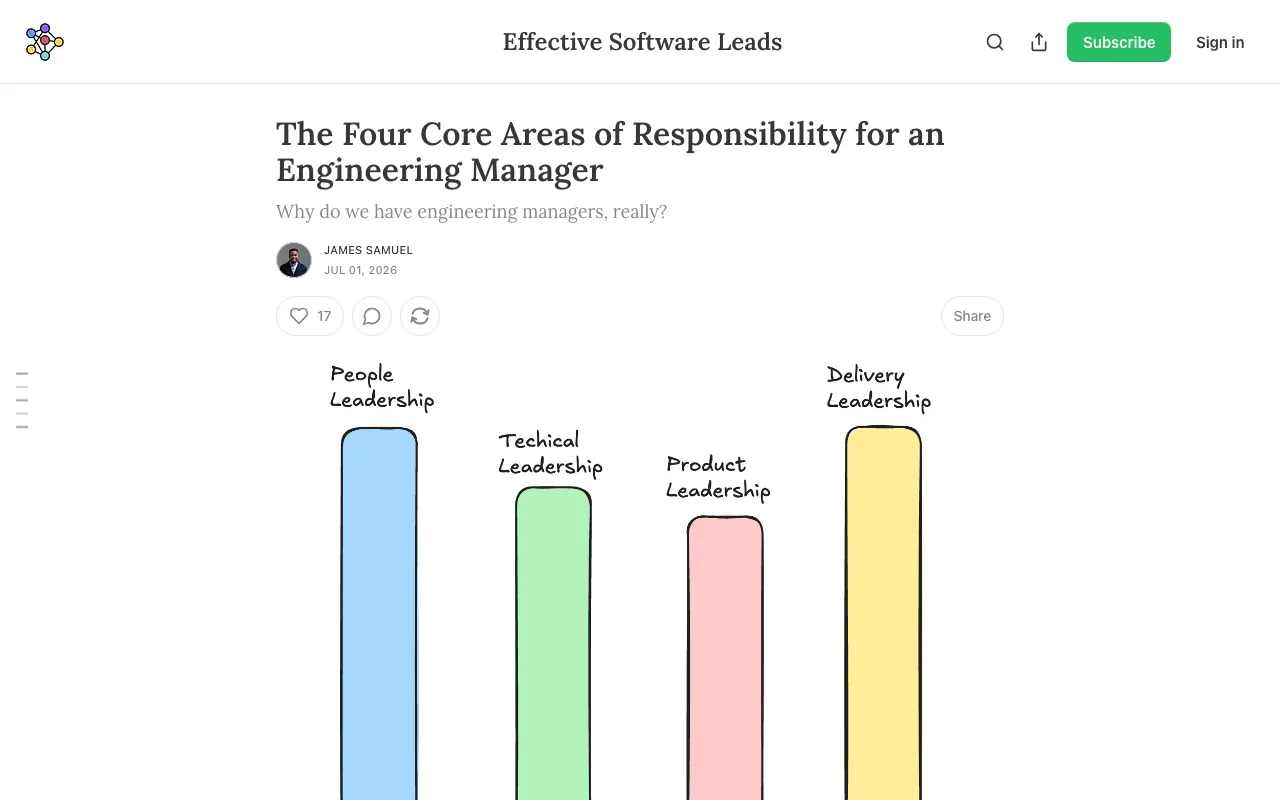
Engineering managers exist to amplify the collective impact of their teams by creating alignment and coordination as organizations scale, a role historically rooted in the same purpose as Roman centurions managing legions. The core responsibilities of an engineering manager span four interdependent areas—people leadership, technical leadership, product leadership, and delivery leadership—with the balance between these shifting based on organizational needs and challenges. Rather than being fixed, an engineering manager's focus naturally adapts throughout the year, moving between priorities like technical architecture guidance during platform migrations or people-focused hiring and onboarding during growth phases.
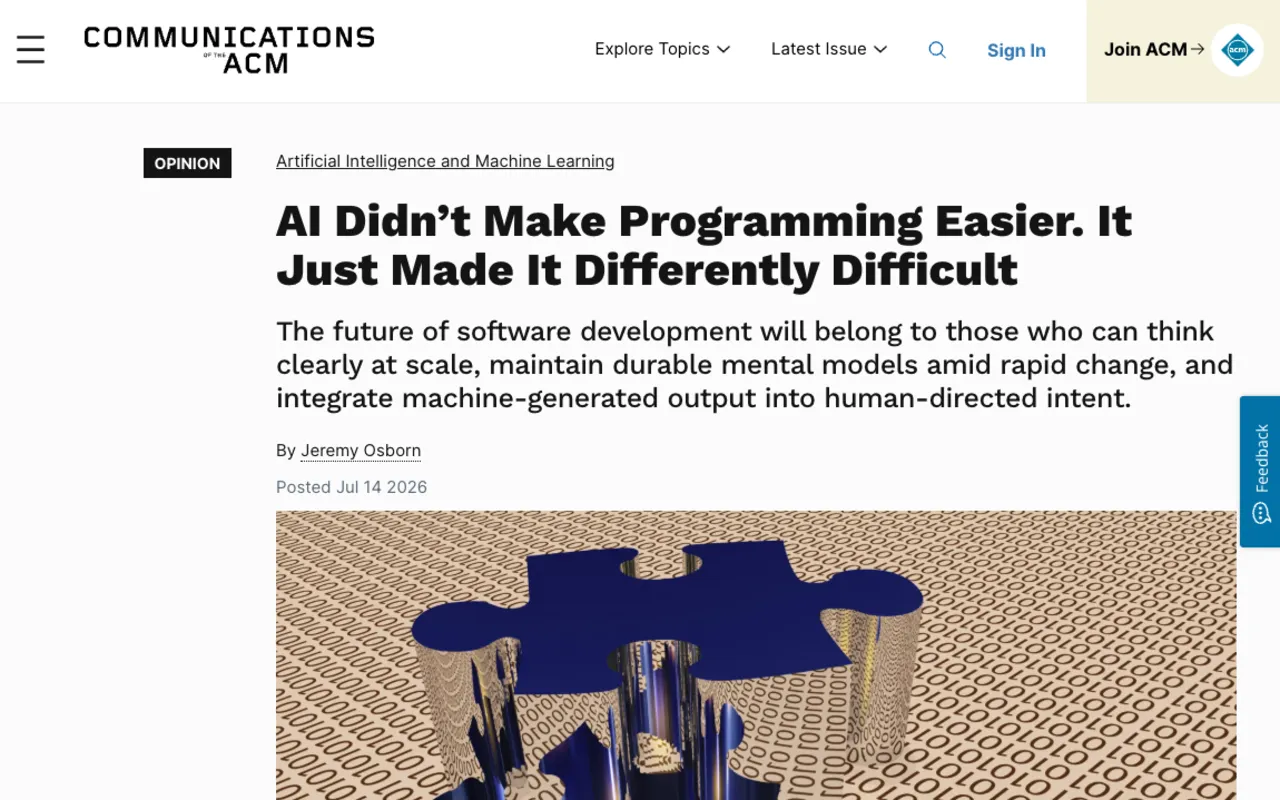
Jeremy Osborn argues in CACM that AI coding assistants have relocated the cognitive work of programming rather than reduced it. Decades of empirical research treated working memory and long-term recall as the discipline's central bottleneck; an assistant that generates boilerplate and retrieves syntax on demand lowers the penalty for imperfect recall, and Osborn reads that through distributed cognition, cognitive load theory and the extended mind hypothesis. What it does not touch is architectural reasoning, impact analysis and long-term maintenance, all of which depend on a mental model of the codebase that cannot be offloaded. The hard part moves from recall -- how do I write this -- to judgment -- does this actually make sense. Osborn draws out four consequences: the field opens to people who would have bounced off the memorisation overhead, the work becomes differently difficult rather than simpler, education bends from syntax toward systems, and the programmer survives as the orchestrating agent who decides what matters. The paradox he names is worth the read on its own: the barrier to producing code falls while the barrier to producing good code rises, because judgment is harder to develop than recall ever was.
Regards,
M@
[ED: If you'd like to sign up for this content as an email, click here to join the mailing list.]
Originally published on quantumfaxmachine.com and cross-posted on Medium.
hello@matthewsinclair.com | matthewsinclair.com | bsky.app/@matthewsinclair.com | masto.ai/@matthewsinclair | medium.com/@matthewsinclair | xitter/@matthewsinclair
Was this useful?