
QFM131: Engineering Leadership Reading List - September 2026
 Source: Photo by Beatriz Cattel on Unsplash
Most of this list is about how an idea gets from one head into another. Anton Zaides reaches for a house to explain to business people why building software is still hard. Will Keleher's small programming tricks close with a habit worth stealing: share one with your team each day, and no more than one.
I'm aphantasic, so I'll single one out: People Who Can't Picture Anything Are Rewriting the Science of Imagination. It belongs on the leadership shelf because the people you lead think in more ways than you might assume, and its summary points to two earlier links I have shared on the subject.
Elsewhere, Iouri Khramtsov argues that if AI coding is lowering your code quality, you're not managing quality right, and SPRIND and HV's European Sovereignty: A Founder's Playbook works through what founders of Europe's strategic companies should want from the state.
As always, the Quantum Fax Machine Propeller Hat Key will guide your browsing. Enjoy!
Propeller Hat Key
- 0 of 5:
- Unrelated to technology, management, or leadership
- 1 of 5:
- Suitable for management and leadership novices
- 2 of 5:
- Topics of interest for the new manager or leader
- 3 of 5:
- Technology management and leadership in real-world use cases
- 4 of 5:
- Topics for experienced managers and leaders
- 5 of 5:
- Advanced topics in management and leadership
Links
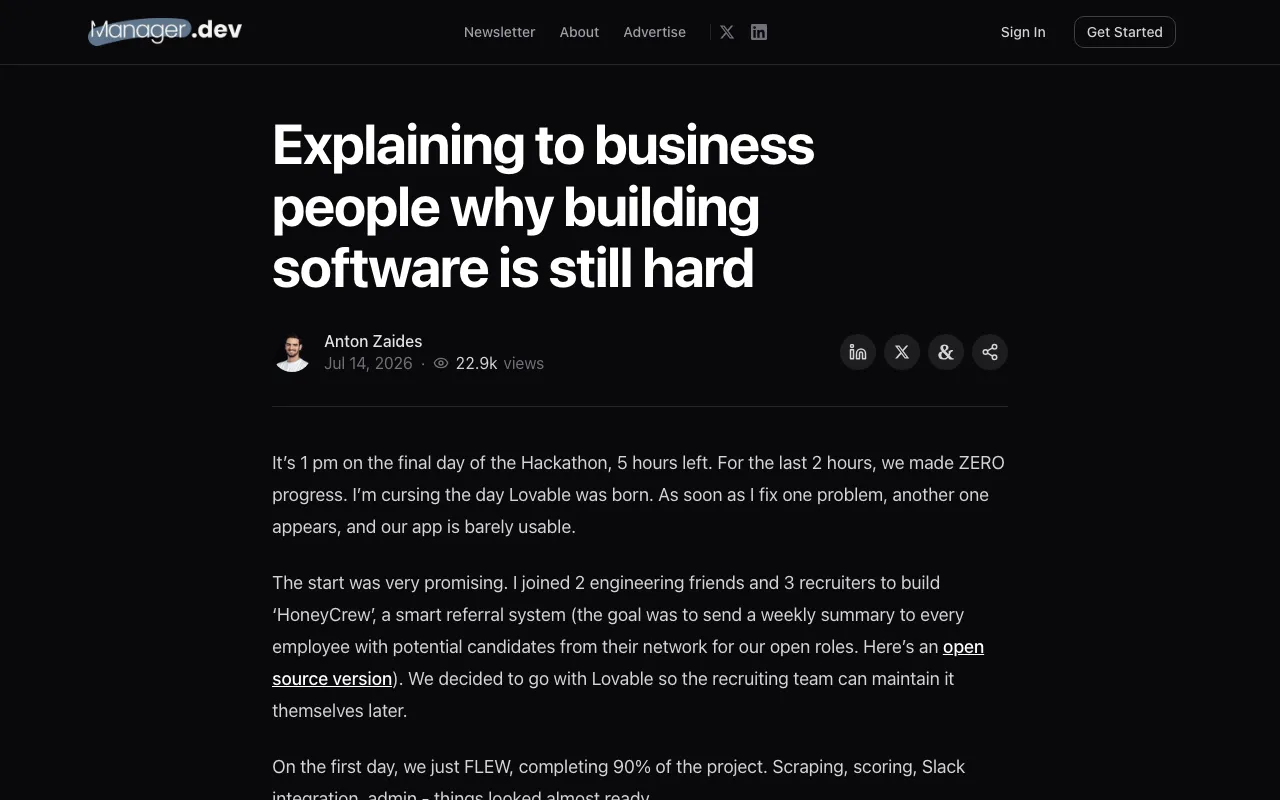
Anton Zaides, who writes the Manager.dev newsletter for engineering managers, spent a two-day hackathon building a referral system in Lovable with two engineer friends and three recruiters, so that the recruiters could maintain it afterwards. The first day got them through "90% of the project"; on the second, things "Completely broke", and slowing down ("Understand, plan, implement.") left them, at least, with a working, demo-able flow. To explain to business people why software stays hard, Zaides uses a house analogy that came out of nearly buying an old house: a leaking roof can be fixed with a bucket or at its cause, and the support for a second floor is far cheaper to build in with the first than to add later.
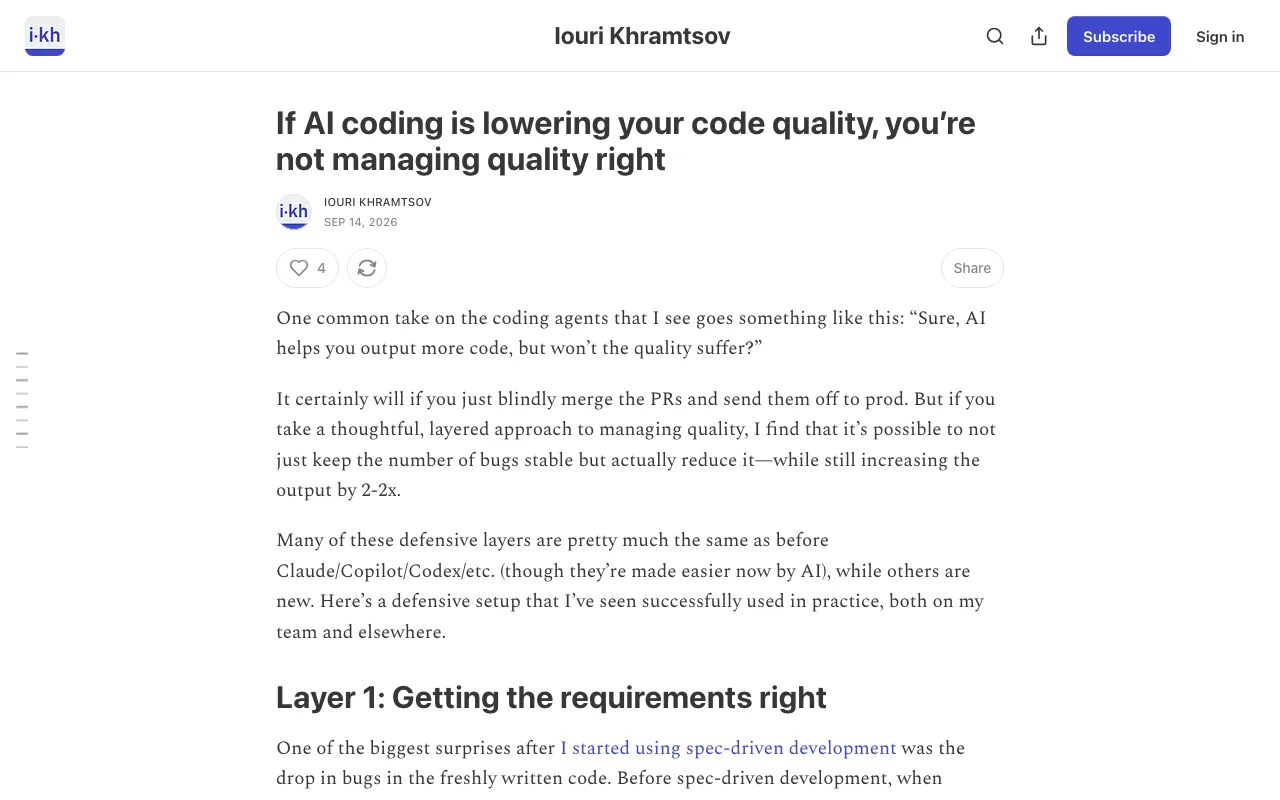
Iouri Khramtsov answers the familiar worry that coding agents mean worse code with seven defensive layers seen working "both on my team and elsewhere": AI review of the requirements in spec-driven development, unit tests above 95% coverage planned before the code, manual testing, automated end-to-end tests, separate AI passes for specific quality problems, pull-request reviews by humans and AI, and monitoring and alerting in production. With those in place, Khramtsov writes, "it's entirely possible to double the delivery speed while keeping the bugs under control". The doubling is Khramtsov's own judgement, not a measurement.
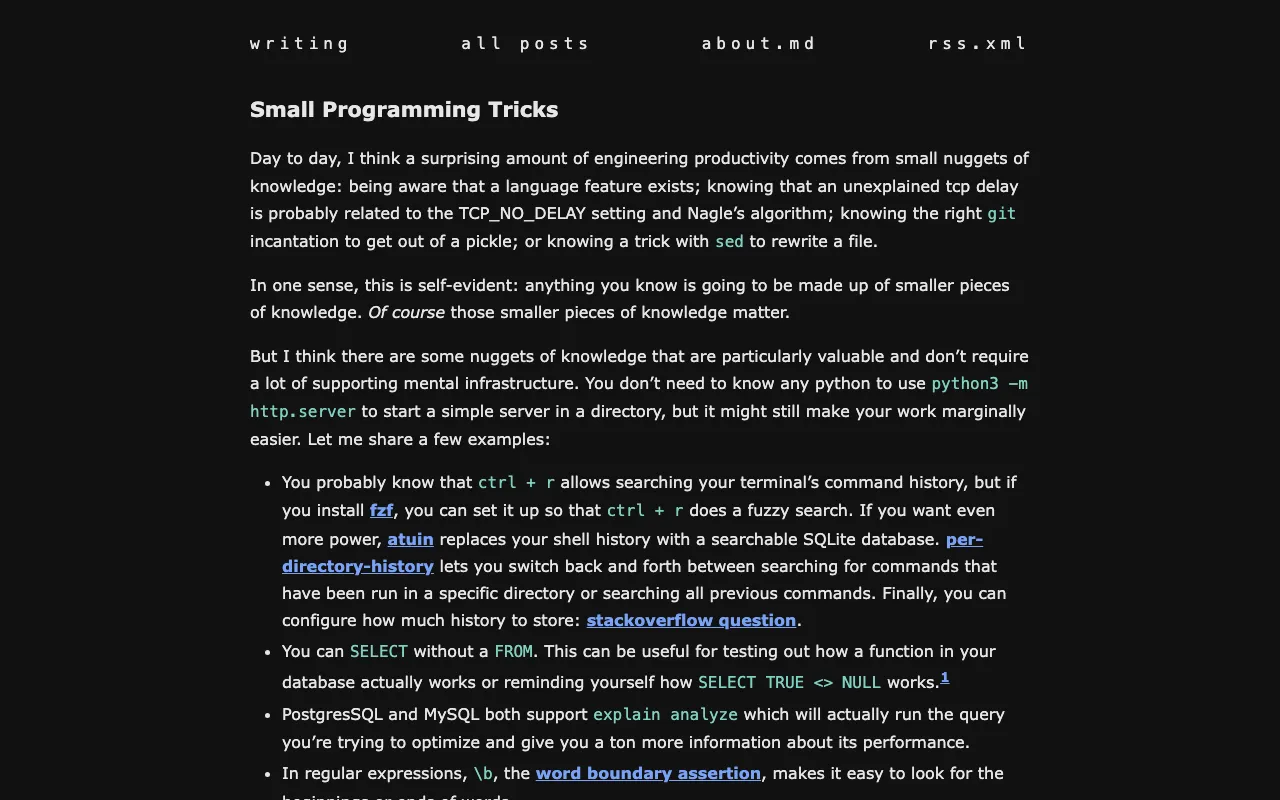
Will Keleher argues that a surprising amount of engineering productivity comes from small nuggets of knowledge, and shares a page of them: fuzzy history search with fzf, a searchable SQLite history with atuin, SELECT without a FROM, EXPLAIN ANALYZE, git's pickaxe search and ripgrep among them. The leadership idea comes at the end. At a previous company, Keleher shared one trick a day on Slack with the engineering team, technical and company-specific alike, and found that one a day was the right number to avoid overwhelming people; the post suggests that more senior engineers try the same.
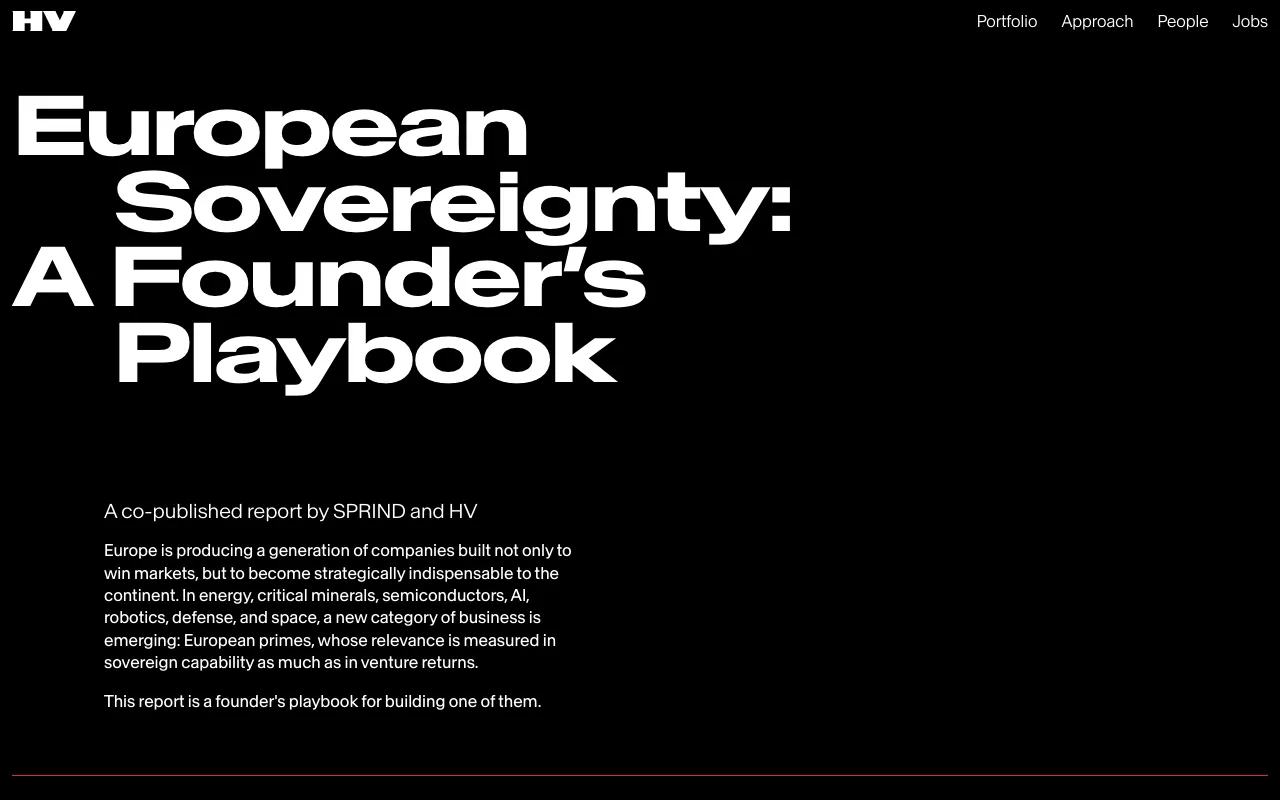
SPRIND, Germany's Federal Agency for Breakthrough Innovation, and the venture firm HV co-published this playbook for founders building Europe's "primes": companies in energy, critical minerals, semiconductors, AI, robotics, defence and space whose relevance is measured "in sovereign capability as much as in venture returns". Its thirteen recommendations treat the state in three roles, as investor, as customer and as rulemaker; one example is to decide, from Series B, whether you want the state on your cap table or on your P&L. The landing page carries the recommendations, and the full report is a download.
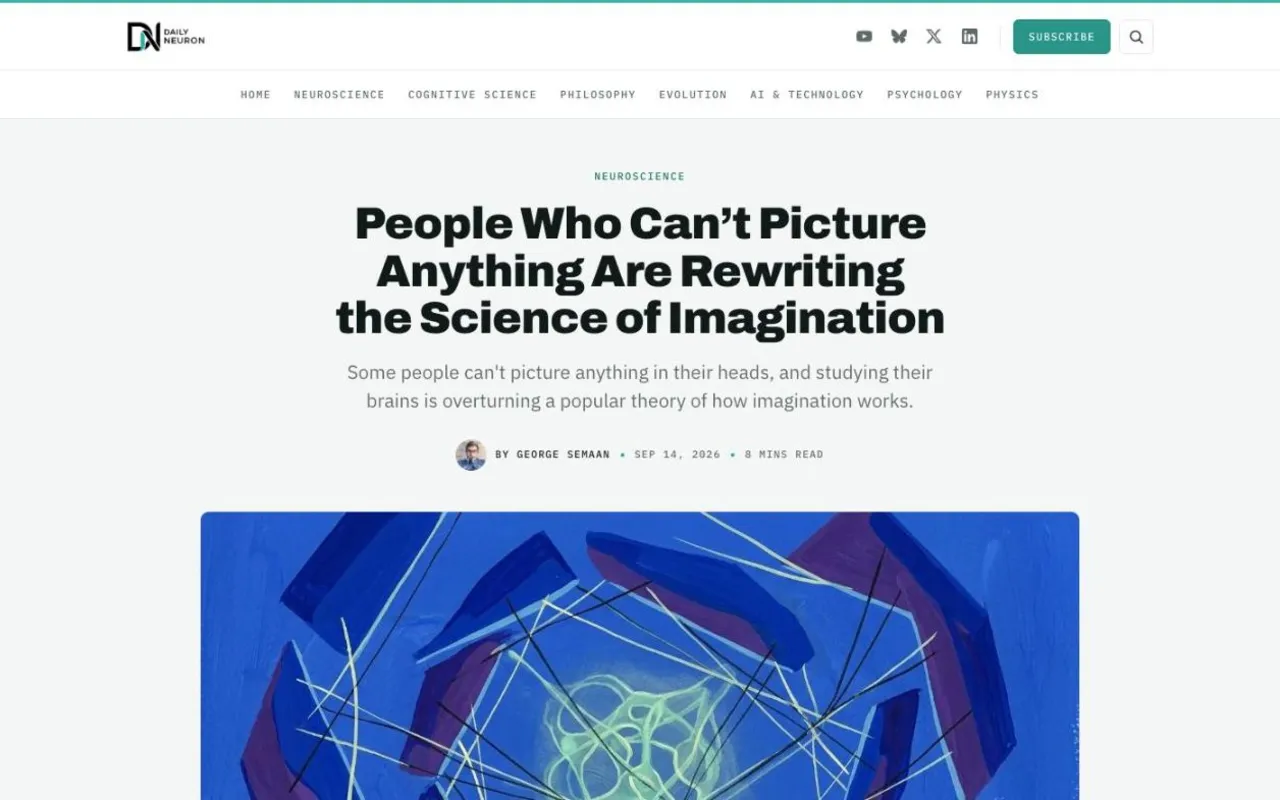
I'm aphantasic, so I read People Who Can't Picture Anything Are Rewriting the Science of Imagination with more than usual interest. It reports a review in Consciousness and Cognition by Derek Arnold and colleagues, two of them aphantasic, arguing that imagination is not seeing run backwards: people whose primary visual cortex has been destroyed can still imagine, so a mental image looks like teamwork between brain regions, and aphantasia like a breakdown in it. The two describe their own inner life as "an awareness of a set of spatial facts". I have shared links on this before: item 24 of my (Almost) 52 Things I Learned in 2025 was about SDAM, a related condition, and the show notes of our What Next? episode with Les Cochrane link a primer on it. If you lead people, the useful claim is the bigger one: inner lives differ, so "just picture it" will not work for every mind on your team.
Regards,
M@
[ED: If you'd like to sign up for this content as an email, click here to join the mailing list.]
Originally published on quantumfaxmachine.com and cross-posted on Medium.
hello@matthewsinclair.com | matthewsinclair.com | bsky.app/@matthewsinclair.com | masto.ai/@matthewsinclair | medium.com/@matthewsinclair | xitter/@matthewsinclair
Was this useful?