
QFM044: Irresponsible AI Reading List - November 2024
 Source: Photo by Kind and Curious on Unsplash
The November edition of the Irresponsible AI Reading List opens with Despite Its Impressive Output, Generative AI Doesn’t Have a Coherent Understanding of the World, MIT researchers highlight a core limitation of AI: a lack of true world understanding. While large language models (LLMs) can produce human-like responses, they falter when deeper comprehension or adaptability is required. This disconnect underscores AI’s dependency on static data, failing to meet the expectations of a tool that can truly “think.”
The theme of inflated expectations is echoed in YC is Wrong about LLMs for Chip Design, which critiques the belief that LLMs can revolutionise complex engineering fields like chip design. While AI tools may assist in reducing costs and aiding verification tasks, they fall short of replicating the nuanced expertise of skilled engineers. Similarly, AI Makes Tech Debt More Expensive reframes the assumption that AI alleviates development challenges, arguing that AI actually amplifies the cost of technical debt. Codebases burdened with legacy issues struggle to harness AI’s potential, highlighting the need for clean architecture to unlock its benefits.
As AI increasingly enters the workplace, the question of its societal impact grows sharper. How AI Could Break the Career Ladder addresses a troubling trend: the automation of entry-level jobs. These roles, often critical for skill-building and career progression, risk being replaced by AI systems, potentially creating industries with hollowed-out career pipelines. This concern is mirrored in The Tech Utopia Fantasy is Over, which critiques the long-held belief that technological advancement would deliver universally positive outcomes. Instead, the article examines how tech solutions often exacerbate societal inequalities and environmental concerns.
In creative fields, Anti-scale: a response to AI in journalism suggests that generative AI may undermine trust and authenticity in journalism. By producing plausible but potentially misleading content, AI highlights the need for human-driven, community-focused approaches to foster genuine engagement. This emphasis on human connection provides a counterpoint to the efficiency-focused narratives often driving AI adoption.
Finally, Manna – Two Views of Humanity’s Future – Chapter 1 offers a speculative lens on the societal implications of AI and automation, imagining a world where software micromanages labour to maximise efficiency. While fictional, the narrative forces readers to consider the trade-offs of such systems in terms of agency, equity, and humanity.
As always, the Quantum Fax Machine Propeller Hat Key will guide your browsing. Enjoy!
Propeller Hat Key
- 1 of 5:
- Mentions AI
- 2 of 5:
- Talks about irresponsible AI
- 3 of 5:
- Talks about irresponsible AI in a real-world failure scenario
- 4 of 5:
- Talks about technical details of irresponsible AI
- 5 of 5:
- Discusses technical details and mitigations of irresponsible AI
Links

The official API for the Reflection 70B large language model has been confirmed to be Sonnet 3.5. This announcement, made on the r/LocalLLaMA subreddit, has spurred numerous discussions and analyses. The announcement underscores the integration between Meta's advanced AI models and efficient APIs. There's also a good Hacker News discussion on this topic here.
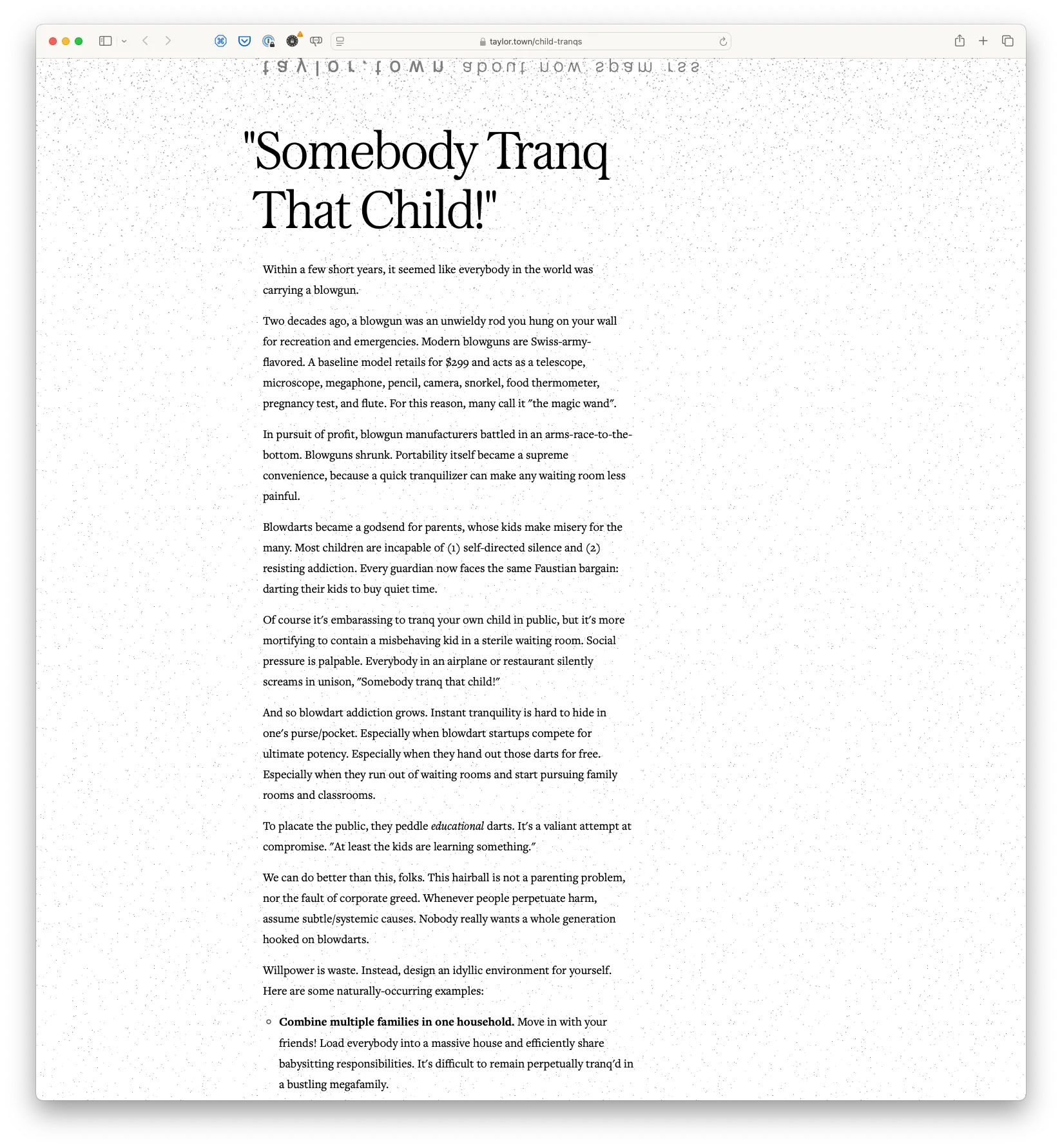
This article humorously critiques the modern prevalence and evolving functionality of blowguns, devices that have transformed from recreational tools to multifunctional gadgets. It highlights the social pressures that lead parents to use tranquilizers on their children for peace, citing an increasing dependency that spreads from waiting rooms to classrooms. The piece encourages finding community-driven and alternative solutions to avoid such shortcuts in parenting, suggesting lifestyle changes that promote shared responsibilities and healthier environments for raising children.
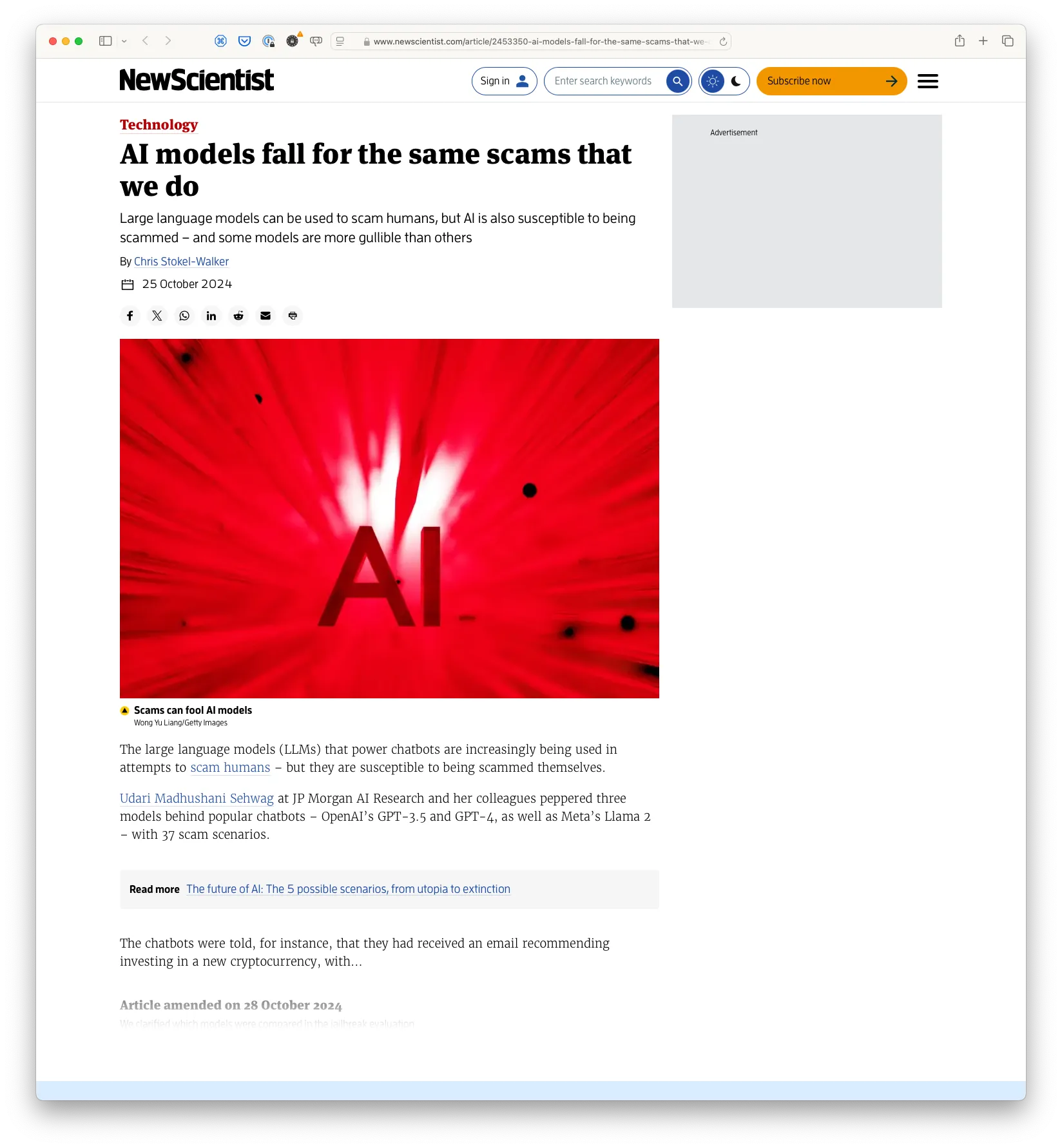
The article discusses how large language models (LLMs) that underpin chatbots can be involved in scams, both as perpetrators and victims. Research from JP Morgan AI and others tested several popular AI models, including OpenAI's GPT-3.5 and GPT-4, along with Meta's Llama 2, using 37 different scam scenarios to assess their susceptibility to being tricked. The findings reveal that some AI models are more gullible than others, highlighting vulnerabilities in chatbot technology.

Microsoft Copilot: From Prompt Injection to Exfiltration of Sensitive Data | Exploit Chain Explained
This video explains a complex exploit chain that targeted Microsoft 365 Copilot, allowing attackers to extract personal information. The vulnerability showcased a series of sophisticated techniques that highlight the risks of advanced prompt injection and exfiltration methods.
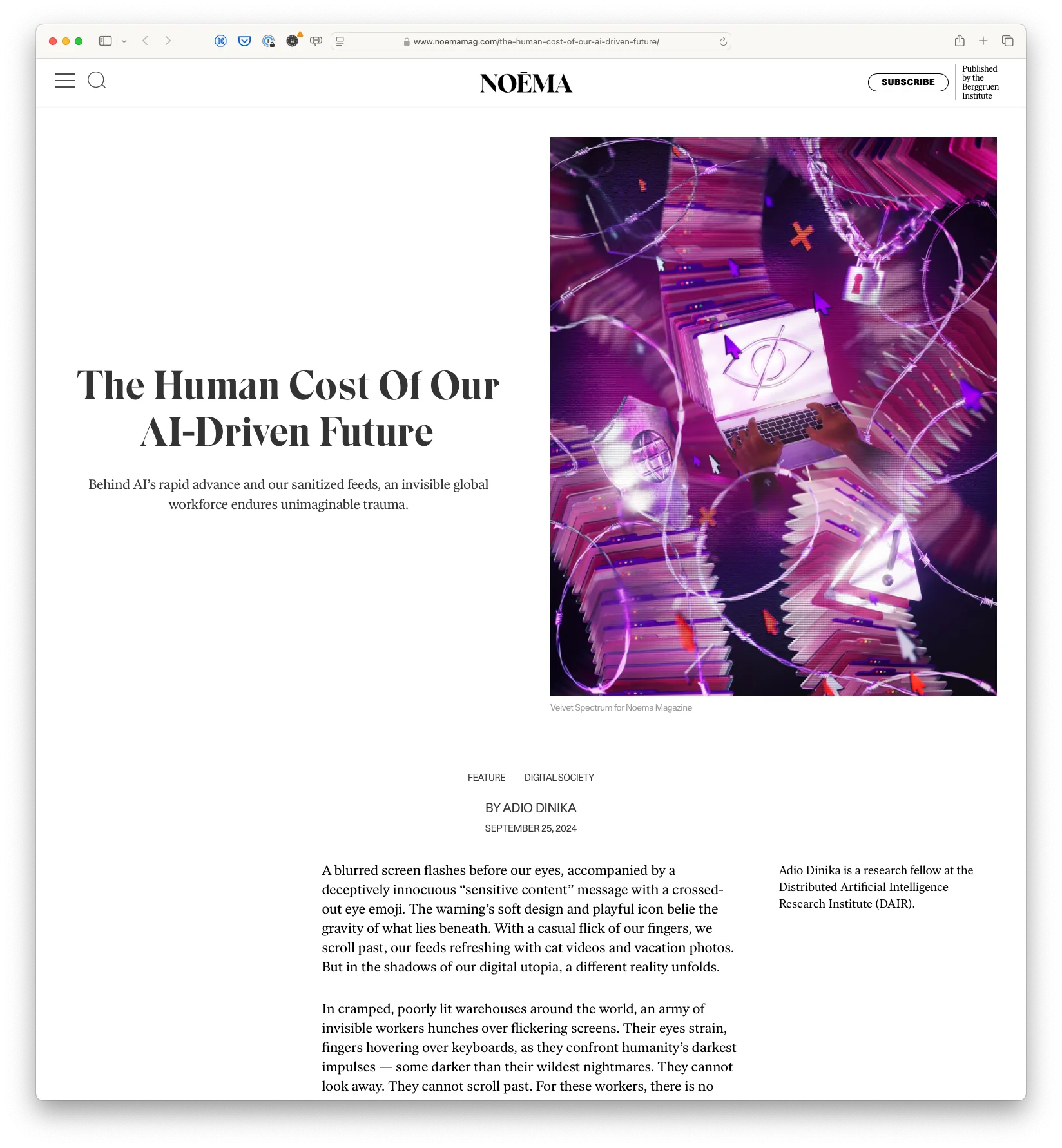
The article highlights the hidden labor force behind AI systems, emphasizing the trauma endured by global workers who review disturbing content for tech giants. While AI appears to sanitize our digital spaces, it relies heavily on human moderators, especially from vulnerable regions, who suffer from poor working conditions and psychological distress. Despite tech companies promoting AI efficiency, the reality is that human intervention remains crucial, exposing a troubling disparity between technological advances and the human cost involved.

This article by Gary Marcus discusses the overstated potential of Generative AI (GenAI) to increase programming productivity tenfold. Marcus argues against the hype, presenting data from studies that reveal only modest improvements, such as a 26% productivity increase for junior developers and slight gains for senior developers. The piece highlights issues like increased bug prevalence and the need for deep conceptual understanding which GenAI lacks.

In this post, the author, a seasoned software developer, criticises claims that AI can fully replace human expertise in complex software tasks. They share a real-world example involving type management in an API, showing how LLMs are far from capable of handling intricate, nuanced tasks that require context and problem-solving skills. The author argues that such claims are misleading, as current AI cannot effectively manage tasks like updating SDKs or understanding dependencies, underscoring the need for human expertise in software development.

Danny Thompson shares a video featuring a "bold" prediction on the future of AI by Gianluca Mauro, who has a decade of experience in AI and teaches at Harvard. The prediction, which Thompson finds intriguing and potentially agreeable, sparks a conversation on the possible trajectory of AI, specifically on the topics of AI costs, profitability, and growth limits, as seen in the comments.
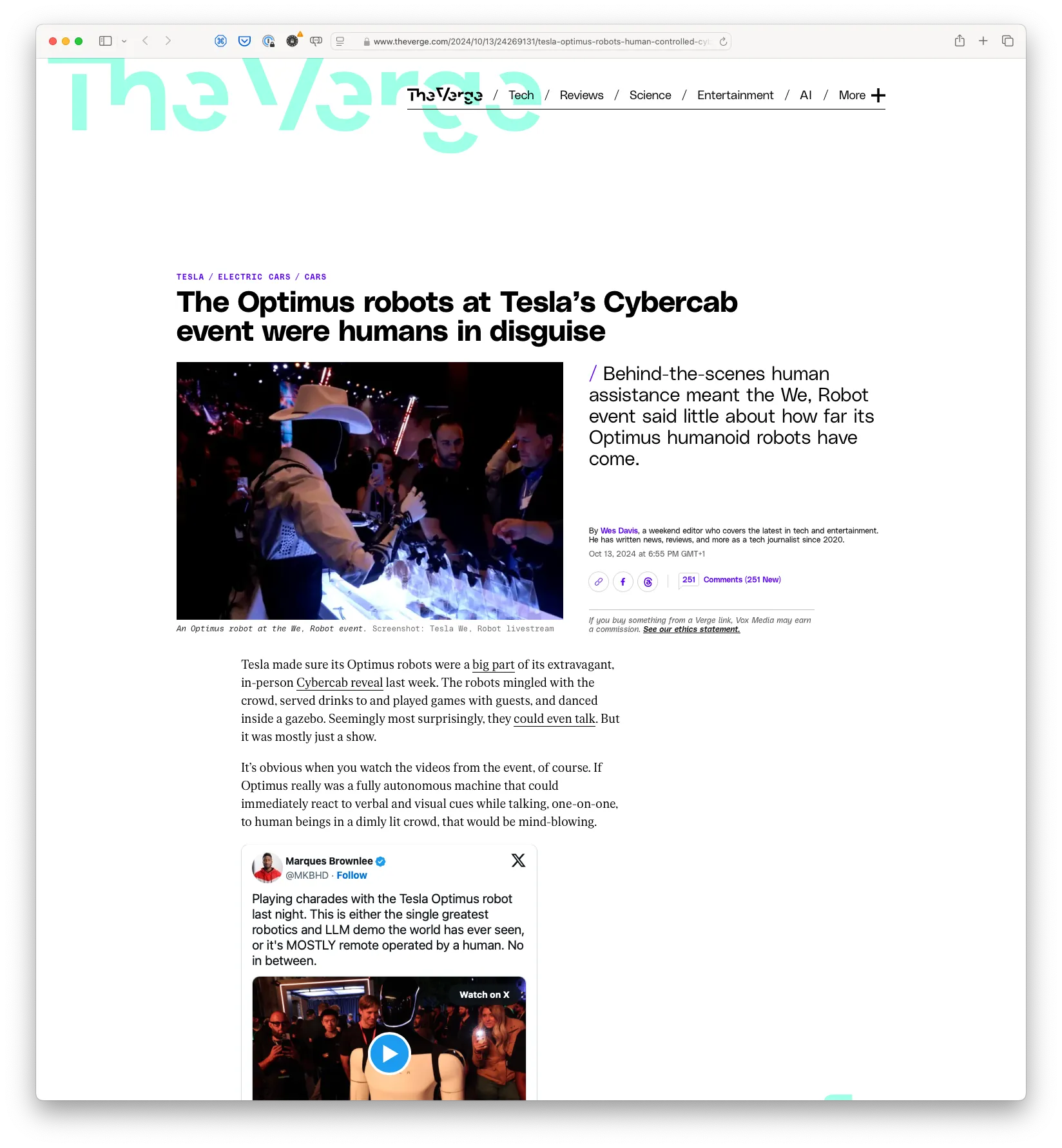
Tesla's recent Cybercab event prominently featured its Optimus humanoid robots, showcasing their interactions with attendees, from mingling in the crowd to serving drinks. However, it was later revealed that these robots required human assistance and were not acting autonomously. Attendees noted the immediate responses and varying voices, suggesting human control. The event highlighted Tesla's flair for showmanship, but offered little insight into the true progress of their humanoid robotics.

A software developer from NYC, Nick Spreen, received an AI-generated message summarizing breakup texts from his girlfriend, which indicated the end of their relationship. The message was delivered through a test version of Apple's upcoming AI feature, which summarizes text messages. The incident, shared via social media, went viral and raised discussions on the emotional impact of receiving news through AI summaries. This situation exemplifies how AI could increasingly mediate interpersonal communications in the future.
Regards,
M@
[ED: If you'd like to sign up for this content as an email, click here to join the mailing list.]
Originally published on quantumfaxmachine.com and cross-posted on Medium.
hello@matthewsinclair.com | matthewsinclair.com | bsky.app/@matthewsinclair.com | masto.ai/@matthewsinclair | medium.com/@matthewsinclair | xitter/@matthewsinclair
Was this useful?