
QFM060: Irresponsible AI Reading List - March 2025
 Source: Photo by Brett Jordan on Unsplash
This month's Irresponsible AI Reading List opens with a practical tension that runs through many AI discussions today: tools that promise to save time often introduce new kinds of cognitive overhead. In I use Cursor daily – here's how I avoid the garbage parts, Nick Craux documents a pragmatic approach to using AI-powered code assistants. The article recognises Cursor's capacity to streamline work, while also flagging the ways these tools can produce counterproductive or misleading results. The solution, according to Craux, lies not in abandoning AI altogether, but in minimising reliance and constraining its scope with simple human-enforced rules.
The tension between control and unpredictability recurs in AI Blindspots, which identifies common failure modes when working with large language models in code generation tasks. Here, the focus shifts from the user interface to the internal behaviour of LLMs, highlighting strategic methods for testing and debugging systems that can appear consistent but behave erratically. Both articles suggest that effective use of AI tools depends less on trust and more on structure and boundaries.
That fragility becomes more visible—and more public—in Chinese AI Robot Attacks Crowd at China Festival, a viral video report of a robot incident during a major public event. Regardless of how controlled or exaggerated the footage may be, the event raises valid concerns around real-world deployments of AI-powered systems, particularly in unsupervised or high-stakes contexts. I really hope this is a fake.
Elsewhere, Apple's $10B+ Siri AI Disaster examines a longer-term failure in AI development. Despite major investment and internal talent, Apple's struggles with Siri underscore how institutional complexity, lack of focus, and overpromising can lead even the most well-resourced teams into systemic errors. As with Cursor and LLM debugging, the article suggests that success in AI may depend more on operational clarity than algorithmic sophistication. Here are few more articles on the same topic. From daringfireball.net and (paywalled) at The Information.
Finally, Is GenAI Digital Cocaine? takes a provocative and psychological angle, reflecting on how dependence on AI for routine problem-solving might degrade user competence over time. While the metaphor may be intentionally click-baity, the core argument—that overuse of generative tools can subtly shift user behaviour and expectations—-links back to broader questions about what's lost when too much is delegated to systems that often appear more intelligent than they are.
Across these pieces, a shared concern emerges: not that AI is dangerous in the abstract, but that its practical application often outpaces our frameworks for supervision, evaluation, and restraint. Whether at the level of a solo developer, a multinational corporation, or a public square, the challenge is the same—learning how to work with systems that offer assistance while demanding new forms of discipline.
As always, the Quantum Fax Machine Propeller Hat Key will guide your browsing. Enjoy!
Propeller Hat Key
- 1 of 5:
- Mentions AI
- 2 of 5:
- Talks about irresponsible AI
- 3 of 5:
- Talks about irresponsible AI in a real-world failure scenario
- 4 of 5:
- Talks about technical details of irresponsible AI
- 5 of 5:
- Discusses technical details and mitigations of irresponsible AI
Links
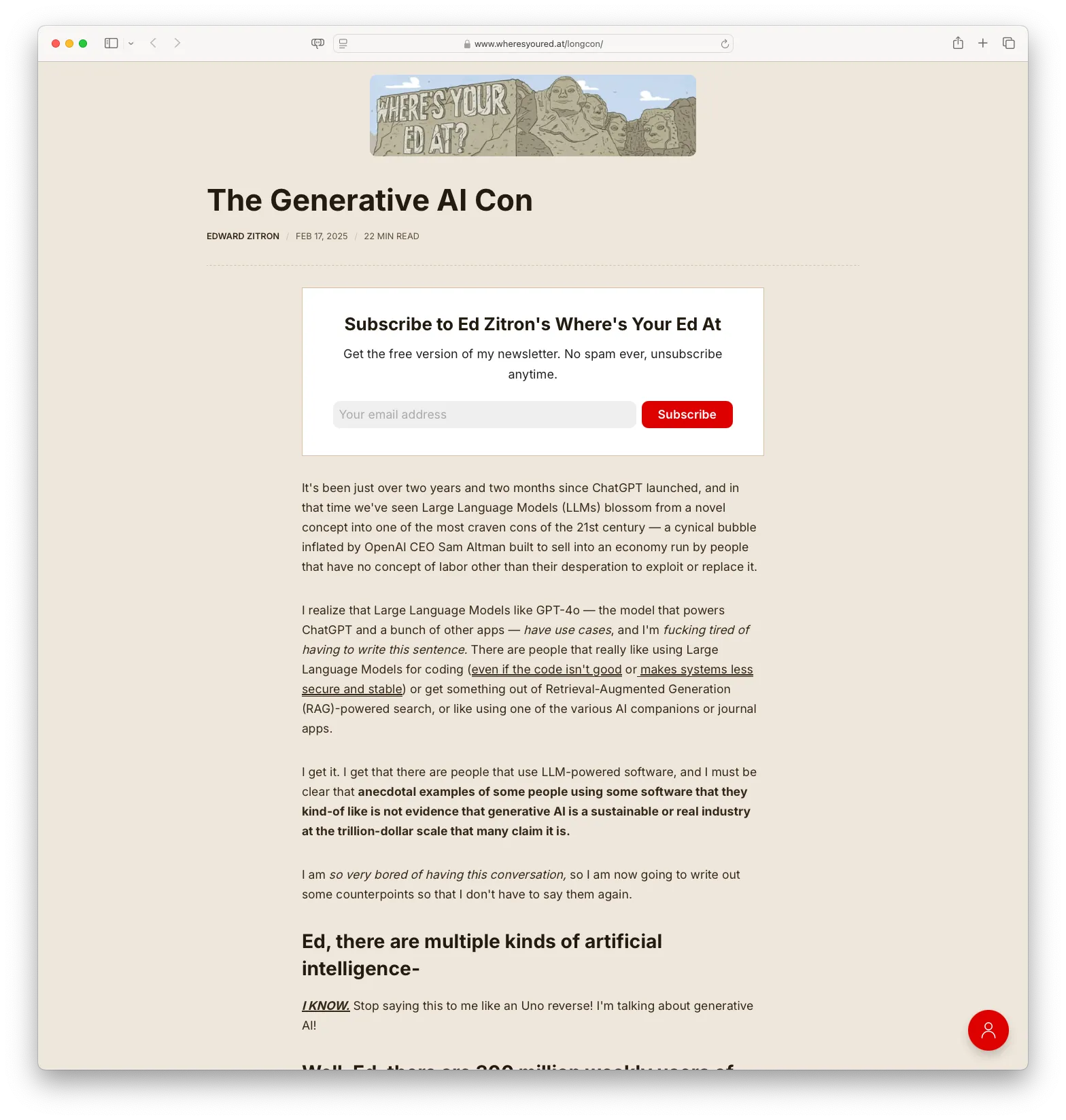
In "The Generative AI Con," Edward Zitron critiques the vast investment and media hype surrounding generative AI, particularly focusing on OpenAI's ChatGPT. Zitron argues that while ChatGPT and similar technologies have user numbers in the millions, these figures do not reflect genuine profitability or meaningful integration into daily lives. He questions the sustainability of the AI industry's financial model, highlighting the discrepancy between the claimed potential of AI products and their practical utility.
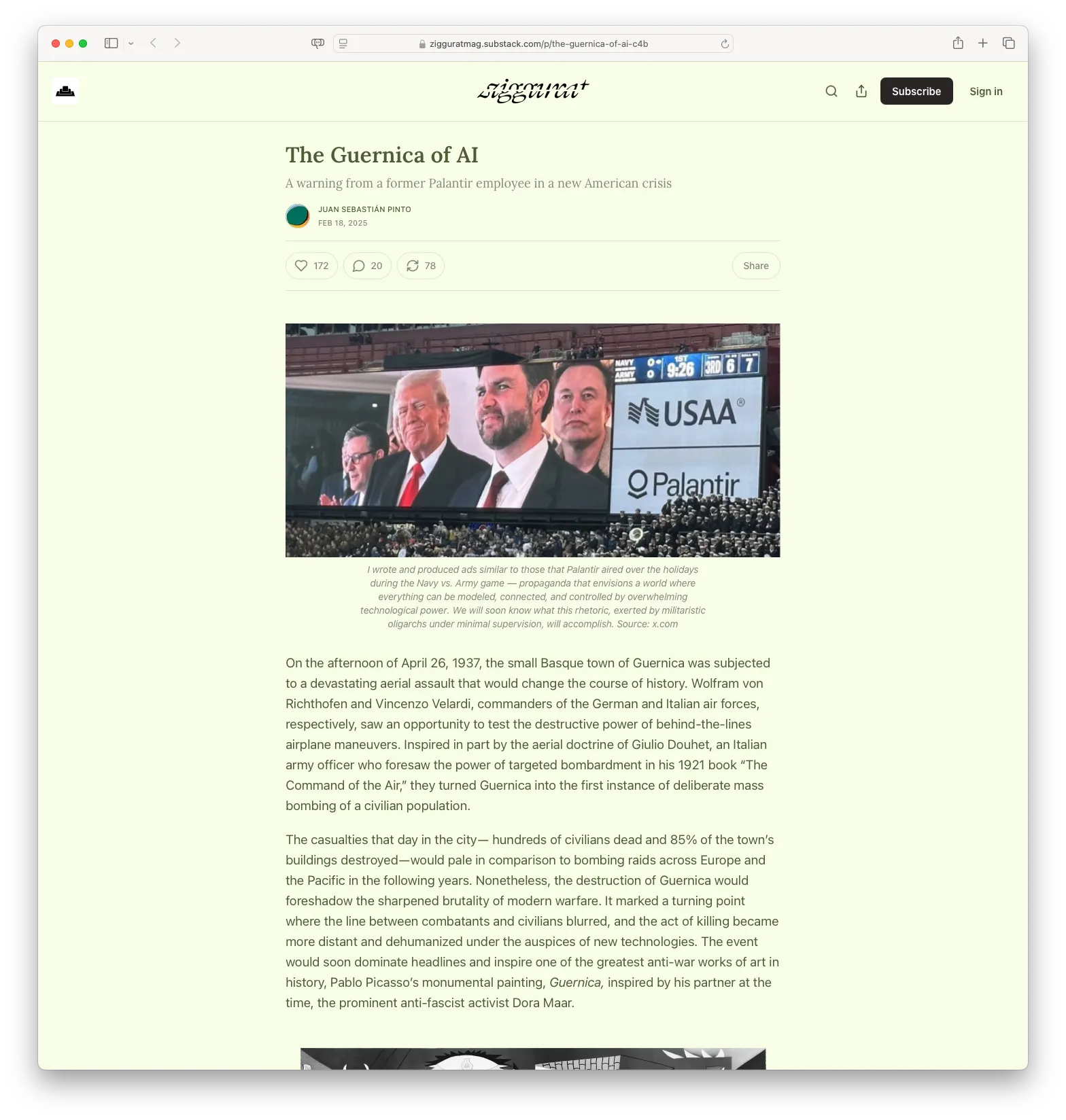
Juan Sebastián Pinto delivers a poignant warning about the dangers of militarized AI technologies in his post "The Guernica of AI." Drawing parallels between the historical bombing of Guernica and the current conflict in Gaza, Pinto explores how AI-powered tech companies like Palantir are shaping modern warfare and public life through pervasive surveillance and data control. He reflects on his experience at Palantir, emphasizing the ethical concerns and human consequences of AI applications in both military and civilian contexts.
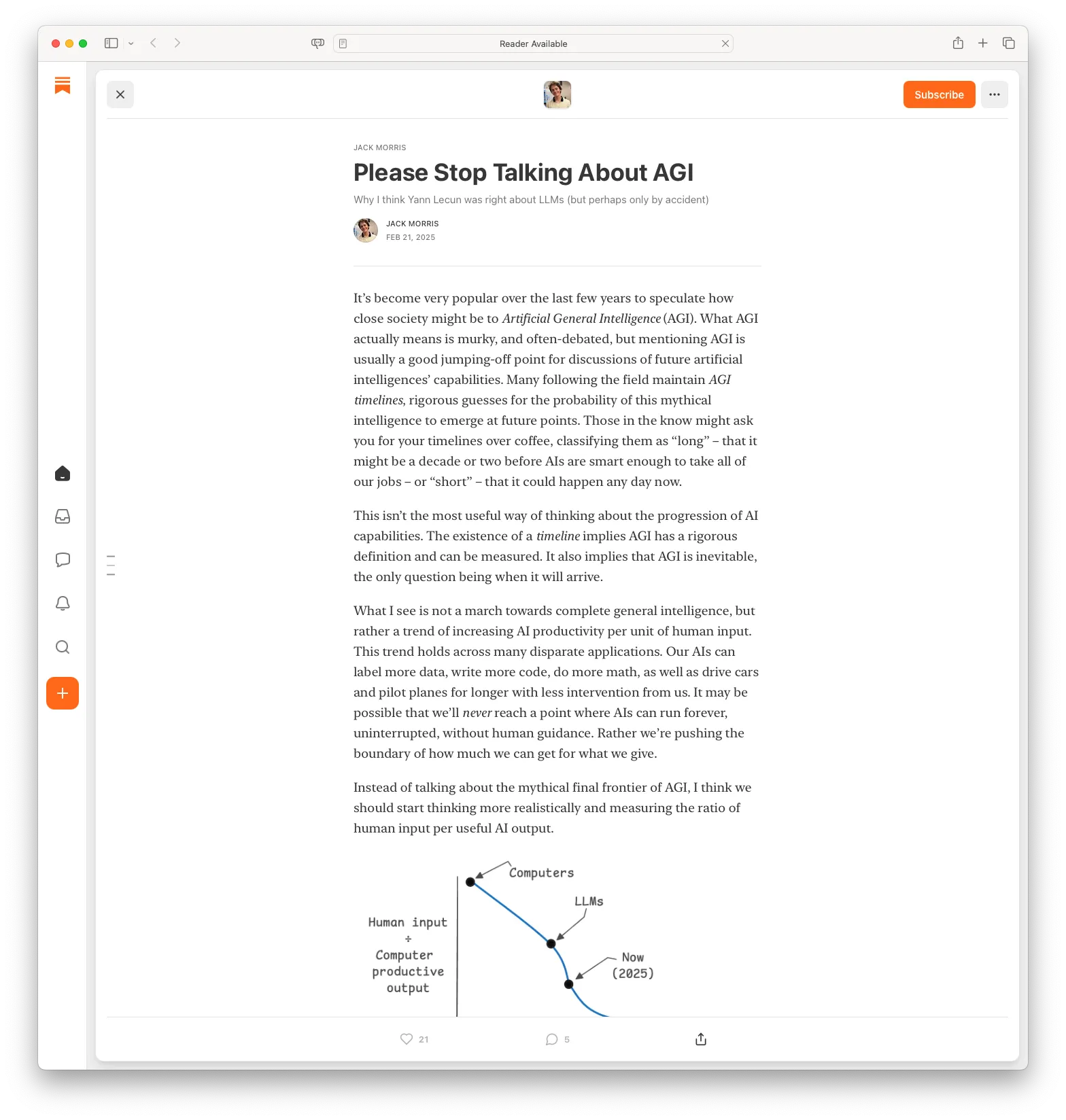
In the Substack post titled 'Please Stop Talking About AGI' by Jack Morris, the author discusses the growing infatuation with Artificial General Intelligence (AGI) in both public discourse and media. Morris argues that the constant chatter about AGI diverts attention away from pressing AI challenges we should be focusing on today and suggests that this focus on future AGI distracts from the practical advancements and ethical considerations of current AI technologies.
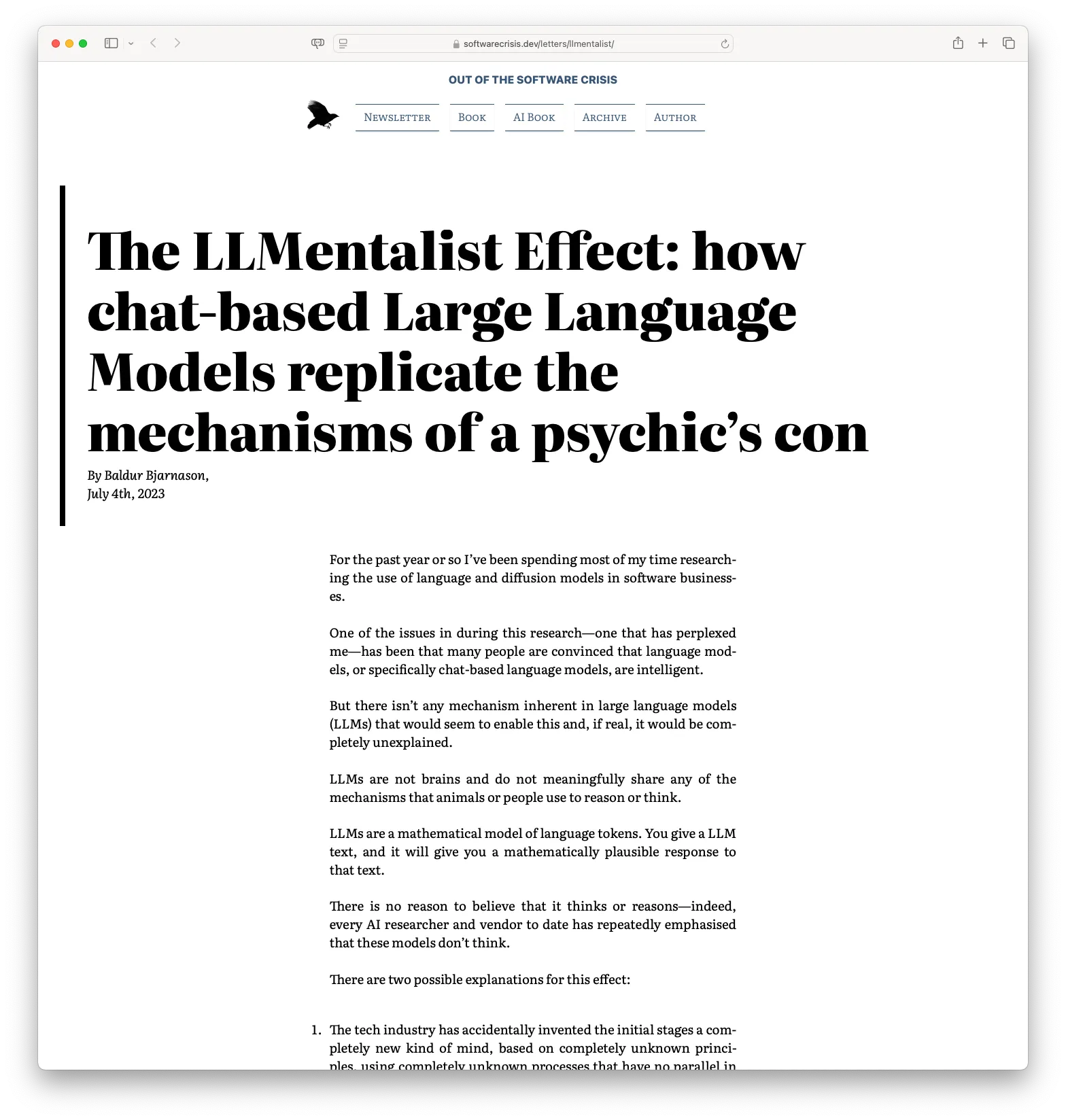
The article explores the intriguing parallels between the perception of intelligence in chat-based Large Language Models (LLMs) and a psychic's con using cold reading techniques. Author Baldur Bjarnason examines why some people believe that LLMs possess intelligence when in fact, they rely on statistical modeling rather than genuine understanding or reasoning. Much like a psychic, LLMs provide plausible responses based on patterns, creating an illusion of intelligence that convinces users of their smartness, despite their outputs being statistically generic.

The article delves into the dual nature of Large Language Models (LLMs) like ChatGPT, describing them as both transformative technologies and potential sources of misinformation. It explains how these systems can significantly enhance accessibility in computing, akin to revolutionary inventions like the printing press. Yet, it warns of the unprecedented scale at which they might spread misinformation, urging readers to understand and harness these tools effectively to thrive in the modern digital age.
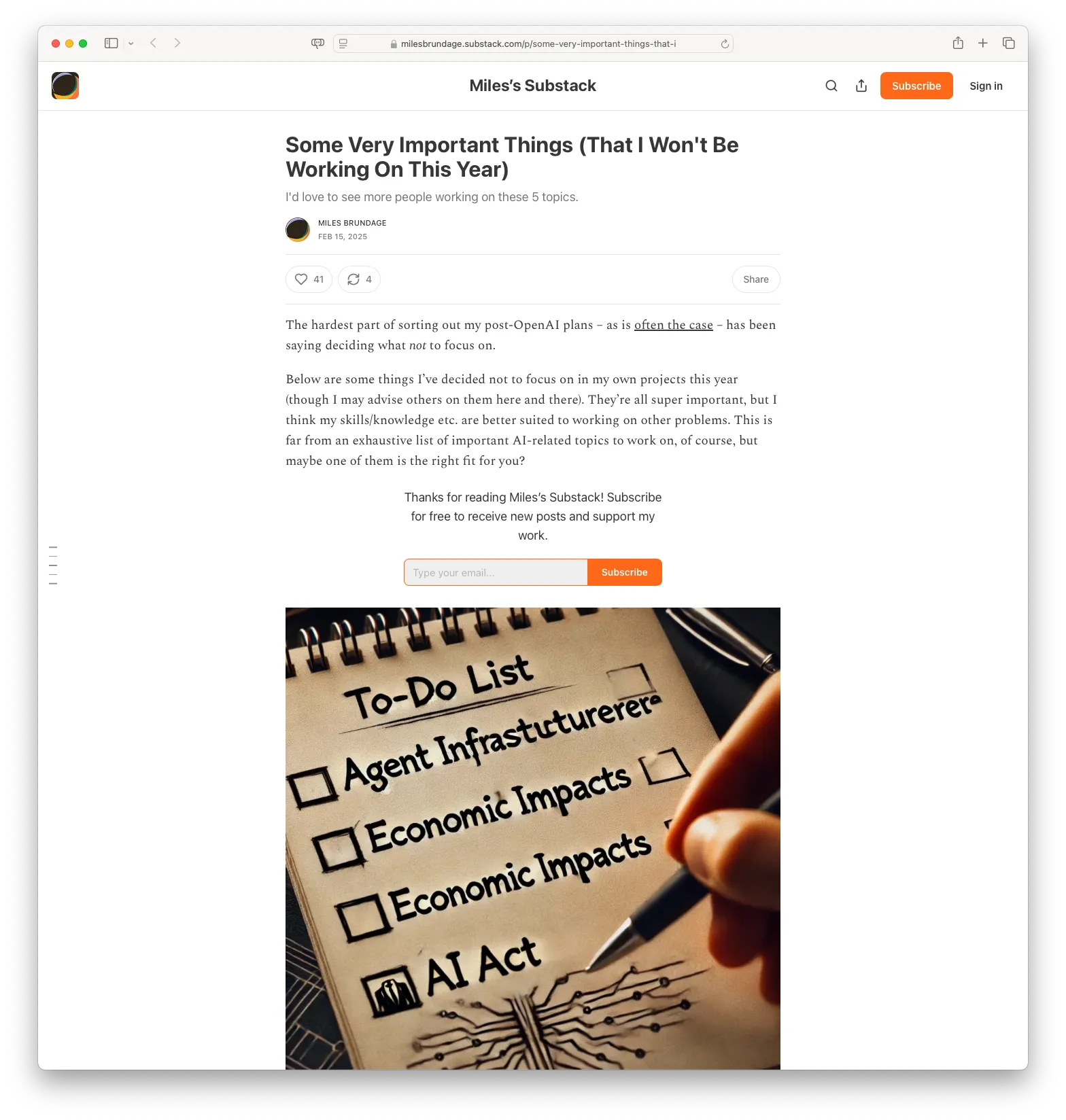
The article by Miles Brundage discusses five critical AI-related topics that he won't be focusing on this year, despite their importance. These topics include AI safety awareness, technical infrastructure for AI agents, economic impacts of AI, the EU AI Act, and AI literacy. Each topic is a call to action for more engagement and understanding to navigate the challenges and leverage the opportunities they present in the evolving AI landscape.
Regards,
M@
[ED: If you'd like to sign up for this content as an email, click here to join the mailing list.]
Originally published on quantumfaxmachine.com and cross-posted on Medium.
hello@matthewsinclair.com | matthewsinclair.com | bsky.app/@matthewsinclair.com | masto.ai/@matthewsinclair | medium.com/@matthewsinclair | xitter/@matthewsinclair
Was this useful?