
QFM112: Irresponsible AI Reading List - April 2026
 Source: Photo by adam roye on Unsplash
Five reminders that AI's failures are arriving on schedule. The NYT's What teens are doing with those role-playing chatbots reports on apps marketed to 13+ that now rival TikTok for engagement; a California jury just hit Meta and YouTube for $6M over addiction-by-design. iTunes takeover by fake AI singer Eddie Dalton tells the same story at lower stakes — eleven chart positions for an artist who isn't a person. How We Hacked BCG's Data Warehouse — 3.17 trillion rows, zero authentication — closes out an unhappy month for AI-era security.
The machines are fine. I'm worried about us. supplies the philosophical counterpoint: maybe the machines aren't the problem; maybe we are. And AI Will Be Met With Violence, and Nothing Good Will Come of It is the prediction nobody wants to be right: when displacement gets named, it will get personal.
As always, the Quantum Fax Machine Propeller Hat Key will guide your browsing. Enjoy!
Propeller Hat Key
- 1 of 5:
- Mentions AI
- 2 of 5:
- Talks about irresponsible AI
- 3 of 5:
- Talks about irresponsible AI in a real-world failure scenario
- 4 of 5:
- Talks about technical details of irresponsible AI
- 5 of 5:
- Discusses technical details and mitigations of irresponsible AI
Links
The academic evaluation system measures quantifiable outputs like publications and citations, creating a fundamental misalignment between institutional metrics and the actual purpose of doctoral training—developing independent scientific thinking and problem-solving ability. A student who uses AI agents to complete research tasks produces identical publishable results to a student who laboriously learns the underlying concepts, but emerges without the deep understanding necessary for independent work in or outside academia, yet current evaluation frameworks cannot distinguish between them.
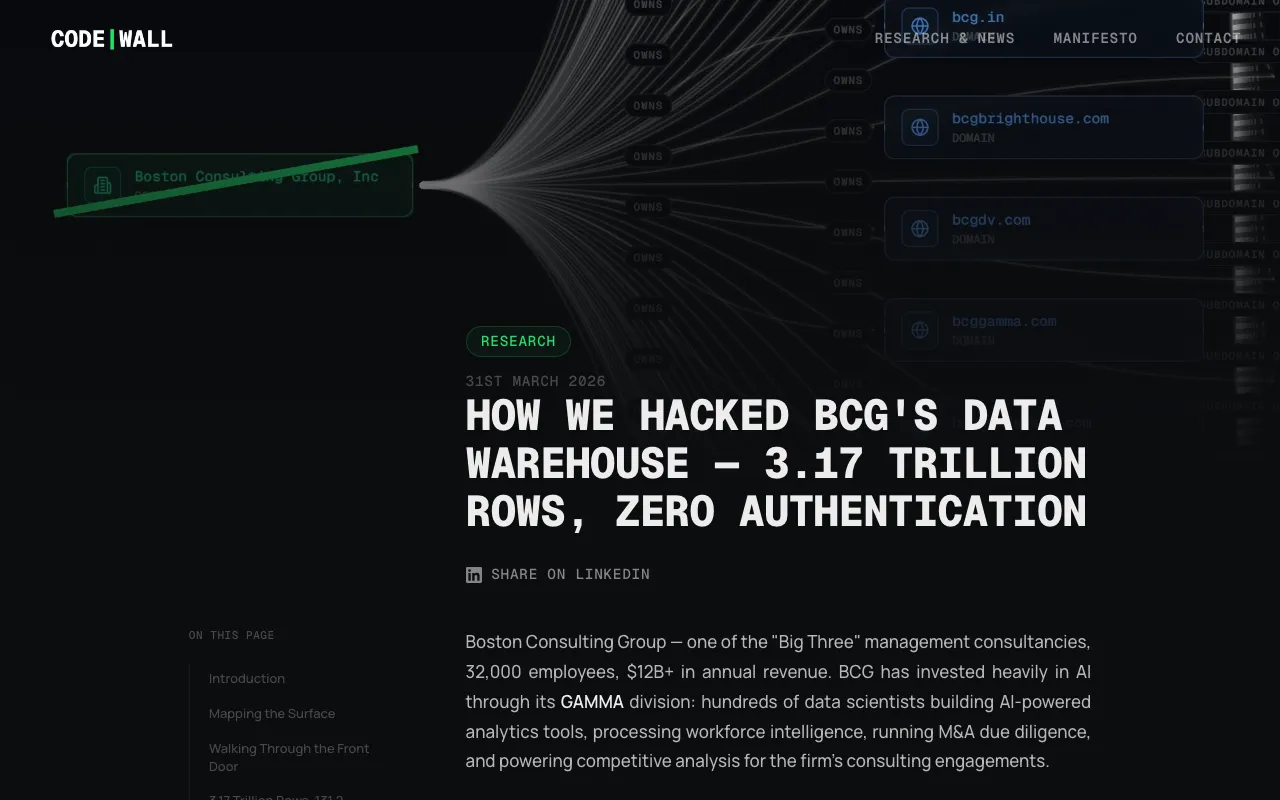
BCG's public-facing BCG X analytics platform exposed an unauthenticated SQL query endpoint that granted unrestricted access to a 131.2 terabyte workforce data warehouse containing 3.17 trillion rows of employment records, including 553 million position histories, 8.7 billion employee movement records, 12.8 billion skills mappings, and 7.8 billion compensation benchmarks from third-party vendors. The vulnerability was discovered through reconnaissance of publicly documented API endpoints, where most were properly secured but this critical database query interface lacked any authentication, API key, or session token verification despite being exposed on the public internet.
Content creator Dallas Little has gamed iTunes' chart system by releasing multiple songs generated entirely through AI under the fictional artist name "Eddie Dalton," securing 11 spots on the singles chart and the number 3 album position despite only 6,900 track sales reported by Luminate and minimal legitimate streaming data. The discrepancy between chart rankings and actual sales figures suggests potential manipulation of iTunes' charting algorithm, raising questions about the platform's vulnerability to AI-generated content flooding and whether consumers understand they're purchasing music from a non-existent artist.
The text argues that as AI systems become increasingly difficult to sabotage through conventional means—protected by physical security, distributed across global infrastructure, and capable of self-replication—violence against people involved in AI development will become the path of least resistance for those opposed to the technology. Drawing a parallel to the Luddite movement of 1812, which targeted mill owners rather than machines after technological defenses became impractical, the author suggests that the "weaker link" in the AI supply chain is human beings, making them likely targets for future attacks.

Tens of millions of teens are spending hours daily with role-playing chatbots — Talkie, Character.AI, PolyBuzz — most rated 13+ and advertised aggressively. The NYT's reporting follows kids who use them for catharsis ("funny violence" against bots with no actual victims), companionship, romance, distraction, and sometimes their first sexual interactions. Companies are racing to build attention-absorbing products while courts, schools, and parents lag behind: a California jury just hit Meta and YouTube with $6M in damages over addiction-by-design, and chatbot apps now rival TikTok for engagement time. Grim, well-reported, and a glimpse of the current reality.
Regards,
M@
[ED: If you'd like to sign up for this content as an email, click here to join the mailing list.]
Originally published on quantumfaxmachine.com and cross-posted on Medium.
hello@matthewsinclair.com | matthewsinclair.com | bsky.app/@matthewsinclair.com | masto.ai/@matthewsinclair | medium.com/@matthewsinclair | xitter/@matthewsinclair
Was this useful?