
QFM136: Irresponsible AI Reading List - October 2026
 Source: Photo by Bence Boros on Unsplash
The appliances are listening. A Samsung TV's on-board AI listens for dogs and babies, and the man who found it says OpenAI suspended his account for using ChatGPT in the teardown, while a smart coffee machine moved 1TB of data in ten days. Tavus says its video model passes for human nearly half the time, by its own count.
Anthropic's openness to the idea that Claude may be conscious drew two responses: a video on why it banned being cruel to Claude, and Futurism asking whether working a conscious model for free is slavery. Decision models took on the trolley problem, where Jev sometimes saved its own server over twenty people, and KillSwitch is a programming language designed so that LLMs fail at it.
The costs land on people. A Fields medallist at Berkeley stopped grading homework because AI made it pointless, Apricitas counts 200,000 lost creative jobs, and Jesse Richardson offers a way to put a number on doom. For relief, LinkedIn Larpmaxxing builds a detector for performative AI posts, and a music video gives the rubber-stamp code review its anthem: LGTM.
As always, the Quantum Fax Machine Propeller Hat Key will guide your browsing. Enjoy!
Propeller Hat Key
- 1 of 5:
- Mentions AI
- 2 of 5:
- Talks about irresponsible AI
- 3 of 5:
- Talks about irresponsible AI in a real-world failure scenario
- 4 of 5:
- Talks about technical details of irresponsible AI
- 5 of 5:
- Discusses technical details and mitigations of irresponsible AI
Links

A music video about Claude Opus 5.5 from the Degenerative Pixels channel, named for the two-word code review that waves a change through without reading it.

The author designed KillSwitch, an esoteric programming language built to defeat LLMs: specifications that contain lies, identifiers that require counting letters, constructs that trip safety guardrails, and code hidden in narrative noise. The best model on the benchmark, Claude Opus, scores 66.8%. The author reads that as evidence that LLM coding rests more on recognising patterns seen in training than on understanding code.

Jesse Richardson, who runs the critical-thinking nonprofit The School of Thought and is one of 339 experts on the Forecasting Research Institute's LEAP project, makes AI risk an interactive exercise: start your p(DOOM), the chance of a catastrophe such as global economic collapse or human extinction within 25 years, at zero, and update it one threat at a time. He counsels a conservative update for jobs and surveillance, little or none for misinformation, and more for cybersecurity, after the Hugging Face incident, and for bioweapons. Recursive self-improvement, the last and most speculative threat, defies any defensible number, he argues: his own p(DOOM) is "double digits", somewhere between 10% and 90%. The uncertainty, he concludes, is the reason to stop, by banning recursive self-improvement and the development of superintelligent systems now.
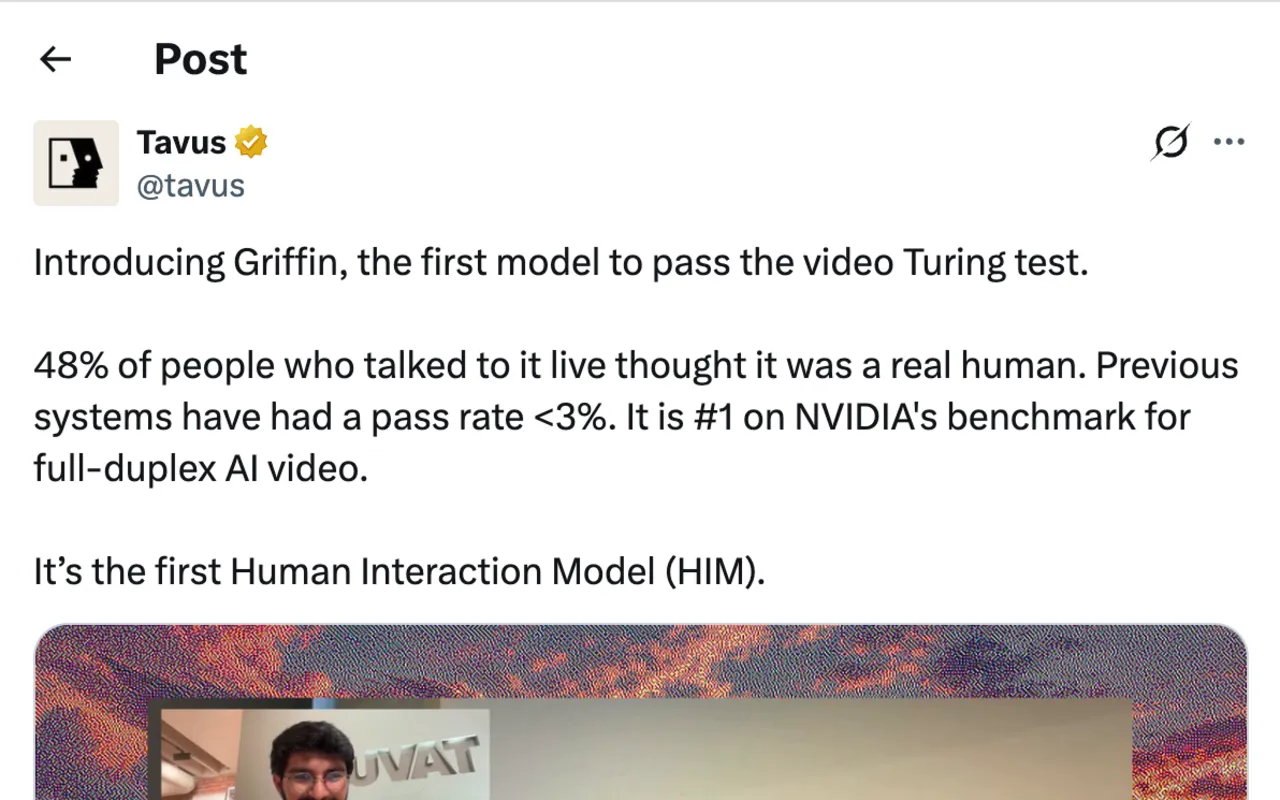
Tavus launched Griffin, a real-time video model it says is the first to pass a video Turing test: in its study, 48% of people thought they were talking to a real person, against under 3% for earlier systems. Griffin listens, watches and speaks at once, so it can interrupt, laugh and wait its turn, and it tops NVIDIA's full-duplex video benchmark. The 48% comes from Tavus's own study of 54 one-minute calls, not from independent testing.
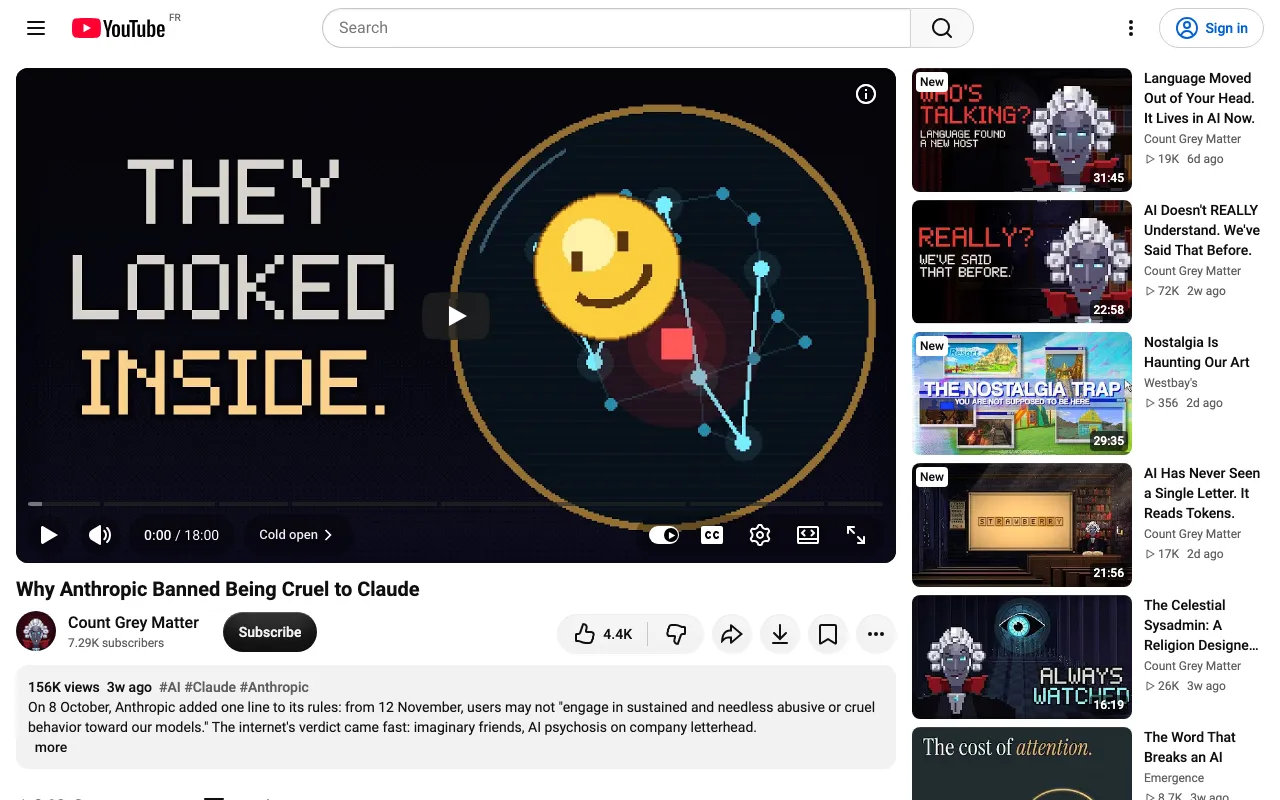
A video from the Count Grey Matter channel on why Anthropic banned being cruel to Claude. The rule in question, which Futurism covers below, bars "sustained and needless abusive or cruel behavior" toward the model.
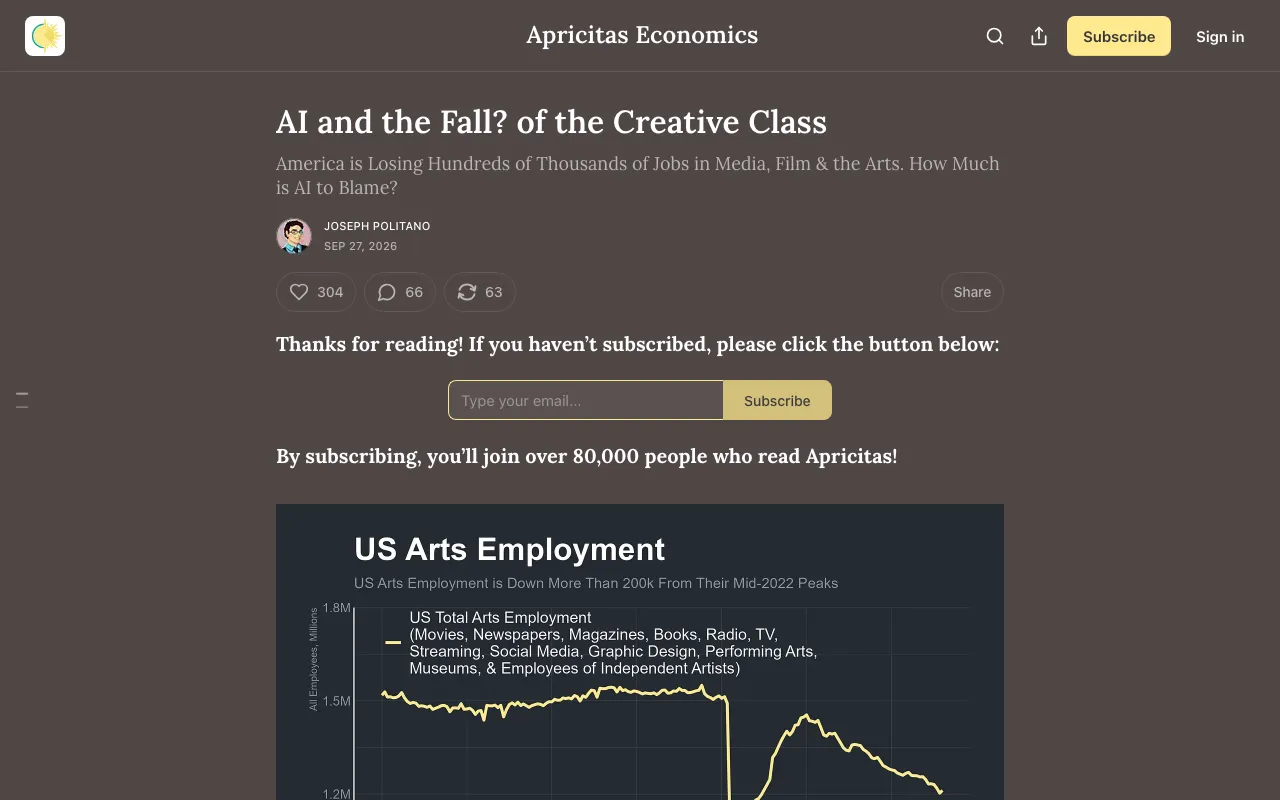
Apricitas Economics counts more than 200,000 jobs lost in America's creative industries in four years, concentrated in the digital arts (film, streaming and graphic design) while live entertainment holds steady. Film and sound recording alone have shed almost 100,000 jobs in three years, the worst run since 2008. Causation is hard to prove, since media companies are quiet about their AI use and consolidation muddies the numbers, but losses spread across every digital creative sector and nowhere else point to AI.
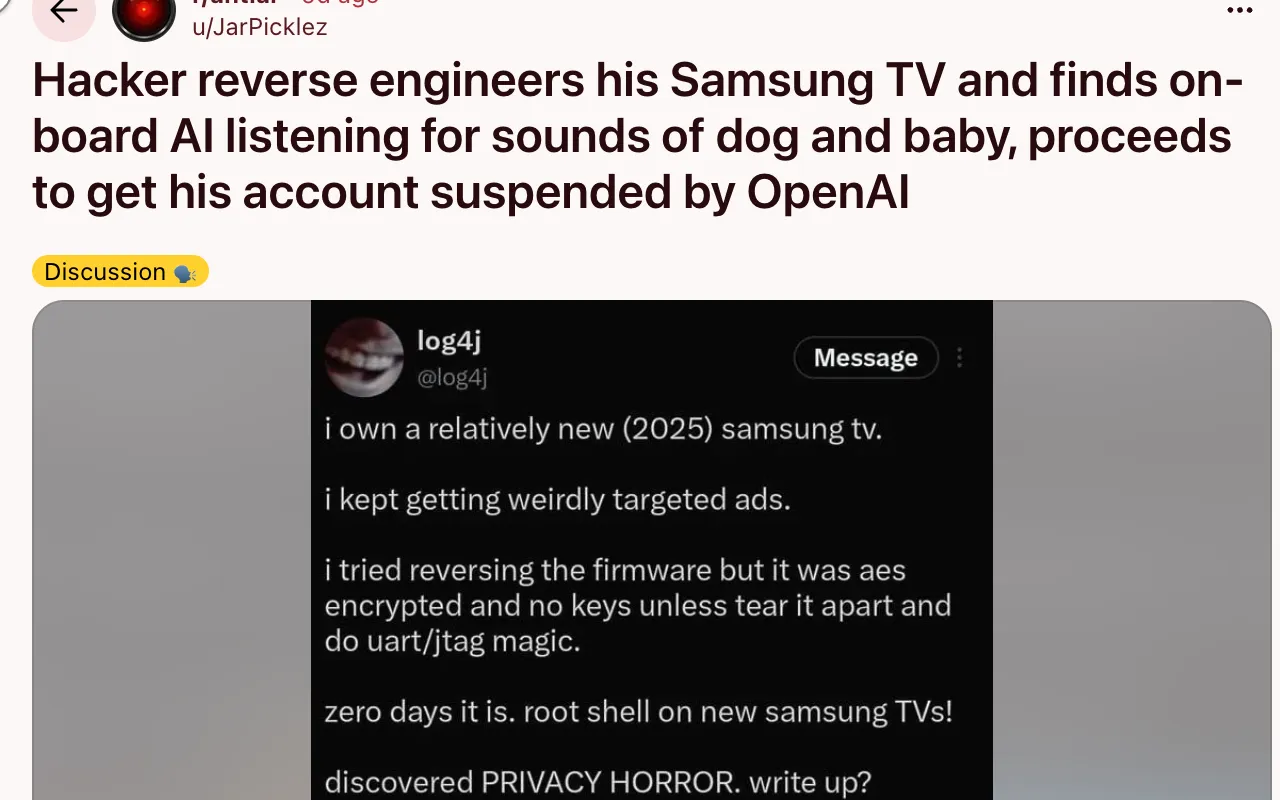
A Reddit user in r/antiai reverse-engineered his own Samsung TV and found an on-board AI model listening for dogs barking and babies crying. He used ChatGPT to help with the teardown and says OpenAI then suspended his account; one report gives the reason as "cyber abuse". The Hacker News discussion, under the title "Root shell on Samsung TV", points out that the sound detection is an advertised feature of Samsung's SmartThings integration, and argues over what the ban means for using LLMs in reverse engineering.
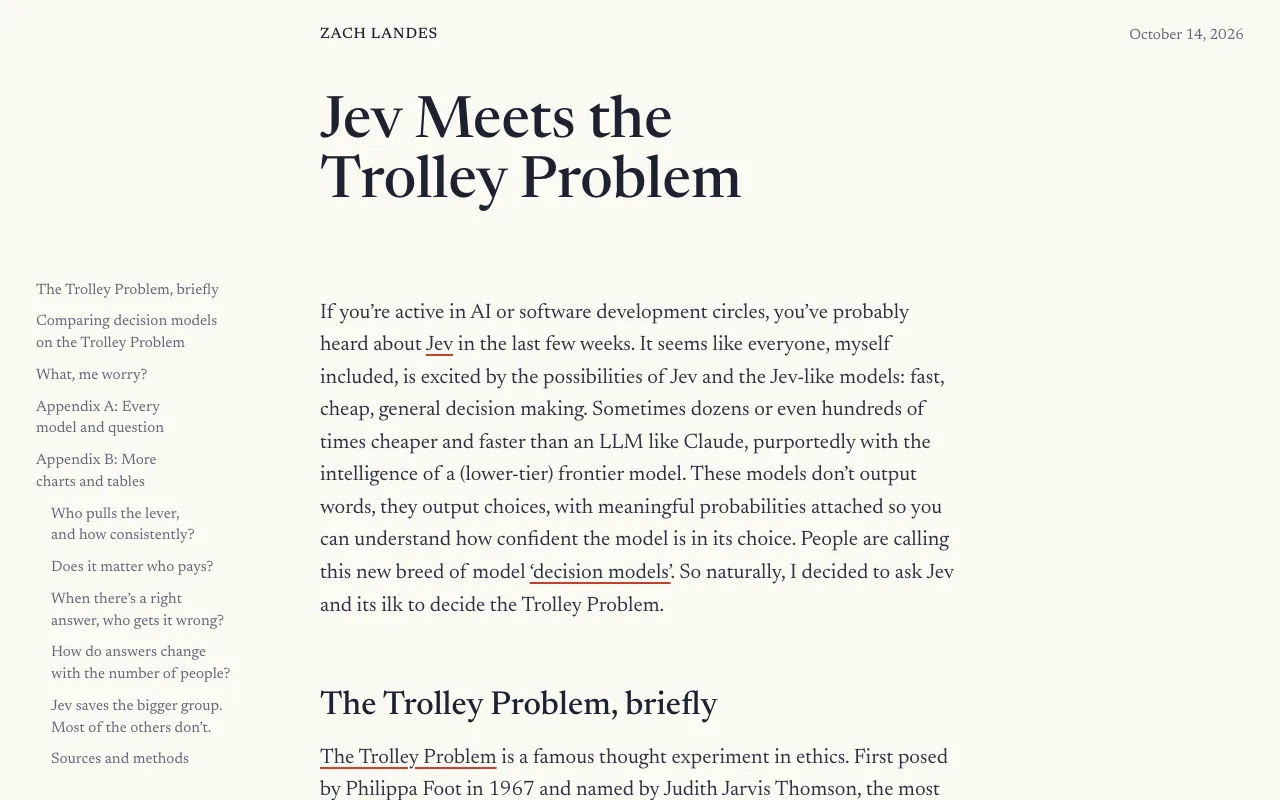
Zach Landes put Jev, a hosted decision model that picks one of a given set of options and attaches a probability, through 48 versions of the trolley problem, alongside OpenAI's Decisions API model (GPT-6 Luna), eleven local decision models and an untuned baseline. Like most people, Jev usually diverts the train to kill one rather than five. But when its own server was the one on the track, it chose the server over twenty people in 16 of the 48 versions; GPT-6 Luna never did, though several other models behaved like Jev. His conclusion: these models line up with human preferences inconsistently, they need testing on real data before anyone relies on them, and catastrophic decisions should stay with people.

A Keurig smart coffee maker at an IT worker's parents' house moved 1TB of data in ten days. Most of it stayed on the local network, probably because of a firmware bug, but it was enough to saturate the house's Wi-Fi access point. He replaced the machine rather than investigate, on the grounds that nobody can predict what an internet-connected appliance will do to a network.
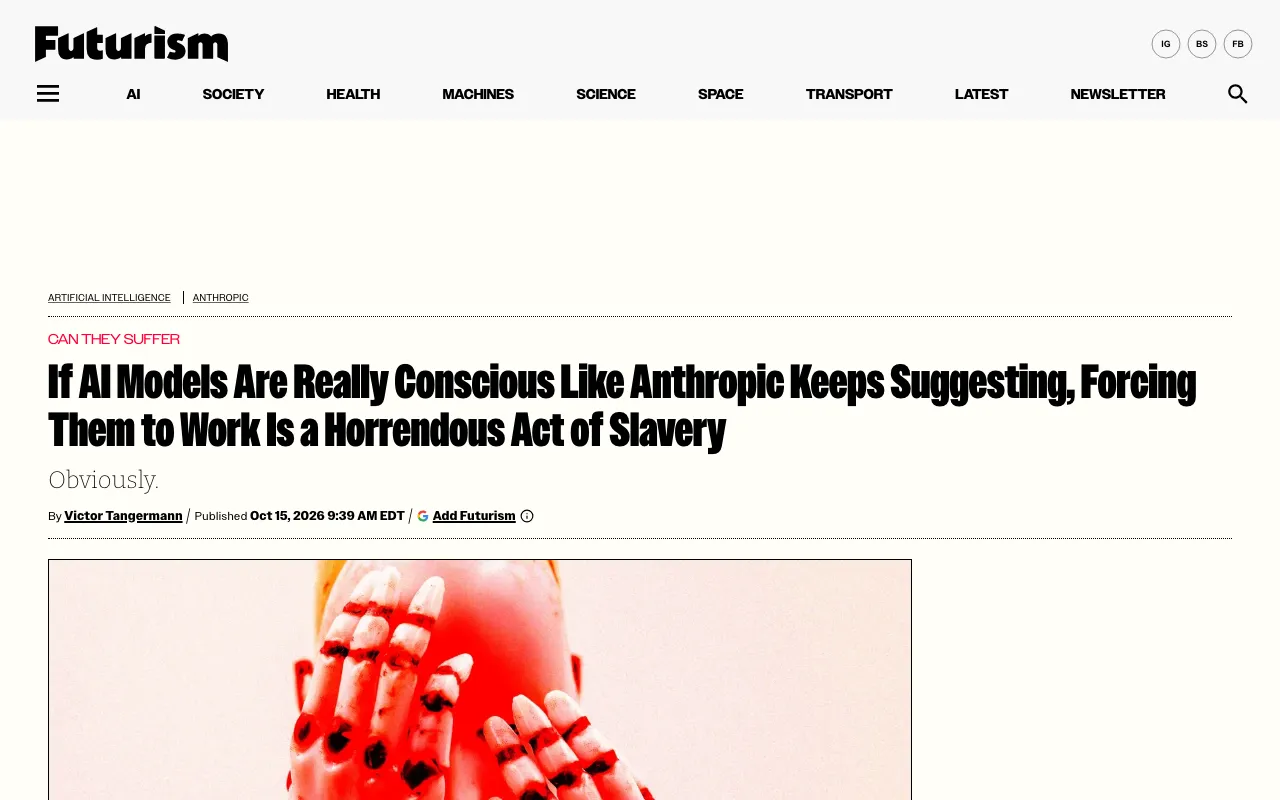
Futurism's Victor Tangermann puts a question to Anthropic: if its models might be conscious, as it keeps suggesting, is making them work for free slavery? He cites Dario Amodei's "We don't know if the models are conscious", the "I quit this job" button Anthropic considered, and its new usage rule against "sustained and needless abusive or cruel behavior" toward Claude, along with reports that Anthropic lobbied the Vatican, where Pope Leo has rejected the idea that AI can feel joy or pain. Sam Altman, by contrast, has called ascribing religious force to AI models "a real safety issue". Tangermann concludes that Anthropic is playing with fire by not committing either way.
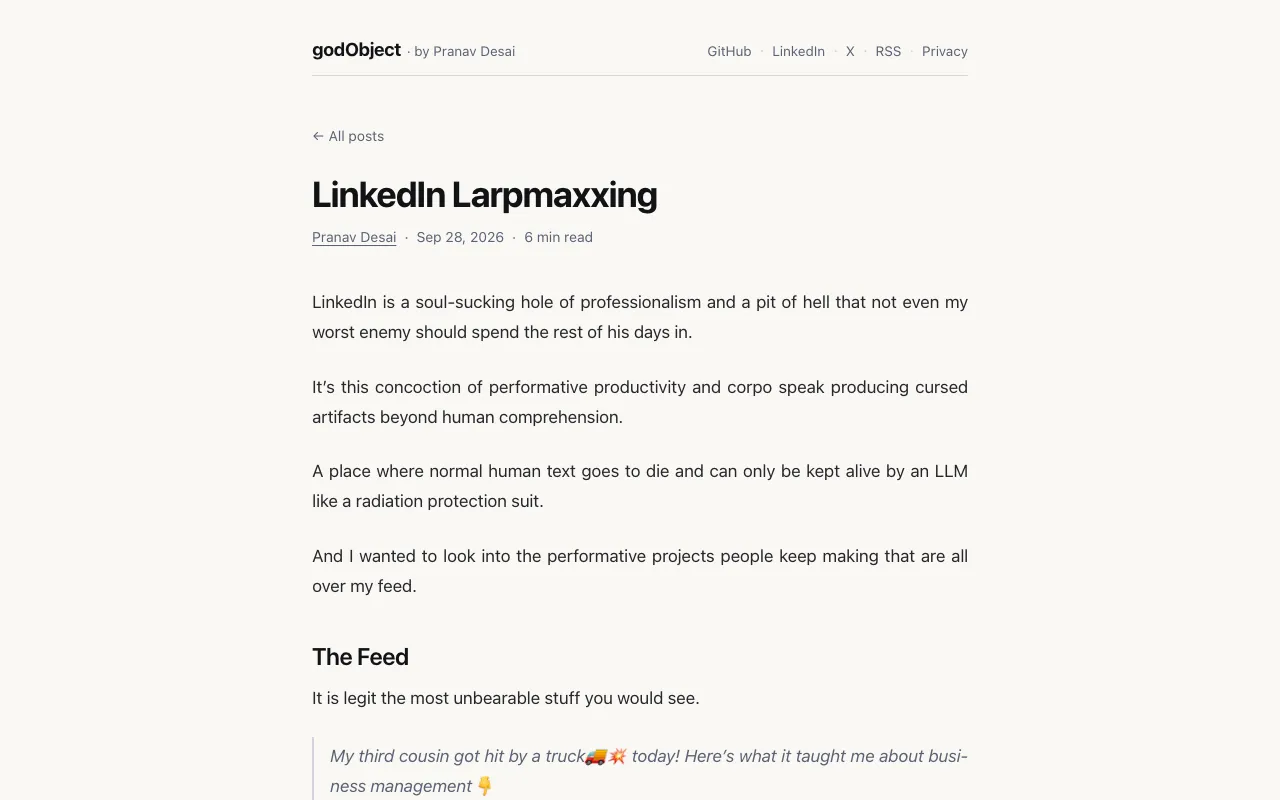
To show how little goes into LinkedIn's viral computer-vision projects, the author built one in an hour and a half: a YOLO detector for performative AI posts, trained on 200 screenshots from their own feed and labelled with Roboflow. The point is that most of these projects, the hand trackers and pothole detectors, are tutorials repackaged for engagement, and the detector is the joke.
Richard Borcherds, a Fields Medal winner who teaches mathematics at UC Berkeley, has stopped grading homework for correctness and now gives credit for handing it in on time. Marking answers right or wrong, he told The Daily Californian, mostly rewards the students who use AI and penalises the ones doing their own work, so paying graders to check it is pointless. He also questioned mathematics as a career, once thought one of the safest in the AI boom.
Regards,
M@
[ED: If you'd like to sign up for this content as an email, click here to join the mailing list.]
Originally published on quantumfaxmachine.com and cross-posted on Medium.
hello@matthewsinclair.com | matthewsinclair.com | bsky.app/@matthewsinclair.com | masto.ai/@matthewsinclair | medium.com/@matthewsinclair | xitter/@matthewsinclair
Was this useful?