
QFM119: Engineering Leadership Reading List - June 2026
 Source: Photo by Felix Mittermeier on Unsplash
The management reads this month circle one question: what exactly do engineers do that machines don't? The Engineering Leadership Report 2026 asks 600 leaders what the job is becoming; charity.wtf argues AI demands more engineering discipline. Not less now that the quality argument against AI code no longer holds; and Brown PLT's Human Judgment as a Specification shows why an LLM that writes both the spec and the program can be perfectly consistent and perfectly wrong.
Two data-driven reads close out the month. Why AI hasn't replaced software engineers, and won't runs the layoff numbers and finds barely any AI in them; and John Burn-Murdoch asks what if remote working, not AI, is to blame for weak junior hiring? — the FT column on the paper showing the junior-hiring signal pinned on AI disappears once remote roles are counted.
As always, the Quantum Fax Machine Propeller Hat Key will guide your browsing. Enjoy!
Propeller Hat Key
- 0 of 5:
- Unrelated to technology, management, or leadership
- 1 of 5:
- Suitable for management and leadership novices
- 2 of 5:
- Topics of interest for the new manager or leader
- 3 of 5:
- Technology management and leadership in real-world use cases
- 4 of 5:
- Topics for experienced managers and leaders
- 5 of 5:
- Advanced topics in management and leadership
Links
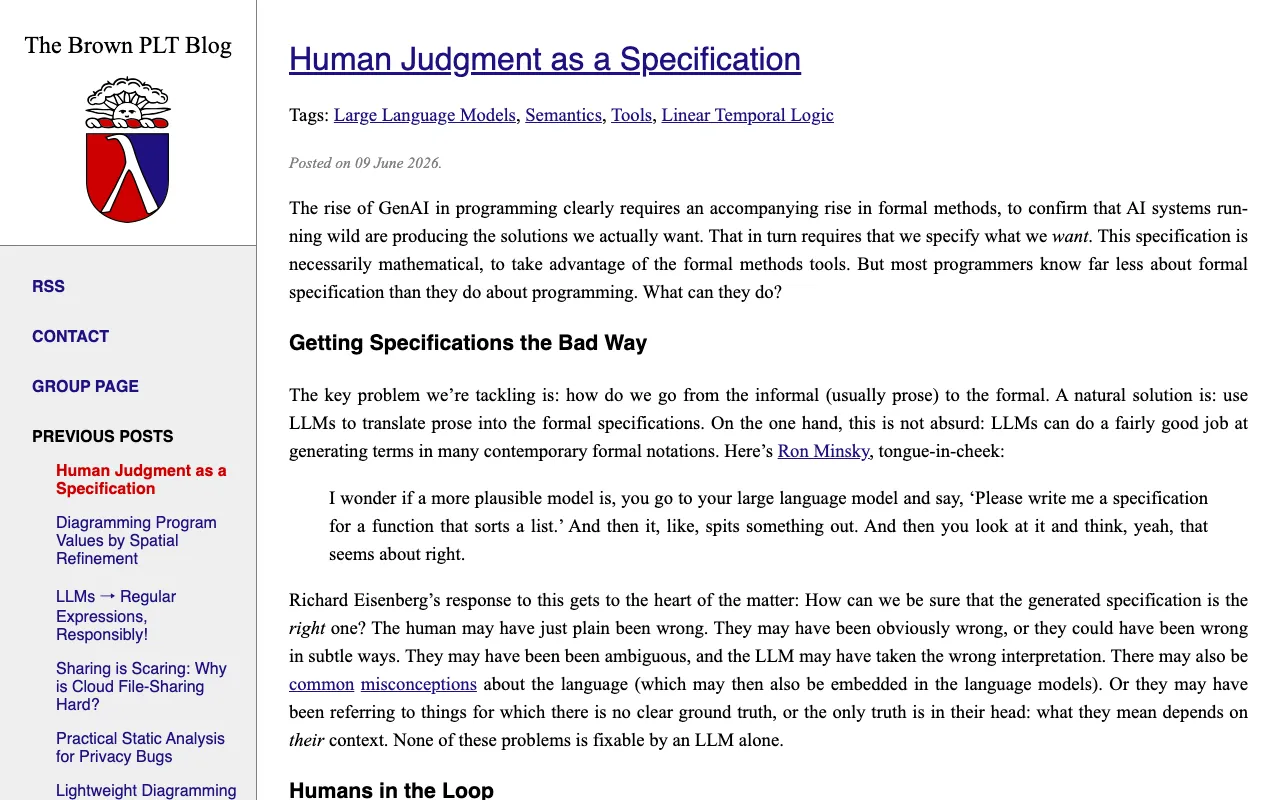
Brown PLT's PICK tackles the by-construction trap in LLM-generated formal specifications: if the spec encodes a misconception, the synthesized program is faithfully wrong, and stacking more LLMs on top adds agreement rather than the redundancy verification actually needs. Their fix routes validation through human judgment made cheap — instead of asking users to parse formal statements, PICK generates concrete disambiguating examples to upvote or downvote, sharpening vague intent into commitments and exposing the assumptions the prompt left unstated. The same algorithm covers regexes, linear temporal logic, and access-control policies; and when no candidate spec survives the feedback, that is itself the finding — the stated commitments can't be satisfied, better learned before shipping than after.
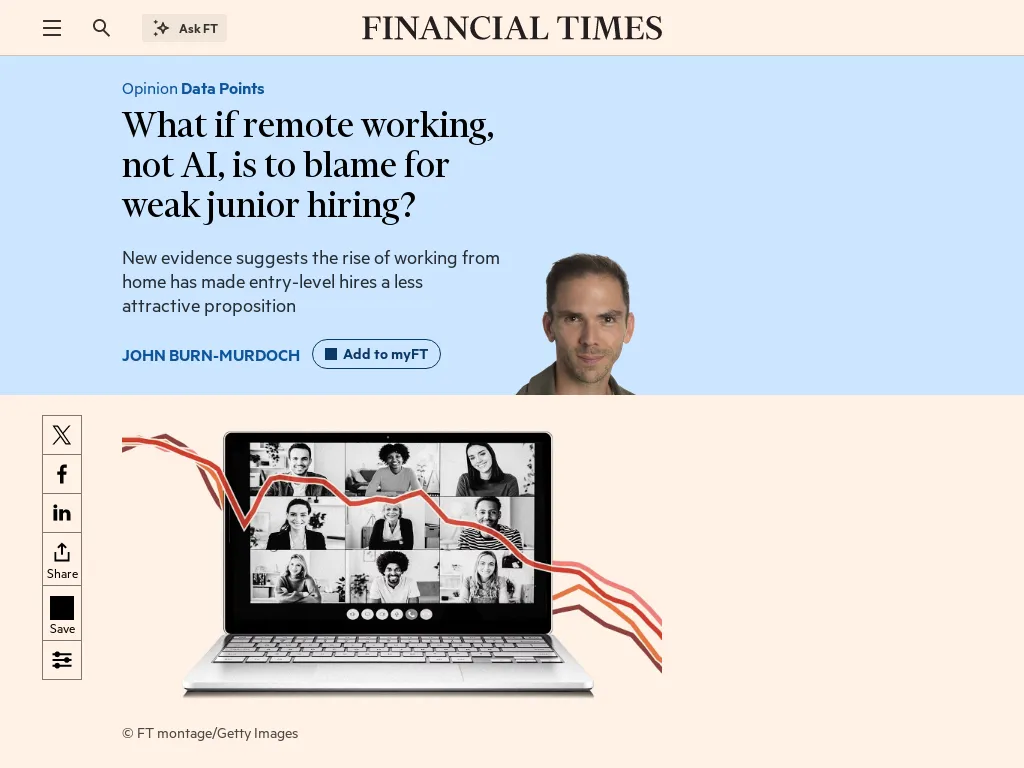
John Burn-Murdoch’s Data Points column on a new paper by Peter John Lambert and Yannick Schindler: analysing hundreds of millions of hires and job postings, they find the apparent link between AI exposure and the junior-hiring crunch evaporates once you account for whether a role is remote — junior hiring in remote-friendly but low-AI-exposure roles (lawyers) has also been weak, while high-AI-exposure in-person roles (receptionists) have held up. The proposed mechanism is that remote work worsened the trade-off for entry-level hires specifically: juniors need supervision and build skills and social capital by working alongside seniors, all of which WFH makes costlier, while the calculus for senior hires is unchanged. None of it exonerates AI — remote work may even be a risk factor for displacement, since managers who only see reports over Slack may judge their work more automatable — but it recasts the youngest workers as hit twice by a shift that most benefits the mid-career, consistent with Gen Z being the generation most opposed to fully remote roles. Unpaywalled here; discussion on HN.
As AI-generated code quality crossed a threshold in late 2025 with models like Opus 4.5 and agentic harnesses becoming viable, skepticism about AI capabilities is becoming untenable—similar to how the industry adapted from handcrafted servers to immutable infrastructure. The author argues that reliability engineers must now embrace engineering discipline around AI validation and harness engineering rather than dismissing AI progress, as the exponential improvement curve is real and moving faster than most anticipated.
Arvind Narayanan and Sayash Kapoor take the layoff narrative apart with numbers: only 0.2% of New York layoff filings cite AI displacement, developers spend somewhere between 9% and 61% of their time actually writing code, and just 44% of agent-generated code survives into user commits. Their sandwich model puts the durable human work in the decide and deliver layers — specification, judgment, accountability — while AI compresses only the execution in the middle. 'If there is a ceiling to the demand for code, we are nowhere near it.' The 364-comment HN thread mostly agrees, with the recurring line that every productivity gain in software's history has moved the goalposts rather than shrunk the profession.
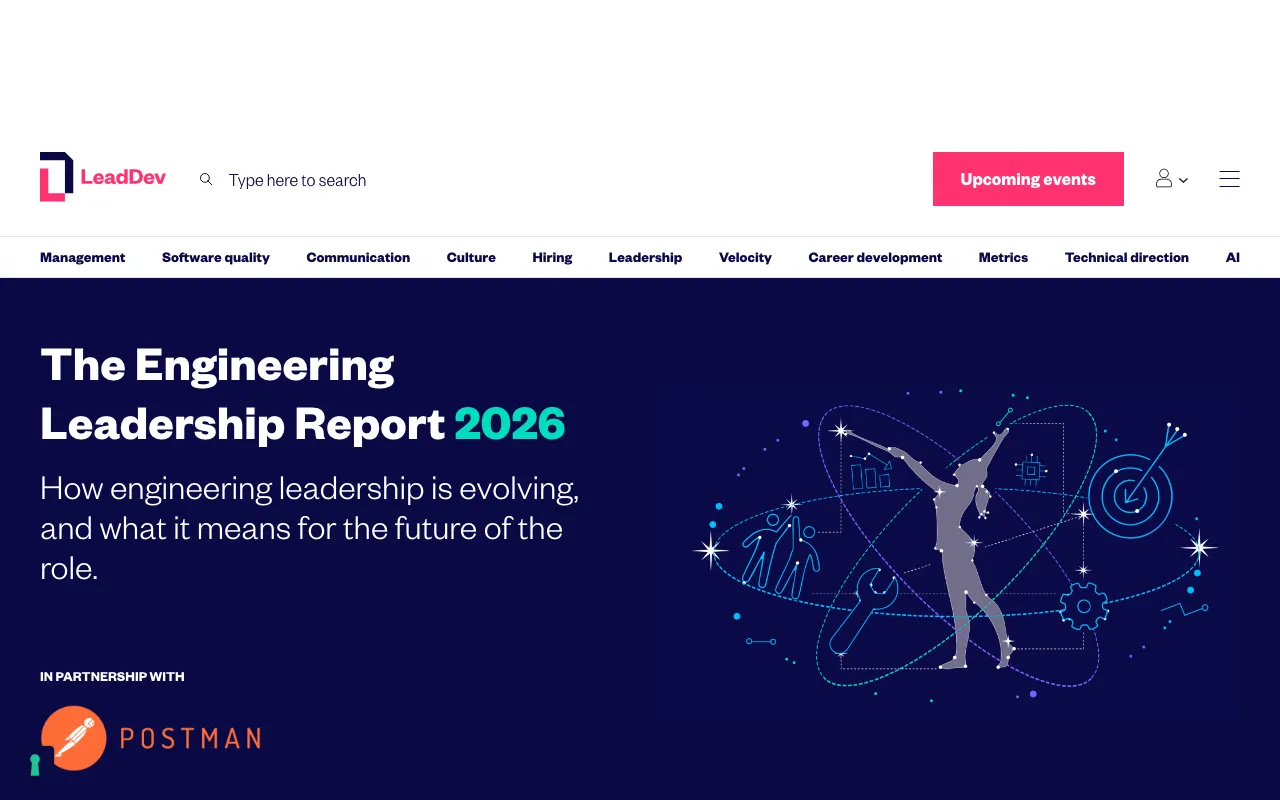
The Engineering Leadership Report 2026 analyzes responses from 600 engineering leaders to examine how the role is evolving amid organizational flattening and AI-driven changes to software development workflows. Engineering leaders face mounting pressure to expand their technical, strategic, and managerial responsibilities simultaneously, creating compounding strain across the industry. The report provides data-driven insights into these emerging trends and their implications for the future of engineering leadership roles.
Regards,
M@
[ED: If you'd like to sign up for this content as an email, click here to join the mailing list.]
Originally published on quantumfaxmachine.com and cross-posted on Medium.
hello@matthewsinclair.com | matthewsinclair.com | bsky.app/@matthewsinclair.com | masto.ai/@matthewsinclair | medium.com/@matthewsinclair | xitter/@matthewsinclair
Was this useful?