
QFM127: Engineering Leadership Reading List - August 2026
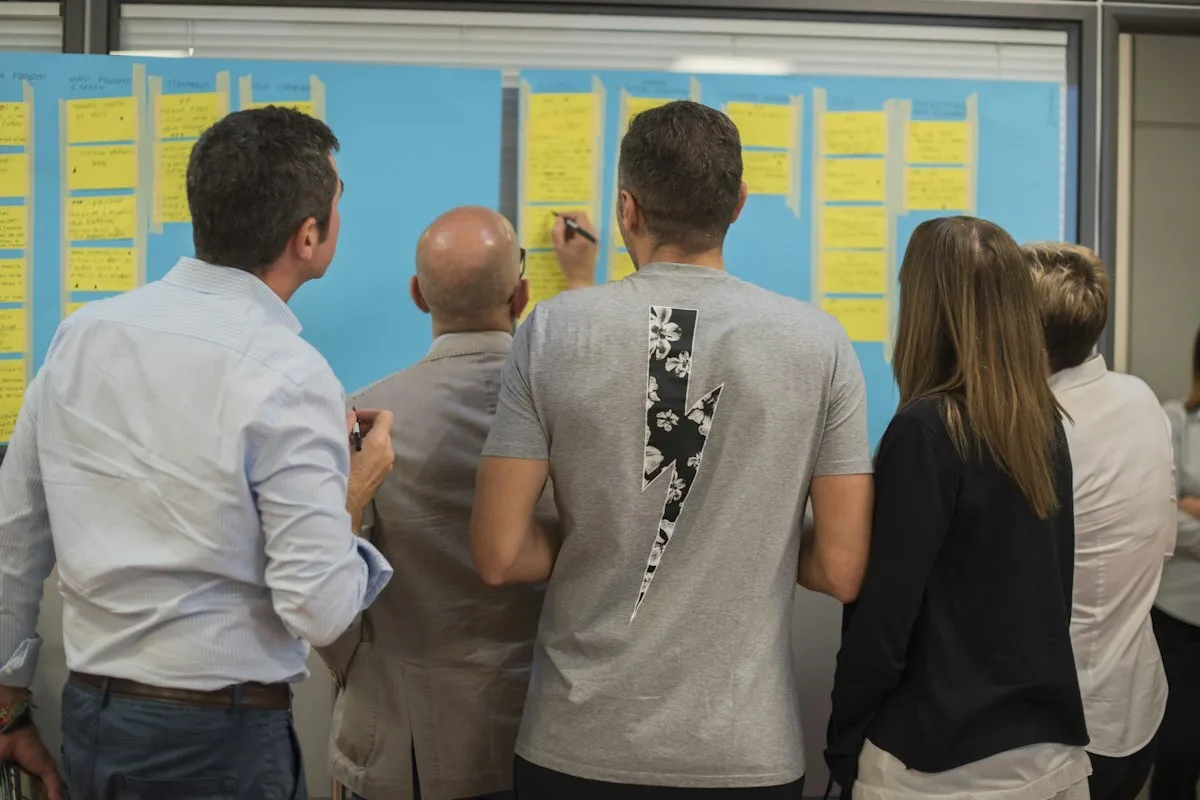 Source: Photo by FORTYTWO on Unsplash
Everything on this list was learned the hard way, then written down. Joseph Heck builds with agentic harnesses and still argues that software engineering fundamentals matter more than ever. 37signals has put the playbook it gives its own managers on the web, which says as much about the company as about management.
Simeon Simeonov and Itamar Novick's anti-pattern series is mostly about running a startup, but engineering leaders will find a few of their own favourite mistakes on the list. And Michael Dubakov, who bet on no-code in 2019, now places a different bet, on solid bases plus custom code, with an imaginary mushroom farm as the test case.
As always, the Quantum Fax Machine Propeller Hat Key will guide your browsing. Enjoy!
Propeller Hat Key
- 0 of 5:
- Unrelated to technology, management, or leadership
- 1 of 5:
- Suitable for management and leadership novices
- 2 of 5:
- Topics of interest for the new manager or leader
- 3 of 5:
- Technology management and leadership in real-world use cases
- 4 of 5:
- Topics for experienced managers and leaders
- 5 of 5:
- Advanced topics in management and leadership
Links
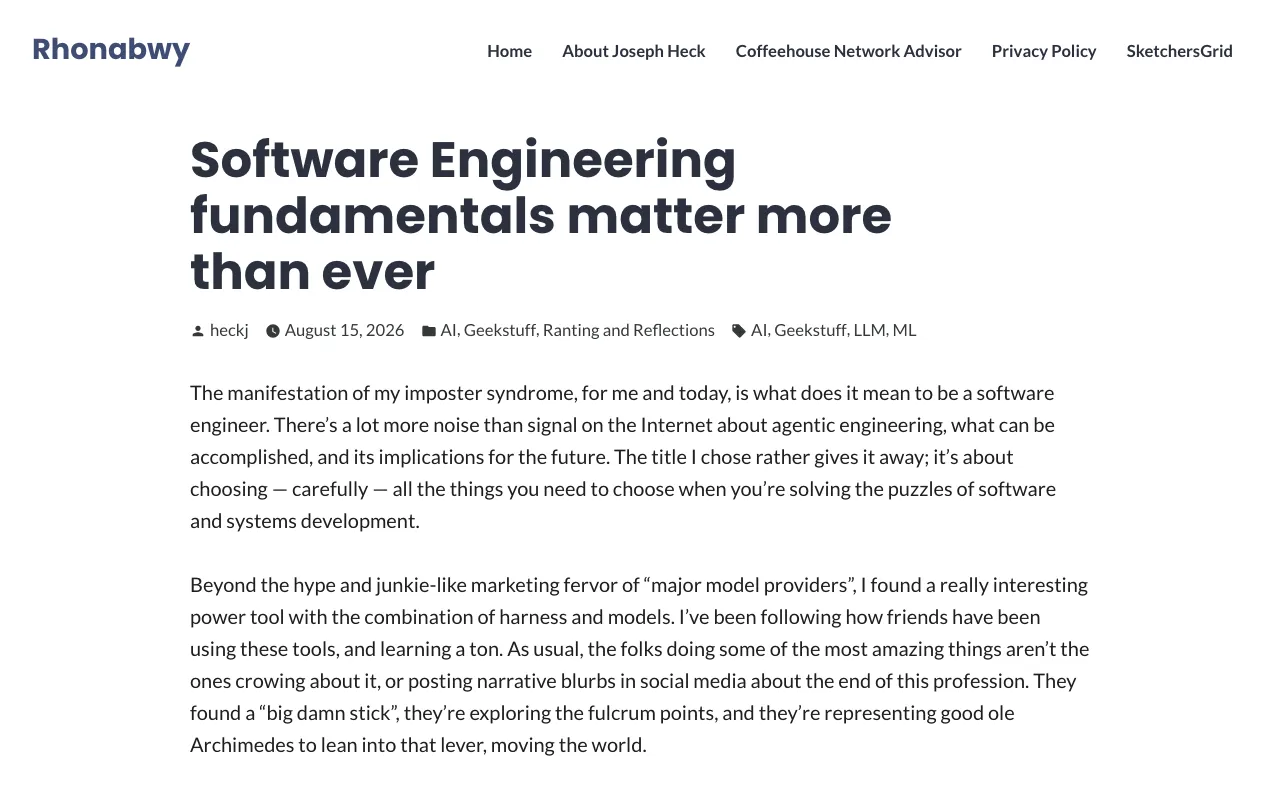
Joseph Heck develops with agentic harnesses, leaning heavily on the prompt "develop with red/green TDD", and calls the combination of harness and models "a really interesting power tool". The essay is about where that tool stops. With some foresight it gets you to "it works" and "it's testable", but making software debuggable, maintainable, layered and composable is "still quite a trick": quite a lot of that work takes extensive, thoughtful reasoning, which is where, in Heck's view, today's models fall short. Heck hopes for near-term advances in how models are trained, and calls carefully reviewing, planning and fixing the seams of software a critical skill "with or without agentic assistants", now "more important than ever".
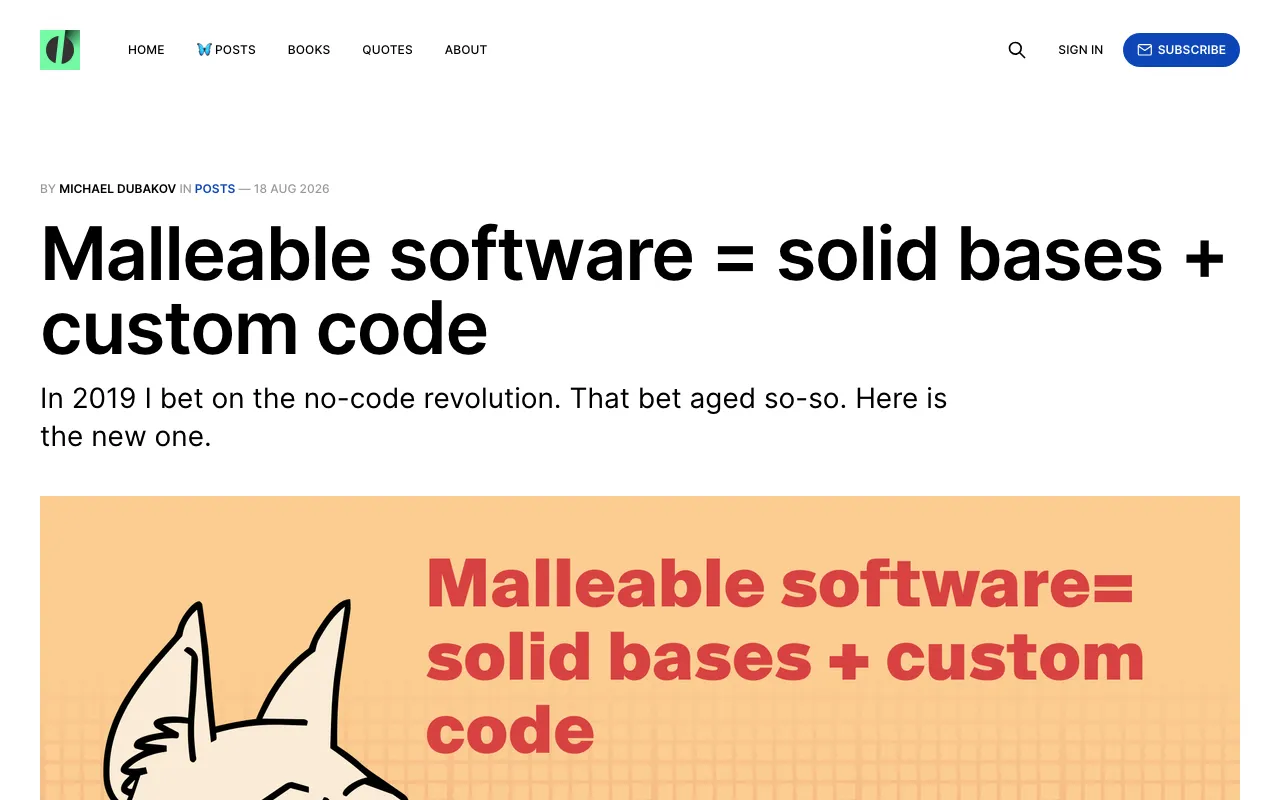
In 2019 Michael Dubakov bet on the no-code revolution; this post makes a new bet, solid bases plus custom code. Using an imagined mushroom farm with ten staff, Dubakov compares five ways to get a team its software: build it from scratch with Claude Code or Codex, vibe-code it with Lovable or v0, use a low-code builder such as Retool or Softr, assemble it in a malleable tool such as Notion or Fibery, or buy a specialised tool. The post favours a base that already handles the hard shared parts (data with relations, concurrent editing, change history, permissions), with custom code for the rest, and expects malleable tools to get there first, "because extension points take quarters to add, while a solid base takes years". Read it knowing that Dubakov founded Fibery, one of the tools named, a fact the post itself does not mention.
The 37signals Manager Playbook is the handbook 37signals wrote for its own people managers, published on the web for anyone to read. It covers what the company expects of a manager, the limits of a manager's authority, hiring and onboarding, performance reviews, feedback, underperformance and difficult conversations, and developing a team through 1:1s, coaching, recognition and promotion. Two things set it apart: its managers also do individual-contributor work, and it is frank about 37signals' own policies, from pay that managers have no say in (for the roles its salary benchmark covers, the top 10% of San Francisco tech pay, wherever an employee lives) to time off that staff announce rather than request.
Simeon Simeonov and Itamar Novick's series on startup anti-patterns names the habits that look like a sensible response to a problem but do more harm than good, with examples from their experience as founders and investors in more than 100 startups. This index post, first published in 2023 and updated as the series grows, lists 75 of them, from Elephant hunting to Outsourcing your architecture, and links the fourteen written up so far, the latest being Bleeding on the Edge in August 2026. Most concern strategy, fundraising and running the company; a few, such as Overengineering, Premature optimization and Featuritis, are engineering's own.
Regards,
M@
[ED: If you'd like to sign up for this content as an email, click here to join the mailing list.]
Originally published on quantumfaxmachine.com and cross-posted on Medium.
hello@matthewsinclair.com | matthewsinclair.com | bsky.app/@matthewsinclair.com | masto.ai/@matthewsinclair | medium.com/@matthewsinclair | xitter/@matthewsinclair
Was this useful?