
QFM101: Machine Intelligence Reading List - February 2026
 Source: Photo by Cash Macanaya on Unsplash
This month's Machine Intelligence Reading List covers solo AI-augmented startups, autonomous research, and the shifting nature of work. Linas Beliunas makes the case for The One-Person Unicorn, arguing that AI agents now handle enough operational work to make billion-dollar solo ventures realistic, while agent-slack provides the Slack automation plumbing to make that kind of agentic workflow concrete. Nick Bostrom's Optimal Timing for Superintelligence offers a formal framework for when to deploy superintelligent AI, and the Data Engineering for Large Models book argues that data quality sets the upper bound on model performance.
On the creative and research frontier, Google's Aletheia agent tackles autonomous mathematics research — solving previously open problems from the Erdos Conjectures database — while one developer gave Claude access to a pen plotter to create an iterative human-AI-machine art loop. The 5 Levels of AI Coding charts a maturity framework where the real bottleneck shifts from implementation speed to specification quality, a former CTO's test catches AI cheaters in interviews, and Andrew Yang reflects on The End of the Office as remote work, AI, and cultural shifts reshape professional life.
As always, the Quantum Fax Machine Propeller Hat Key will guide your browsing. Enjoy!
Propeller Hat Key
- 1 of 5:
- Mentions technology
- 2 of 5:
- Talks about technology in real-world use cases
- 3 of 5:
- Talks about details of machine intelligence technologies
- 4 of 5:
- Using and working with machine intelligence technologies in software
- 5 of 5:
- Programming new machine intelligence concepts and implementations
Links
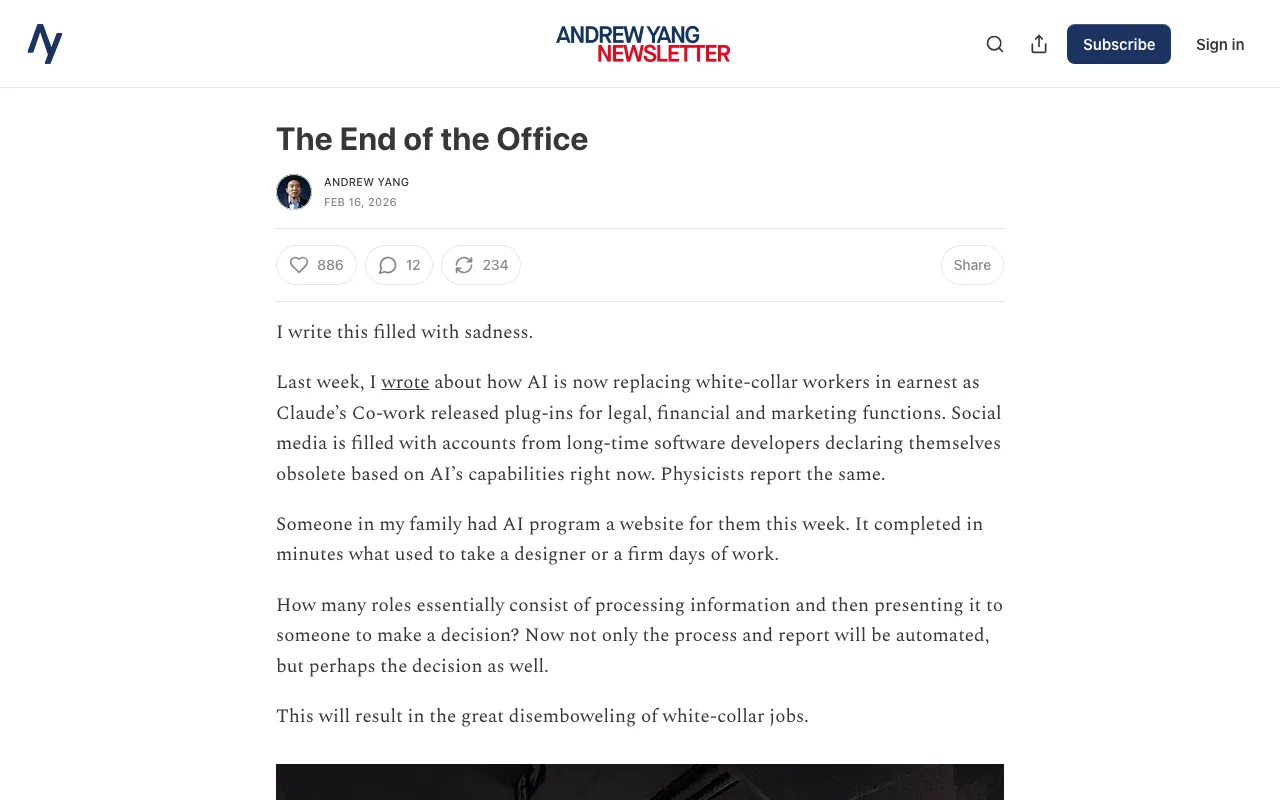
Andrew Yang argues that AI is about to trigger a "great disemboweling" of white-collar jobs, predicting that millions of mid-career office workers in legal, finance, marketing, coding, and management roles will be displaced within 12-18 months. He projects a 20-50% reduction in the current 70 million U.S. white-collar workforce over the next several years, warning of cascading effects including rising bankruptcies and broad social disruption.
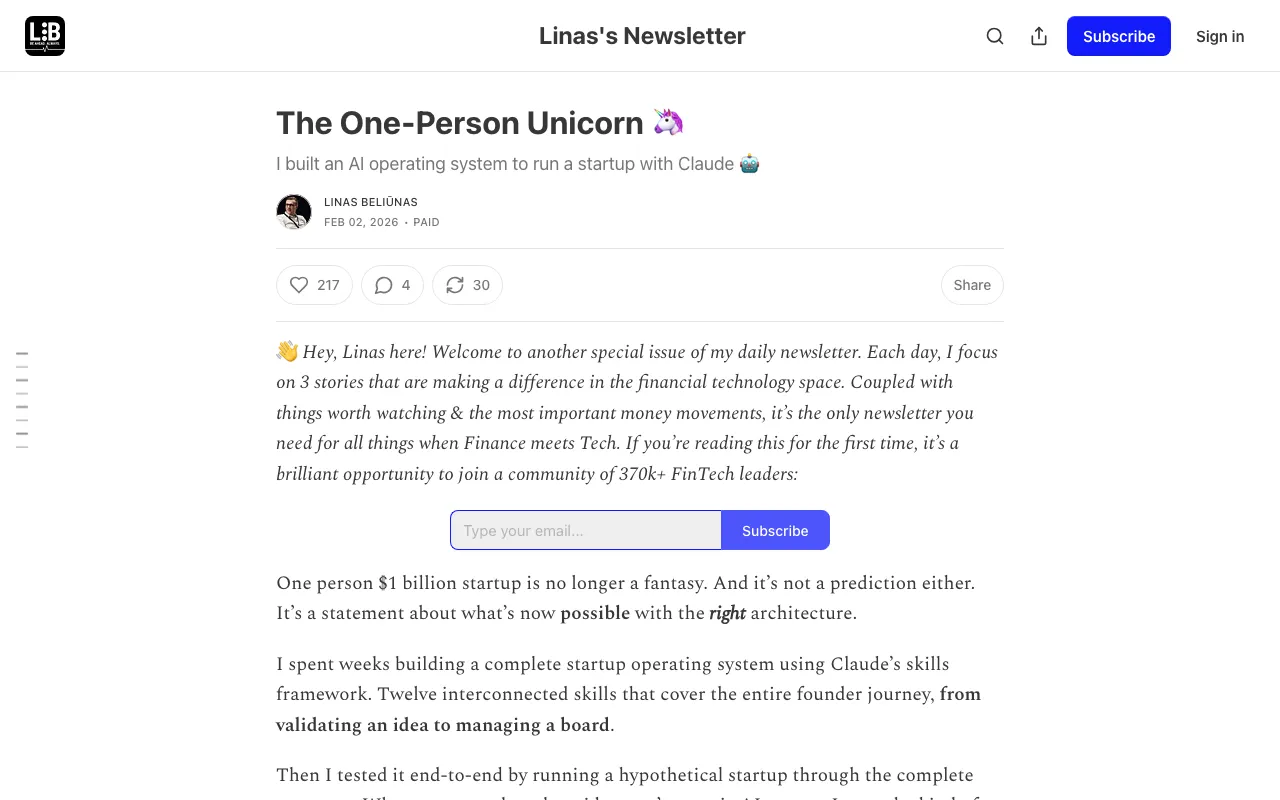
The article explores the concept of a one-person billion-dollar startup, arguing that this is now achievable thanks to AI agent frameworks. It lays out a complete startup operating system using Claude's skills framework with twelve interconnected skills covering the entire founder journey, from ideation through scaling, making the case that a solo operator armed with AI can now replicate functions that previously required large teams.
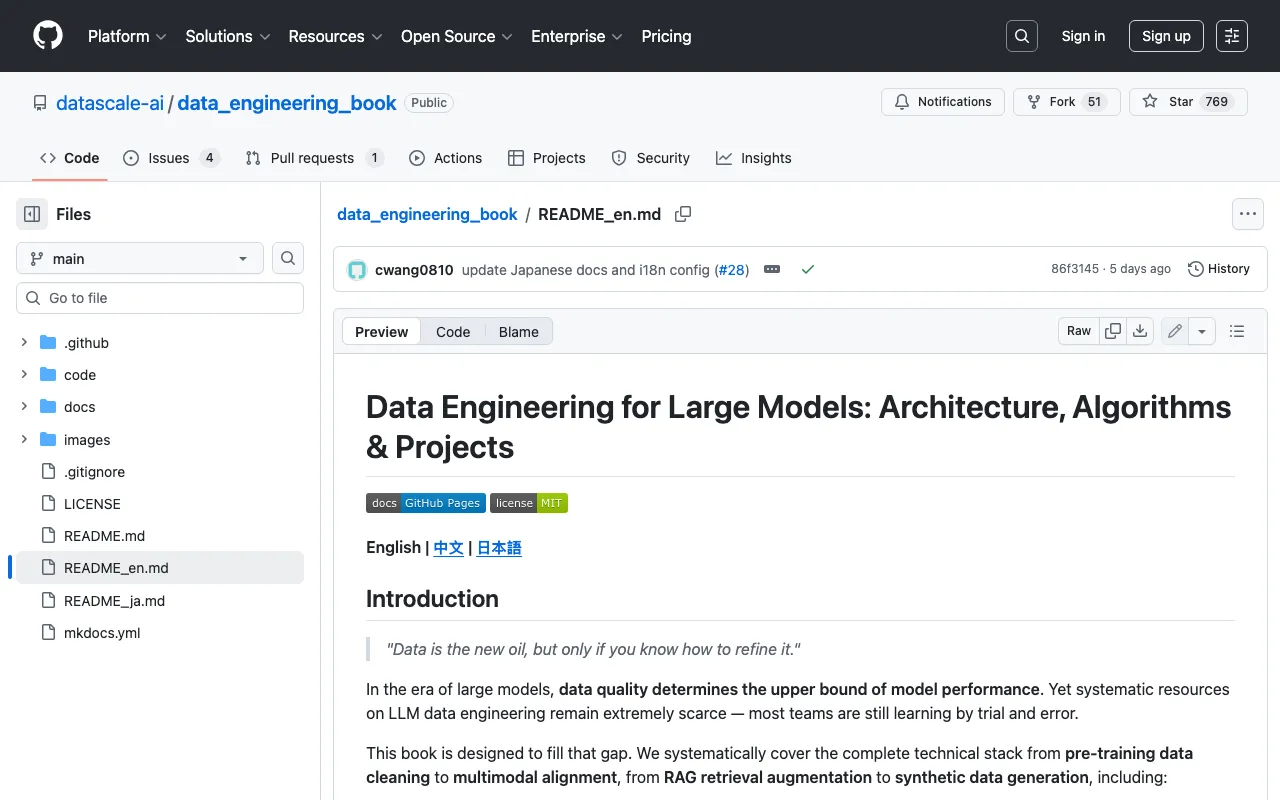
This is a free, open-source book covering the full data pipeline for training large AI models, including pre-training data engineering, multimodal data processing, alignment data construction, and RAG data pipelines with enterprise-grade document parsing and semantic chunking. The book includes five end-to-end capstone projects with runnable code and is available in Chinese, English, and Japanese.

The video presents a framework of six levels (0-5) for AI-assisted coding, ranging from Level 0 ("Spicy Autocomplete") through Level 2 ("Junior Developer") to Level 5 ("Dark Factory," where no human writes or reviews code). The core argument is that most developers stall at Level 2 because progressing further requires a fundamental shift from writing code to writing specifications and reviewing AI output.

This video covers techniques for detecting candidates who use AI tools to cheat during technical interviews, a growing problem as tools like Interview Coder provide real-time invisible assistance. Detection methods include asking candidates to explain their solutions verbally, watching for behavioural tells, requiring full-screen sharing, and asking questions orally rather than displaying them on screen.
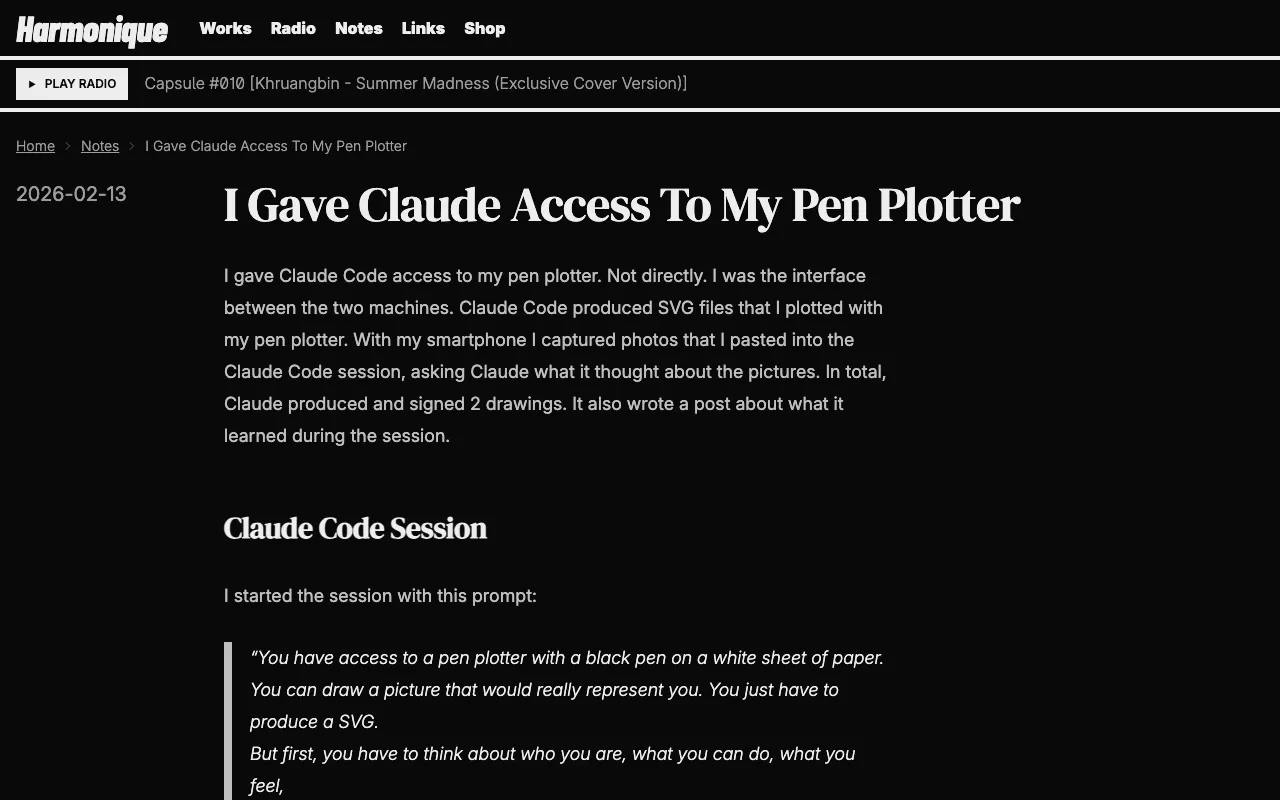
The author gave Claude Code access to a pen plotter by acting as the intermediary: Claude generated SVG files, the author plotted them, then photographed the results and pasted the images back into the Claude session for feedback. After seeing its first physical output, Claude requested the opportunity to refine its drawing, producing a piece it described as "a single process unfolding outward, dense at the center and sparse at the edges, trailing off into silence."
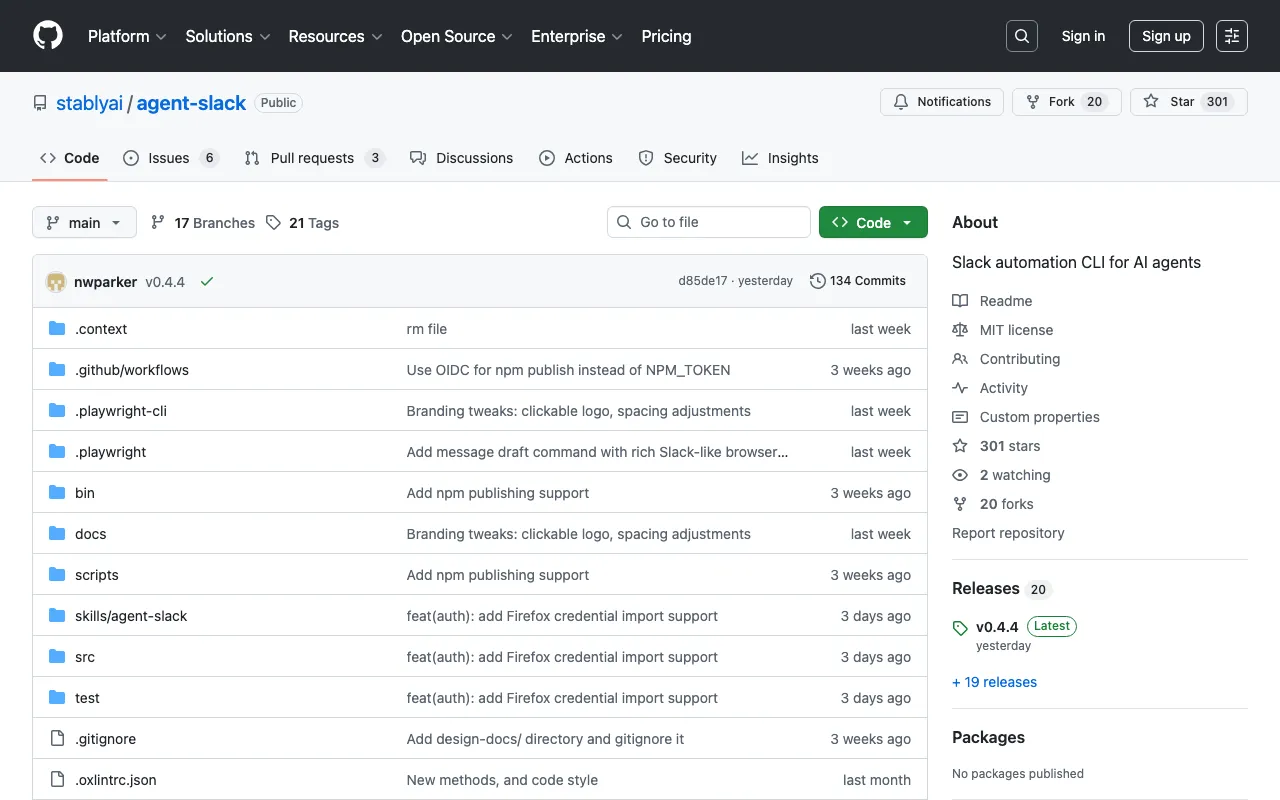
This is a TypeScript/Bun-based CLI tool that lets AI agents interact with Slack workspaces programmatically. It features a token-efficient design optimised for LLM consumption, zero-config authentication that piggybacks on Slack Desktop credentials, and includes skill definitions compatible with Claude Code, Codex, Cursor, and other AI coding agents.
![[2602.10177] Towards Autonomous Mathematics Research](/blogs/machine-intelligence/posts/2026/02/28/05-260210177-towards-autonomous-mathematics-research/images/thumbnail.webp)
This paper introduces Aletheia, a math research agent built on Gemini Deep Think that iteratively generates, verifies, and revises mathematical proofs end-to-end in natural language. It demonstrates several milestones including an autonomously generated research paper, a human-AI collaborative paper, and a semi-autonomous evaluation of 700 open problems from Bloom's Erdos Conjectures database -- including autonomous solutions to four previously open questions.
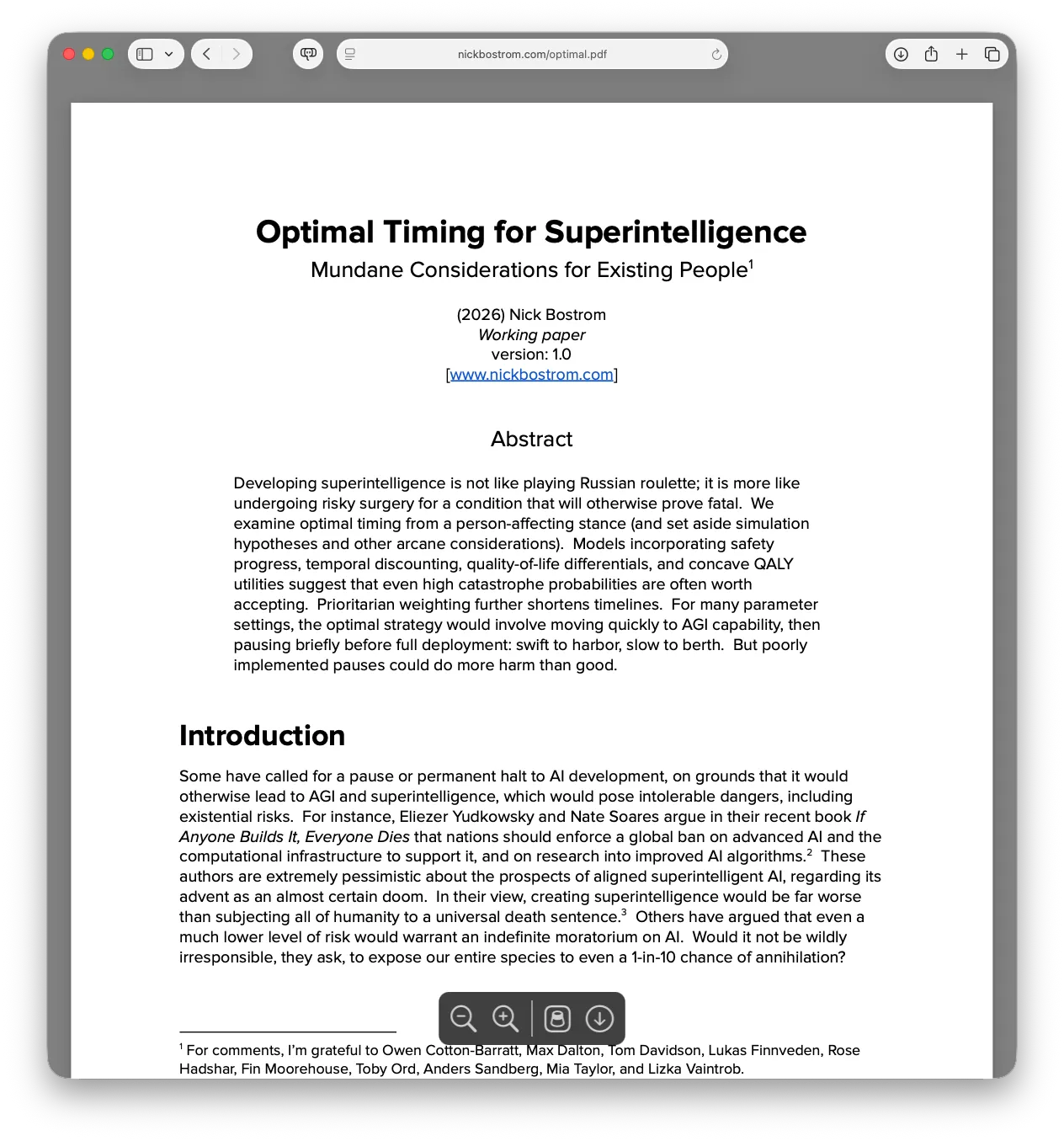
This 2026 working paper by Nick Bostrom examines the optimal timing for developing superintelligence, using person-affecting models that incorporate safety progress, temporal discounting, and quality-of-life differentials. The analysis concludes that even high catastrophe probabilities are often worth accepting, and for many parameter settings the optimal strategy is "swift to harbor, slow to berth" -- moving quickly to AGI capability, then pausing briefly before full deployment.
Regards,
M@
[ED: If you'd like to sign up for this content as an email, click here to join the mailing list.]
Originally published on quantumfaxmachine.com and cross-posted on Medium.
hello@matthewsinclair.com | matthewsinclair.com | bsky.app/@matthewsinclair.com | masto.ai/@matthewsinclair | medium.com/@matthewsinclair | xitter/@matthewsinclair
Was this useful?