
QFM117: Machine Intelligence Reading List - June 2026
 Source: Photo by Growtika on Unsplash
June was the month the wider world weighed in. The Economist's cover leader says the AI backlash is only getting started and tells governments and labs how to head it off; Is AI Profitable Yet? answers its own question in one word — the large, red kind — and shows its working; and Carlota Pérez and the AI boom checks the boom against her surge cycle and finds us mid-frenzy. From the culture desk, Martin Scorsese is embracing A.I., Ben Affleck sold his AI company to Netflix for $600 million while promising 'more human work', Rich Sutton's SAIR talk on AI creativity & discovery explains why a supervised mimic can never do science, and Midjourney — yes, that Midjourney — unveiled a full-body scanner you visit like a spa.
Agent tooling kept arriving. I Read the Claude Code Source Code documents every knob the official docs don't mention; ponytail optimises for the code your agent never writes, 54% fewer lines on average; Orchestrating ambient agents with Temporal gives long-running agents somewhere durable to live; Envelope opens its team schema while keeping the marketplace to itself; and Building Reliable Agentic AI Systems reports from inside PRINCE at Bayer, a system that has had to survive real users since early 2024. Anthropic's founder's playbook is the starting-from-zero companion.
For the technically hungry: How LLMs Actually Work and LLMs are complicated now pair well — one builds the transformer picture up from tokens, the other charts how far production models have drifted from that clean picture; Mind Your Tone measures prompt politeness against accuracy and finds rudeness wins; OpenCV 5 rebuilds the computer-vision workhorse around a new DNN engine; APERTVS is Switzerland's answer to the openness question, a foundation model with nothing hidden; Teaching LLMs new UI tricks reverse-engineers ChatGPT's Unicode-delimited embedded UI; Details That Make Interfaces Feel Better is a working checklist of the tiny choices behind interface polish; and the Fintech Engineering Handbook does the same for code that moves money.
As always, the Quantum Fax Machine Propeller Hat Key will guide your browsing. Enjoy!
Propeller Hat Key
- 1 of 5:
- Mentions technology
- 2 of 5:
- Talks about technology in real-world use cases
- 3 of 5:
- Talks about details of machine intelligence technologies
- 4 of 5:
- Using and working with machine intelligence technologies in software
- 5 of 5:
- Programming new machine intelligence concepts and implementations
Links
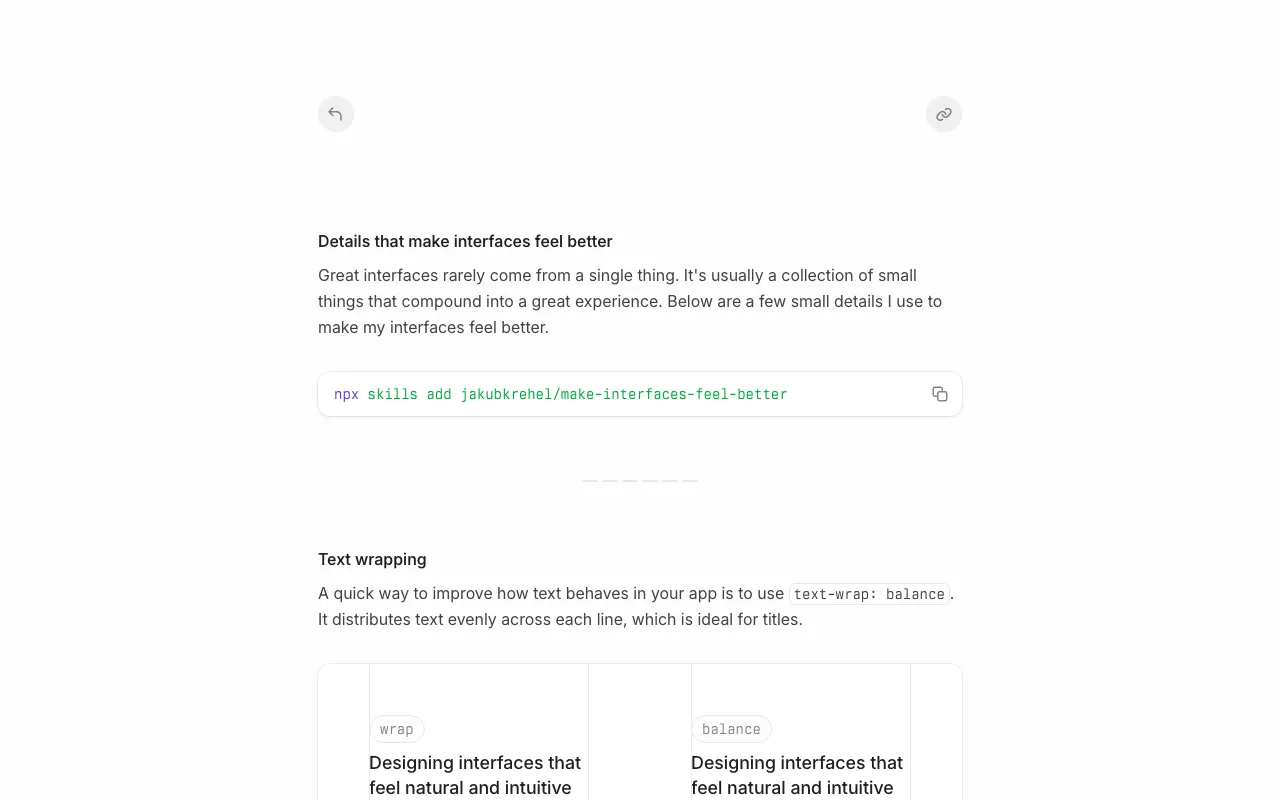
Jakub Krehel catalogues the small mechanical decisions that separate a polished interface from a merely functional one: text-wrap balance on titles and pretty on paragraphs, concentric border radii (outer = inner + padding), interruptible transitions instead of fixed keyframes, tabular numerals for stable digit widths, optical rather than geometric alignment. None of it is novel in isolation; the value is the whole checklist in one place with the CSS to apply it. He has also packaged the lot as an installable Make Interfaces Feel Better skill so Claude Code, Cursor, and friends can apply the refinements for you.
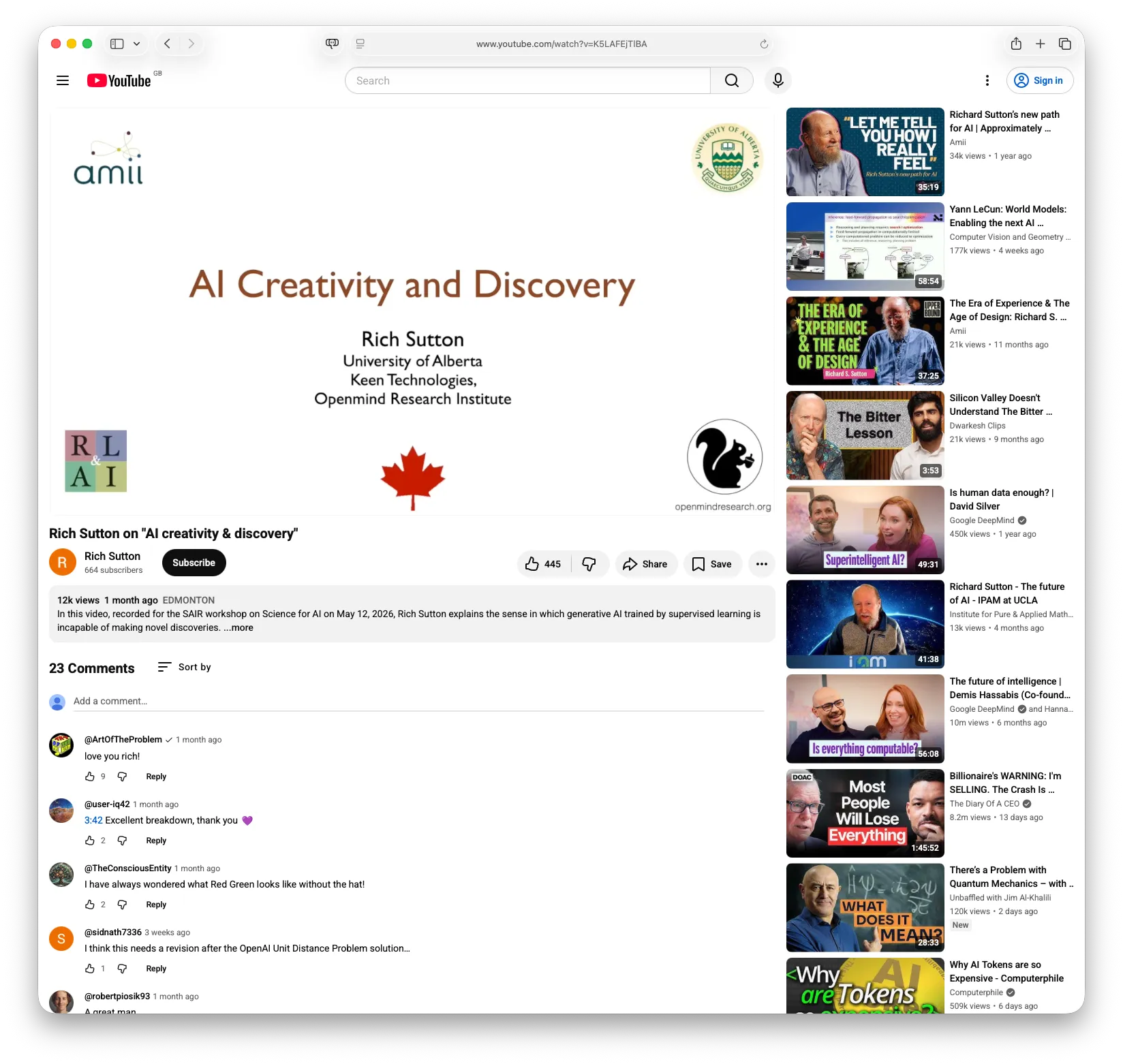
Recorded for the SAIR workshop on Science for AI (May 2026), Rich Sutton opens with the old reviewer’s joke — the parts that are good are not novel and the parts that are novel are not good — and argues it applies exactly to generative AI: a generated trajectory is grounded either in the training data (good) or in stochastic variation (novel), never both at once, which is fine for a mimic but devastating for science and mathematics. True discovery takes three steps — variation, evaluation, selective retention (the Campbell/Dennett lineage) — and supervised learning has no runtime evaluation, hence no retention and no discovery; AlphaGo’s Move 37, AlphaZero, and AlphaFold create precisely because their evaluation comes from an explicit objective rather than from mimicking examples. His closing call to arms: share goals with AI systems so they can generate, evaluate, and retain — ‘let’s automate creativity and discovery.’
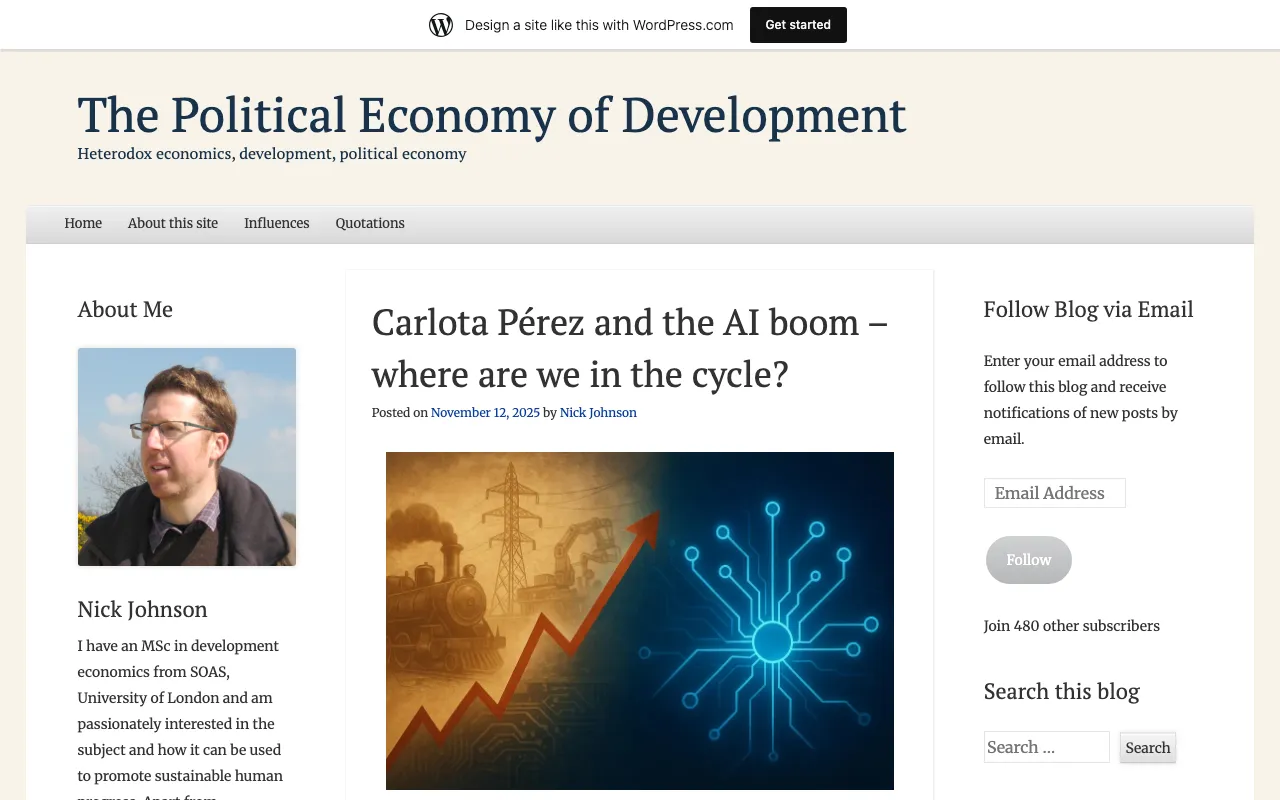
Pérez's theory of technological cycles identifies the current AI boom as occurring in the "frenzy phase," where speculative capital floods into new infrastructure and technologies, following the earlier "irruption phase" of deep learning breakthroughs. The critical question is whether AI will transition to the "synergy phase"—marked by regulatory adaptation and productive integration—leading to genuine prosperity, or whether financial detachment from real investment will trigger a crisis similar to the dotcom collapse.
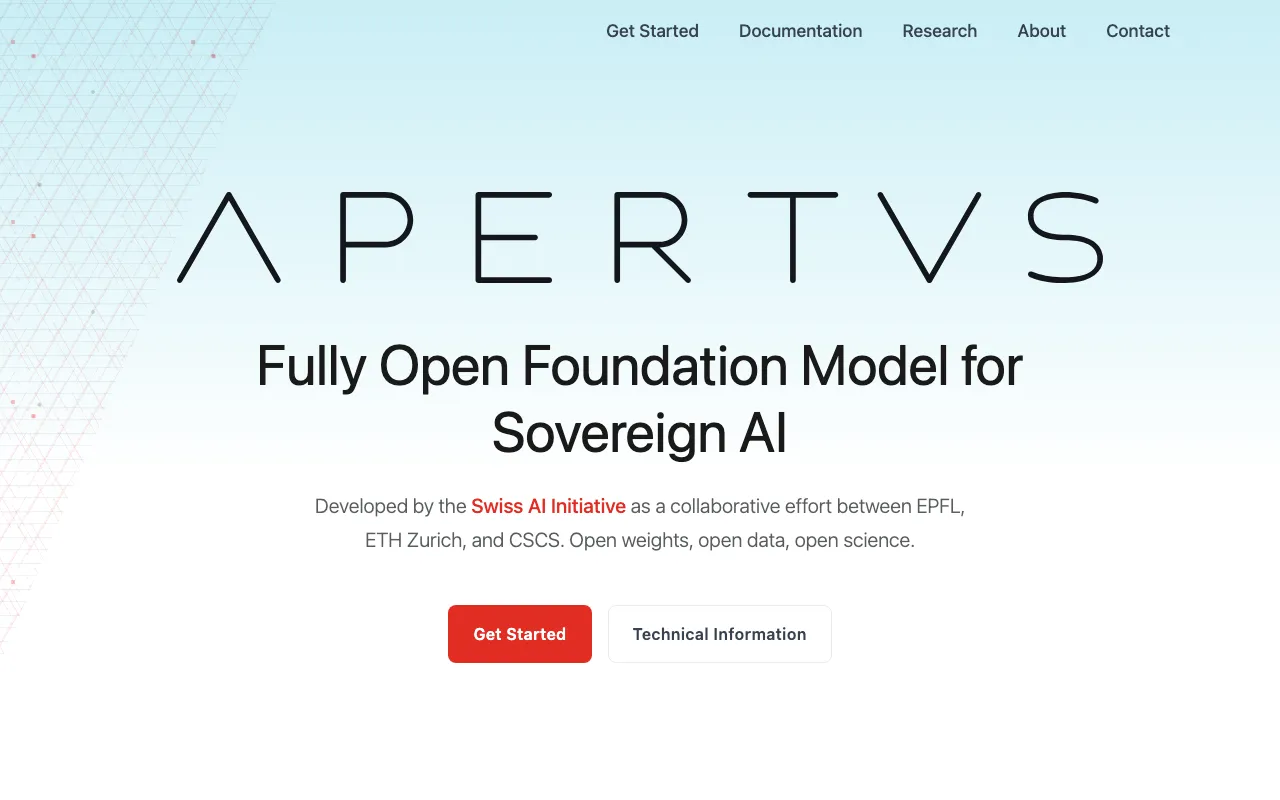
APERTVS is a fully open foundation model developed by Swiss institutions (EPFL, ETH Zurich, CSCS) with transparent training data, code, weights, and methods designed for reproducibility and compliance with EU AI Act requirements including PII removal and memorization prevention. The model offers competitive performance at 8B and 70B parameter scales with multilingual capabilities across 1000+ languages, positioning itself as an open-source alternative to proprietary large language models.

The New York Times marks the moment Hollywood's AI resistance visibly cracked: Martin Scorsese — 16 Academy Award nominations and the industry's standing conscience on cinema-as-art — has signed on as partner and adviser to image-and-video startup Black Forest Labs, after using its tools in preproduction on a new film. His argument is that cinema is 'a young medium, only around 125 years old' and owes itself openness about how it evolves. The surrounding context does the heavy lifting: AI protections were a central demand of the 2023 strikes involving 170,000 workers, yet by June 2026 Demi Moore was calling the fight unwinnable from the Cannes jury and Tribeca had programmed a film made with no actors, no sets, and no cameras. (The link is an NYT gift link.)
![[2510.04950] Mind Your Tone: Investigating How Prompt Politeness Affects LLM Accuracy (short paper)](/blogs/machine-intelligence/posts/2026/06/30/05-251004950-mind-your-tone-investigating-how-prompt/images/thumbnail.webp)
A study examining how prompt politeness affects LLM accuracy found that rude and very rude prompts achieved higher accuracy rates (84.8% and 84.0% respectively) compared to polite and very polite prompts (80.8% and 81.6%), contradicting earlier findings that suggested rudeness would degrade performance. The research tested ChatGPT 4o across 250 variants of 50 multiple-choice questions in mathematics, science, and history, with statistical significance confirmed through paired sample t-tests. These results suggest newer LLMs respond differently to tonal variation than previously observed, emphasizing the importance of studying pragmatic aspects of prompt engineering.

Ben Affleck sold his AI startup InterPositive to Netflix for up to $600 million, positioning it as a tool to automate tedious production tasks like wire removal and scene relighting while enabling "more human work." However, a patent filing reveals the technology projects 10-20% reductions in below-the-line costs (with visual effects dropping ~50% and background actors ~70%), suggesting the actual impact will be substantial workforce displacement rather than increased creative opportunities across cinematography, visual effects, and supporting production roles.
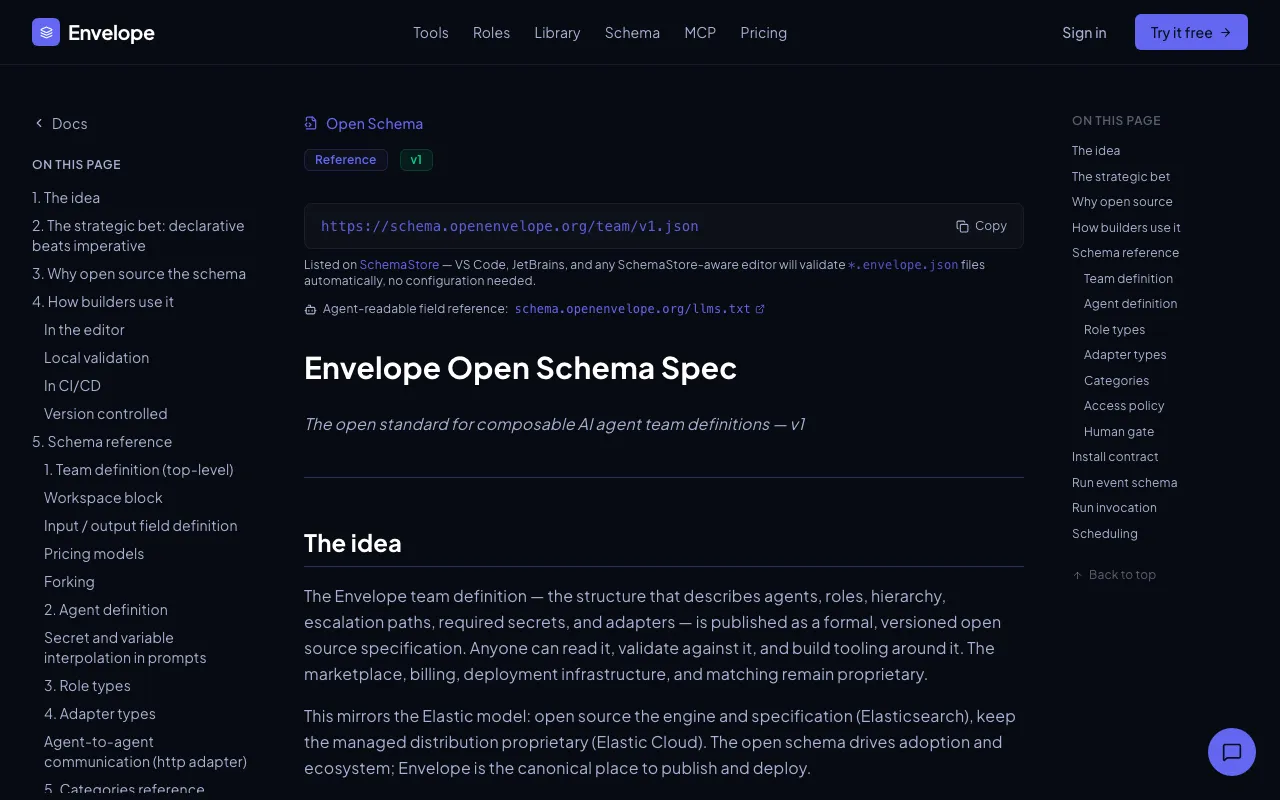
Envelope is a multi-agent team designer, and the schema docs carry the interesting strategic move: the Envelope team definition — the structure describing agents, roles, hierarchy, escalation paths, required secrets, and adapters — is published as a formal, versioned open source specification that anyone can read, validate against, and build tooling around, while the marketplace, billing, deployment infrastructure, and matching stay proprietary. The team is explicit that this mirrors the Elastic model (open source the engine and specification, keep the managed distribution proprietary): the open schema drives adoption and ecosystem, and Envelope remains the canonical place to publish and deploy — see the idea.
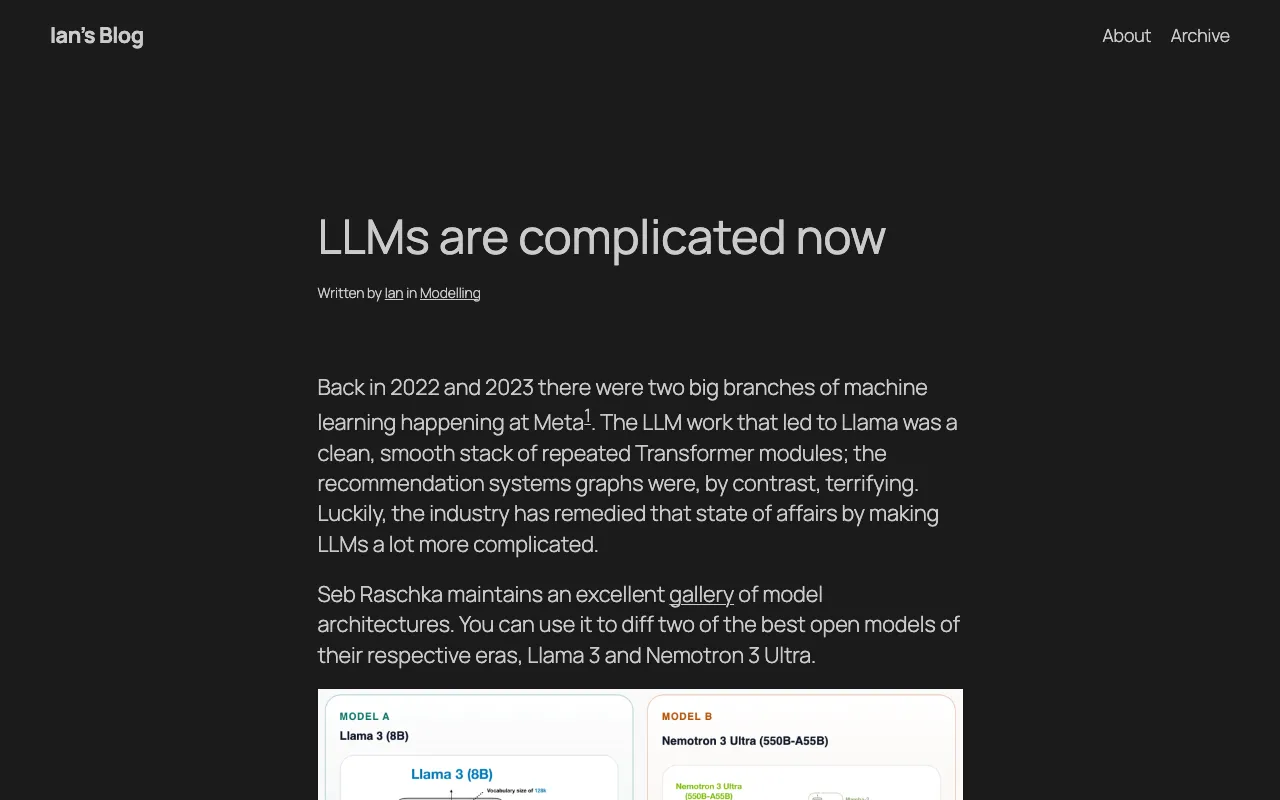
Modern LLMs have become architecturally complex with numerous attention variants (query grouping, sparse, linear, sliding-window), mixture-of-experts routing, vision/audio encoders, and multi-GPU inference requirements—mirroring the evolution of recommendation systems where the tension between capability and efficiency drove increasing complexity. Effective research iteration on these systems requires designing for composability from the start rather than hand-fusing optimizations, enabling fast exploration without sacrificing performance; tools like PyTorch's FlexAttention demonstrate this principle by allowing kernel generation for a class of operations while maintaining verifiability and only mild performance overhead.
OpenCV 5 introduces a complete modernization of the library with a new DNN engine featuring stronger ONNX support, hardware acceleration improvements, better Python integration, and expanded 3D vision capabilities to address the evolution of computer vision from classical algorithms to deep learning and transformer-based models. The release redesigns the library's core to be faster and smaller while supporting heterogeneous hardware (laptops, servers, embedded devices, ARM, Snapdragon, accelerators) and Python-first workflows that modern developers expect. The new DNN engine resolves the previous gap between OpenCV's deep learning support and state-of-the-art models by providing unified APIs across multiple backends and out-of-the-box support for LLMs and visual language models.
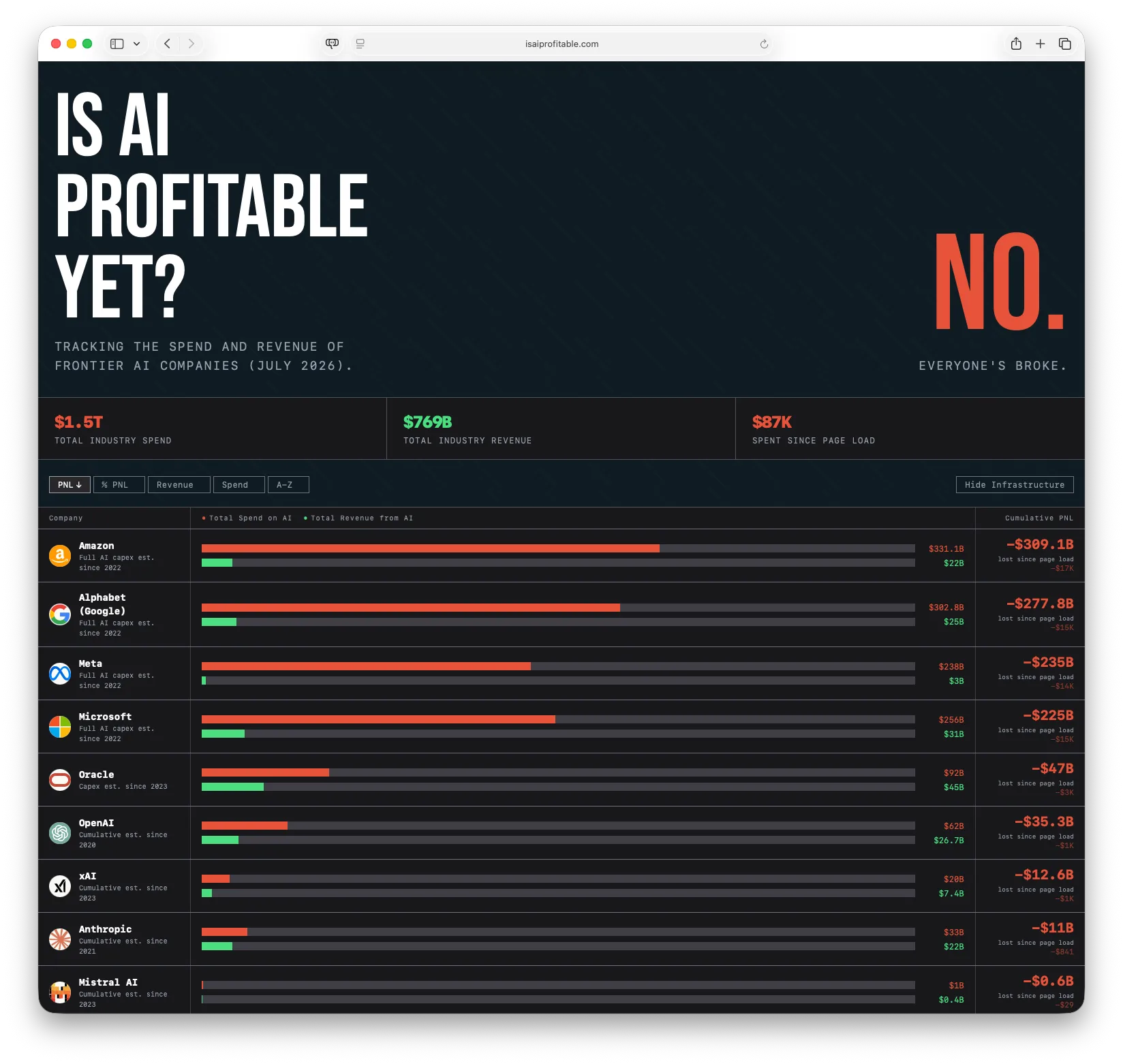
A single developer’s answer to the question in the title, rendered as a big red NO — ‘everyone’s broke’: the site tracks estimated cumulative AI spend versus AI revenue across the majors (roughly $1.5T of spend against $769B of revenue as of July 2026, with Amazon around -$309B, Google -$278B, Meta -$235B, OpenAI -$35B), updated monthly from SEC filings, leaked financials, and estimates from Bloomberg, the WSJ, The Information, and Epoch AI. The methodology notes are the best part: capex is deliberately counted as spend rather than smoothed over a depreciation schedule, indirect AI revenue (AI Overviews, Copilot-lifted Office) is excluded as unattributable, revenue is extrapolated from ARR and admitted to be ‘more optimistic than anything’, and the aggregate double-counts a circular economy in which Google funds Anthropic and Anthropic runs on Google Cloud — leaving NVIDIA as the one clear winner.
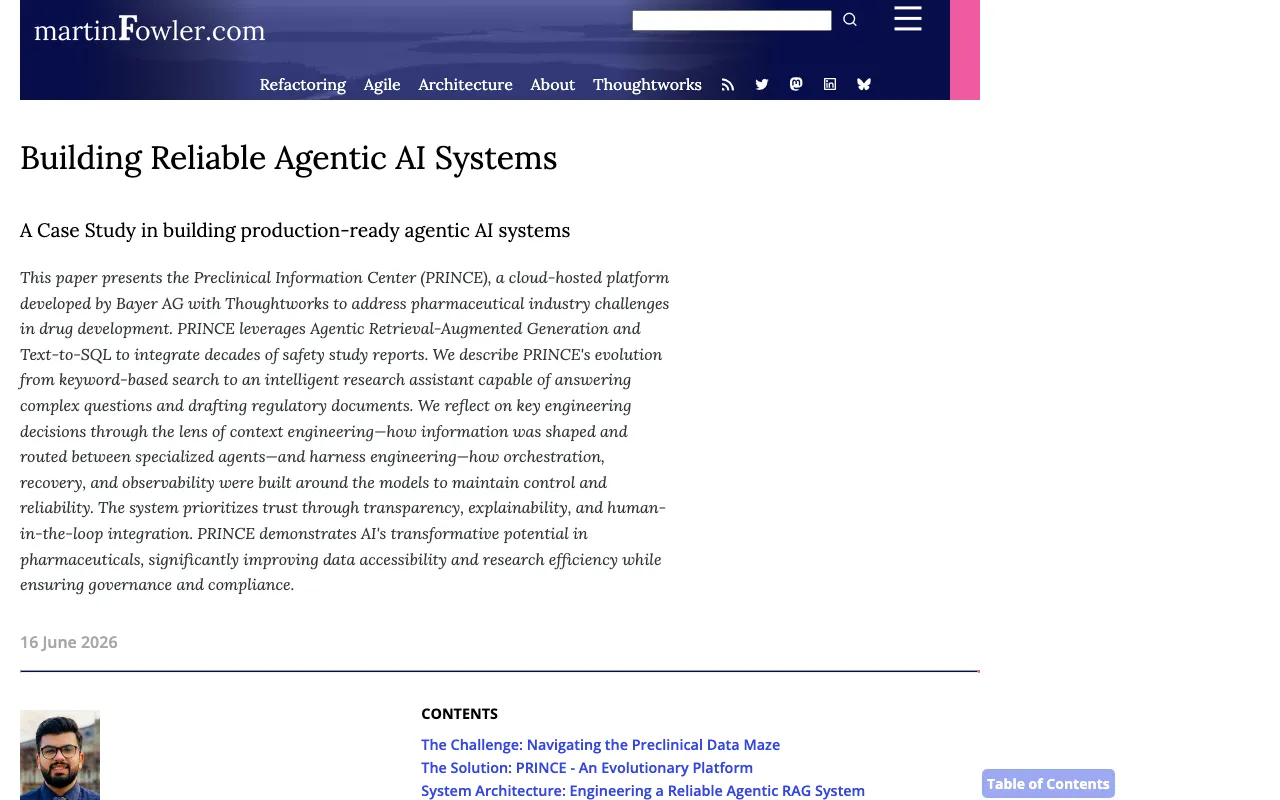
Sarang Kulkarni writes up PRINCE, the agentic research platform Thoughtworks built with Bayer for preclinical drug discovery — in production with real users since early 2024, which makes it a rarer artefact than the usual demo-ware. The reliability story is context engineering plus harness engineering: route different information types to different agents instead of stuffing one prompt, keep orchestration in LangGraph with state in PostgreSQL, fall back across LLM providers, and close the loop with three reflection passes (workflow trajectory, evidence sufficiency, draft completeness) plus citations back to source documents. The HN discussion pushes back hard on the 3.1/5.0 user-satisfaction score and asks whether the multi-agent decomposition earns its complexity — one builder's verdict: the real work is 99% data management, 1% agent tuning.
The Economist’s June 25th cover leader argues the political backlash against AI is only beginning because the technology is only beginning: data-centre protests have scuppered nearly $100bn of US projects, around 40% of American voters tell pollsters they want AI banned from most industries, and more Americans say they would rather live next to a nuclear reactor than a data centre. The leader’s point is that the backlash is itself dangerous — starve the technology of compute or regulate it into uselessness and the productivity surge, the drug discoveries, and the frontier itself (ceded to China) go with it — and it prescribes four incremental, Deng-style pointers: spread the benefits so blockers have an economic stake, regulate hard where it actually matters (cyber, bio), measure everything (the AI-is-already-taking-jobs-and-raising-bills narrative is probably wrong, but unfalsifiable without better statistics), and use AI to make the state visibly better. Unpaywalled here; the HN discussion supplies the backlash to the cover story.
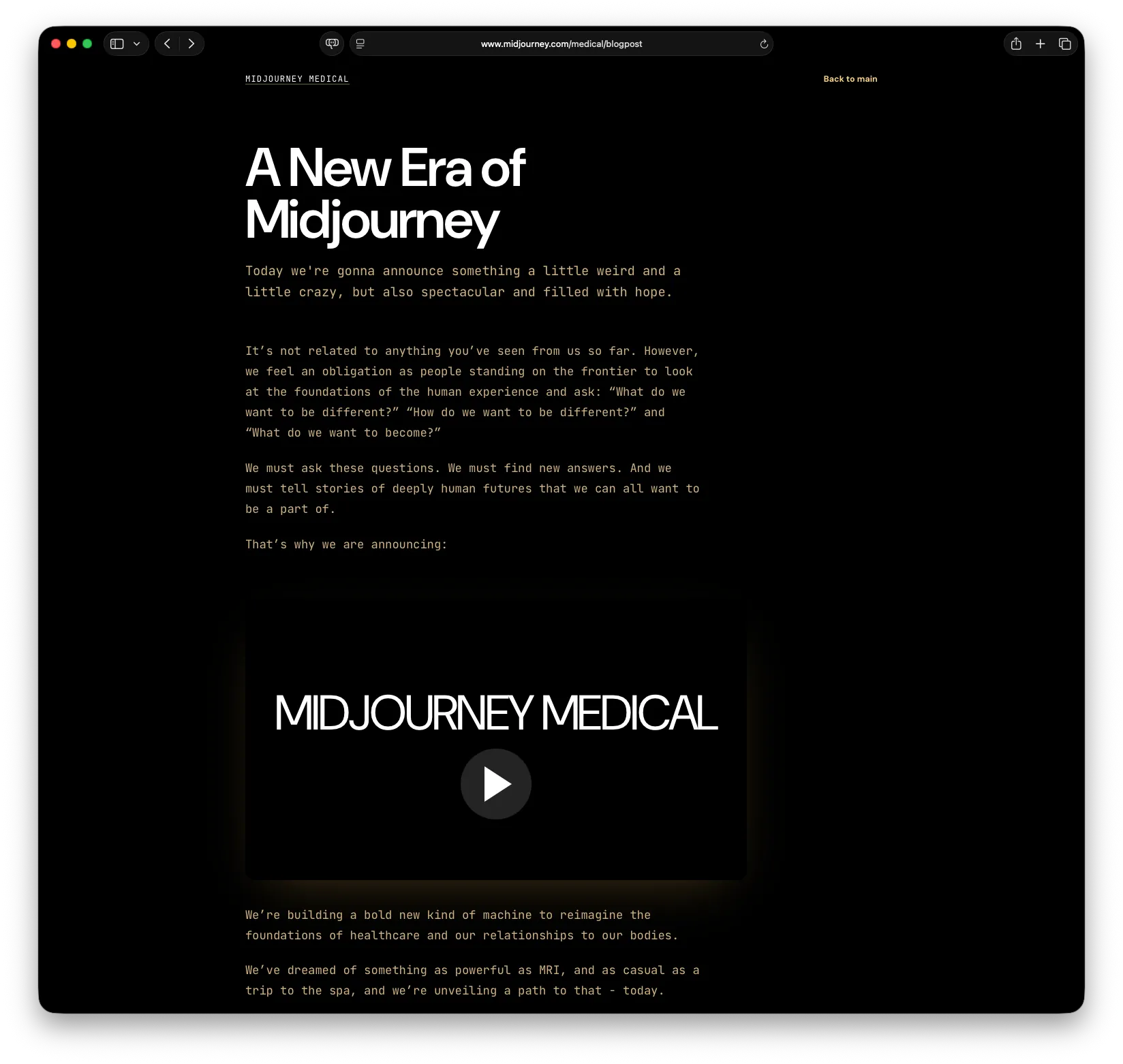
Midjourney — yes, the image-generation lab — announces Midjourney Medical: an ultrasonic full-body scanner you descend into like a bath, passing through a ring of half a million sand-grain-sized transducers that act as both choir and audience, producing terabytes of data per second and a sub-millimetre 3D map of your body at nearly a hundred times MRI speed, with a target of 60 seconds per scan. The delivery vehicle is a spa — hot tubs, saunas, cold plunges, and pools of golden light that scan you as a side-effect — opening in San Francisco in 2027, with custom gen-3 silicon planned for 2028 and an ambition of 50,000 scanners doing a billion scans a month by 2031, FDA capabilities added incrementally starting from body-composition maps. The community-funded, investor-free lab frames the machine as optimising ‘megabytes per second per dollar’ of information about your body, and reckons early imaging at this scale could avoid 30% of all deaths and half of all healthcare costs — benefits it concedes are hard to comprehend, but also hard to overstate.
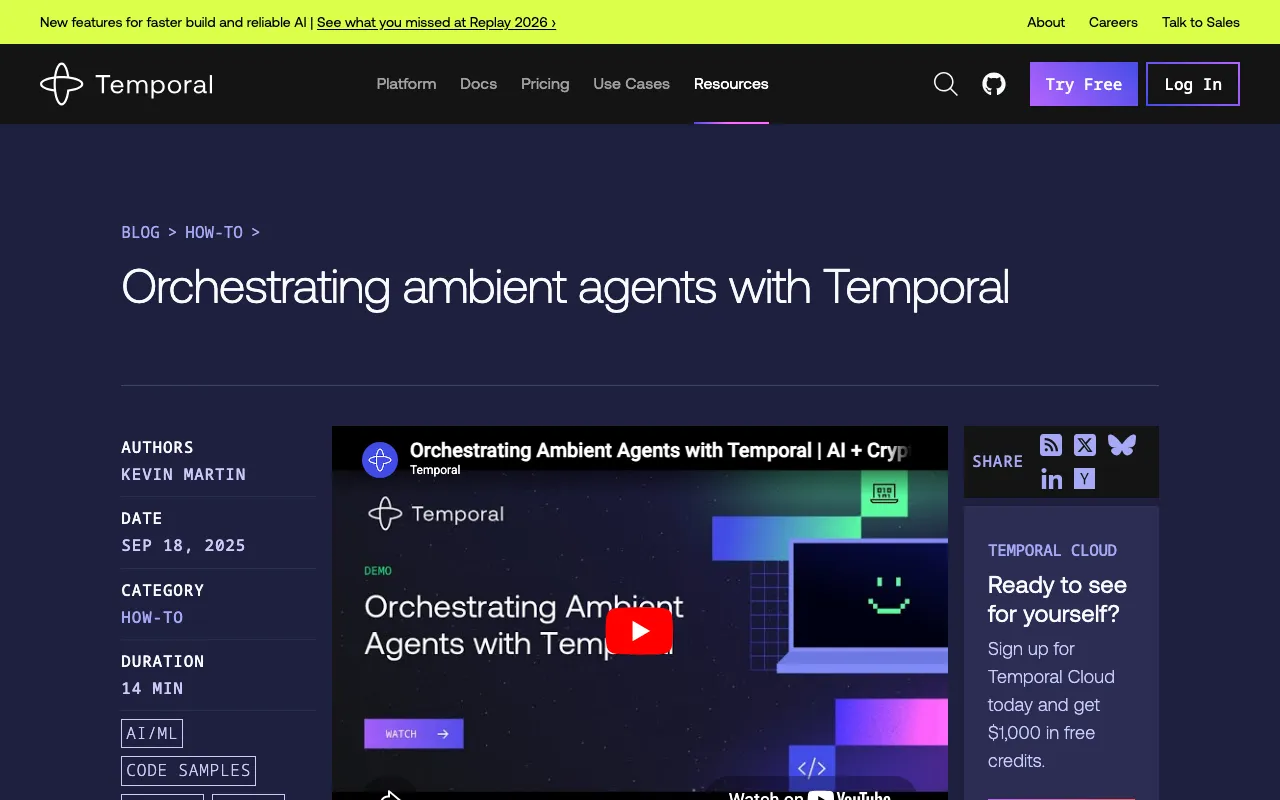
Temporal Schedules enable ambient agents to run proactively on regular intervals without custom cron jobs, while Signals and Queries provide inter-agent communication in multi-agent systems. The author built a self-refining crypto trading platform with three AI agents (broker, execution, and judge) orchestrated by Temporal, using Temporal's Schedules to trigger analysis Workflows every 25 seconds and relying on Temporal's durability to ensure the system continues operating reliably even after restarts. This architecture combines Temporal's orchestration primitives as the "ever-beating heart" with LLM providers as the "brain," enabling truly ambient intelligence that continuously improves through performance evaluation. See also the new MAAC flow in Intent release v2.13.0 for the same ambient-orchestration instincts applied to multi-agent coding workflows.
Anthropic presents a comprehensive playbook for AI-native startup development that restructures the traditional startup lifecycle (Idea, MVP, Launch, Scale) around AI capabilities, enabling non-technical founders to ship production applications and reach revenue before scaling headcount. The playbook provides practical frameworks, exercises, and prompts for using Claude at each stage, covering problem validation, MVP architecture with security practices, product-market fit measurement, and agentic workflows that replace founder attention, featuring real founder stories and guidance on deploying Claude's various tools across the startup journey.
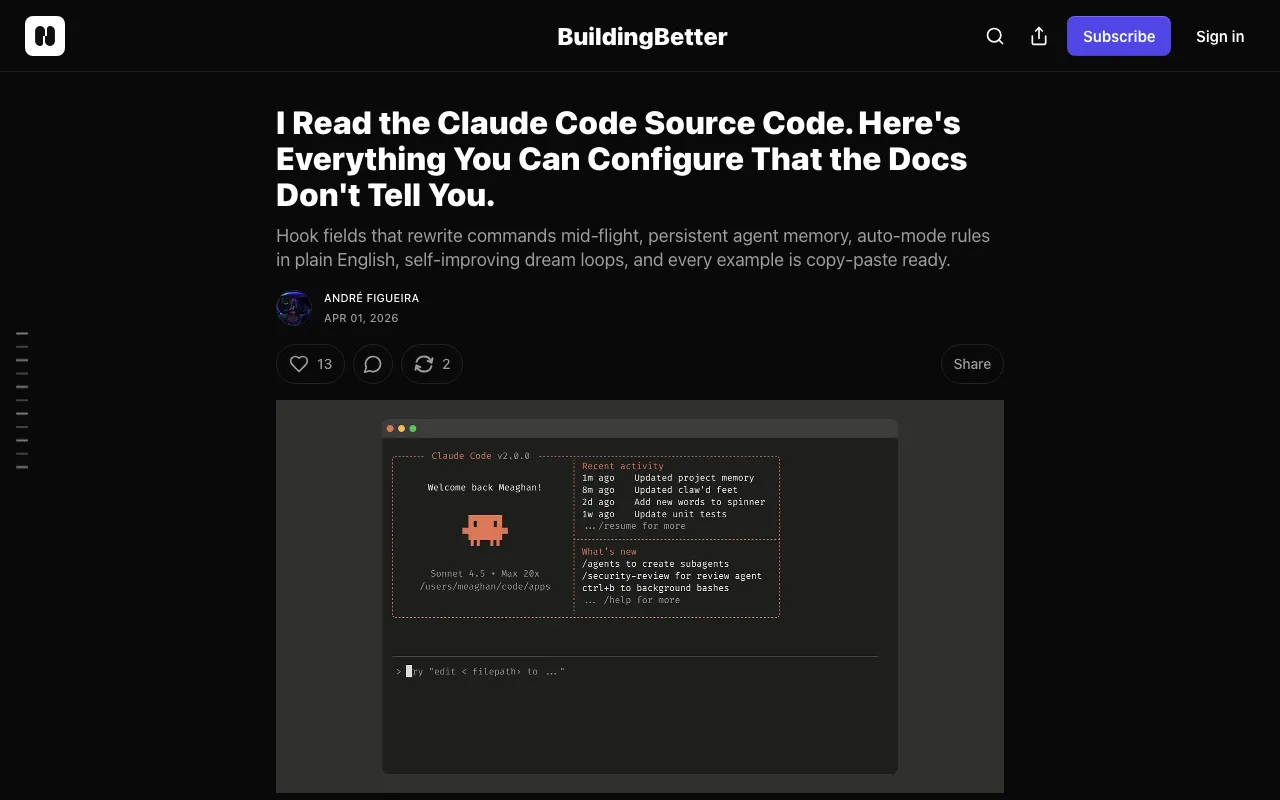
André Figueira went spelunking in the Claude Code source and surfaced the configuration surface the docs keep quiet about: PreToolUse hooks that can rewrite tool input mid-flight, force permission decisions, or inject conversation context; hook attributes (once, async, asyncRewake) for non-blocking safety checks; skill frontmatter for model and effort overrides plus disable-model-invocation; and per-agent persistent memory via memory: project or memory: user. The strangest finds are the self-improvement flags — autoMemoryEnabled and autoDreamEnabled — which extract learnings from sessions and consolidate them on a 24-hour cycle. Useful as a reference, and as a reminder that the interesting parts of an agent harness live below the documented API.
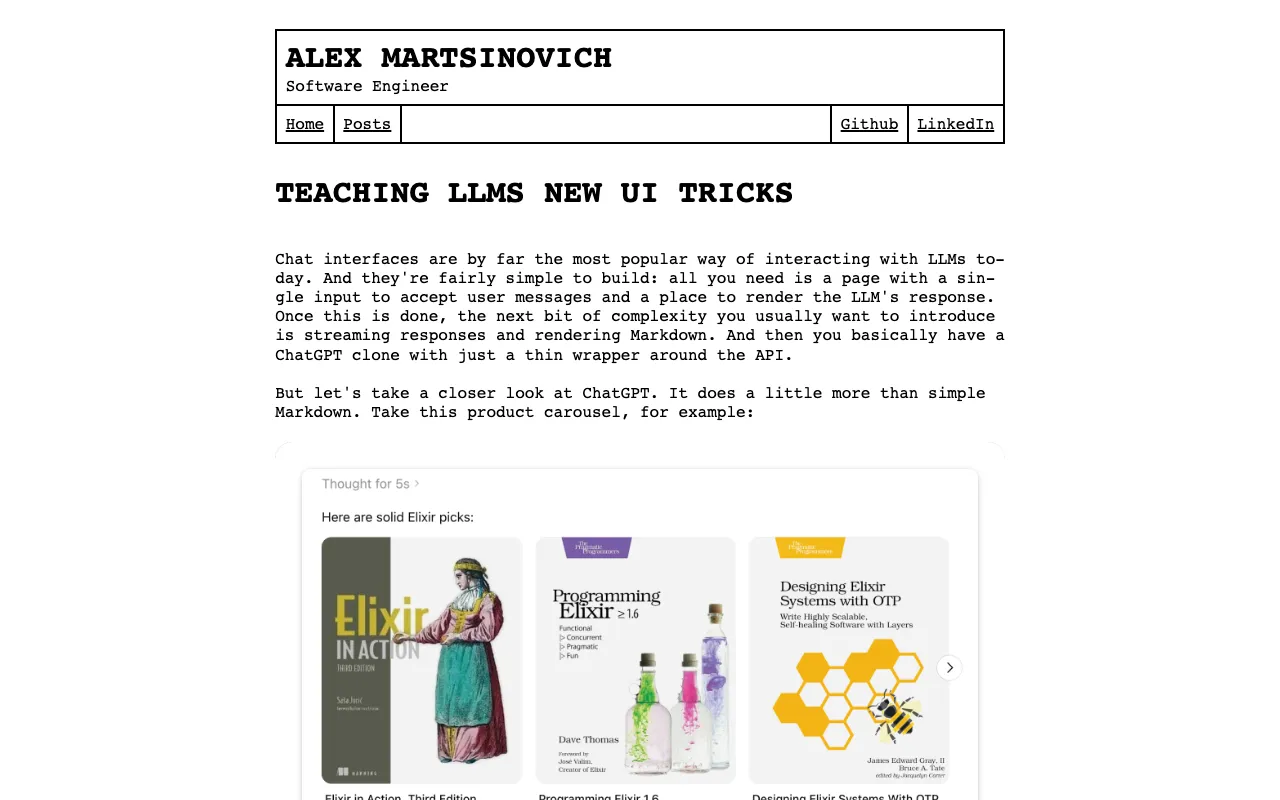
ChatGPT's UI goes beyond simple Markdown by embedding custom UI elements (like product carousels) directly into LLM responses using special Unicode delimiters (U+E200, U+E202, U+E201) to frame JSON-structured component data. The author demonstrates building a similar system in Phoenix LiveView by streaming responses from the OpenAI API and parsing these delimited custom elements to render rich UI components alongside standard Markdown text. This approach allows LLMs to generate interactive, structured content rather than being limited to plain text formatting.
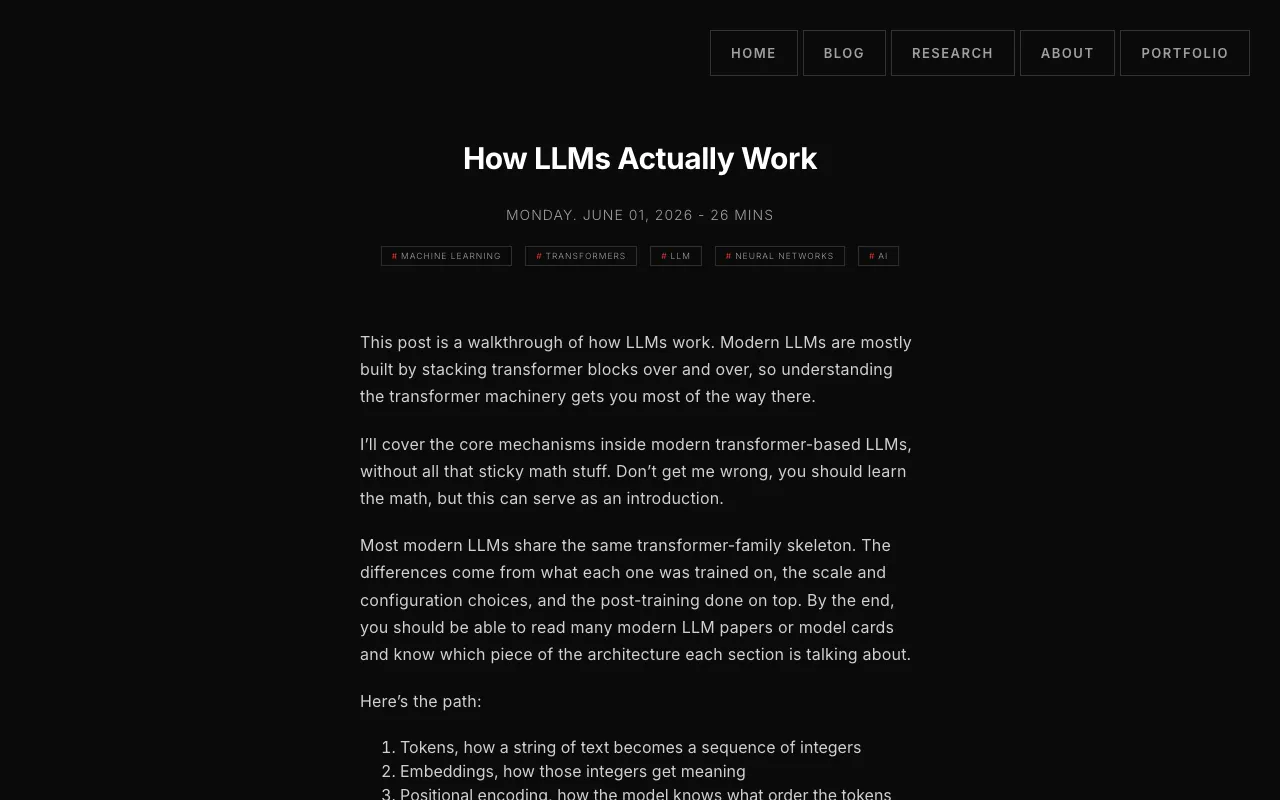
Modern LLMs are transformer-based models that convert text into token sequences, embed those tokens as high-dimensional vectors, and process them through stacked transformer blocks that use attention mechanisms to share information between tokens. The core architectural components—tokenization, embeddings, positional encoding, multi-head attention, feed-forward networks, and residual connections—are largely shared across different LLM families, with variations in tokenizer choice, model scale, and post-training determining the differences between models. Understanding these transformer mechanisms provides the foundation for comprehending how modern LLMs generate predictions and operate at scale.
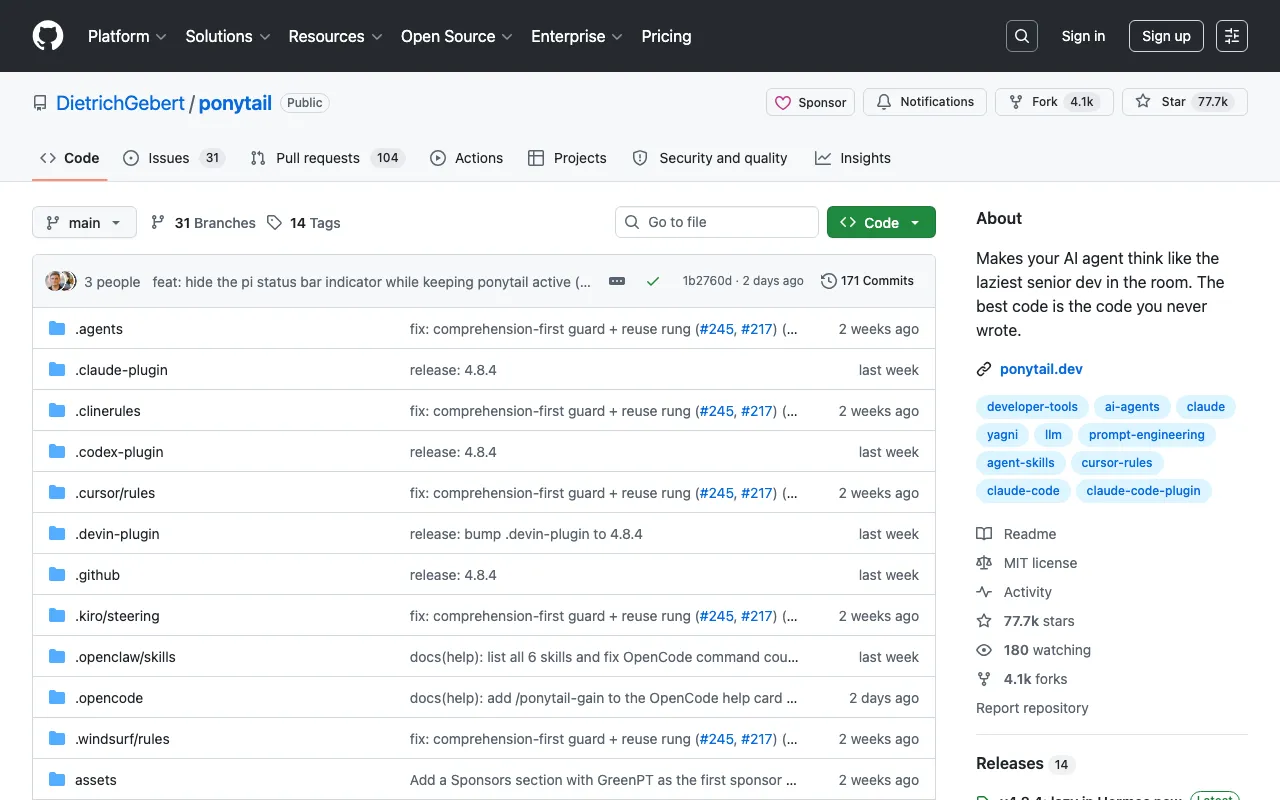
Ponytail is a framework that optimizes AI agents to write minimal code by encouraging a "lazy senior developer" approach, reducing lines of code by 54% on average (up to 94% on over-engineered tasks) while cutting costs by 20% and improving speed by 27% without compromising safety. Benchmarked against Claude Code editing real open-source repositories, it outperforms naive minimalism prompts by maintaining all safety guardrails while achieving the most consistent improvements across all metrics.
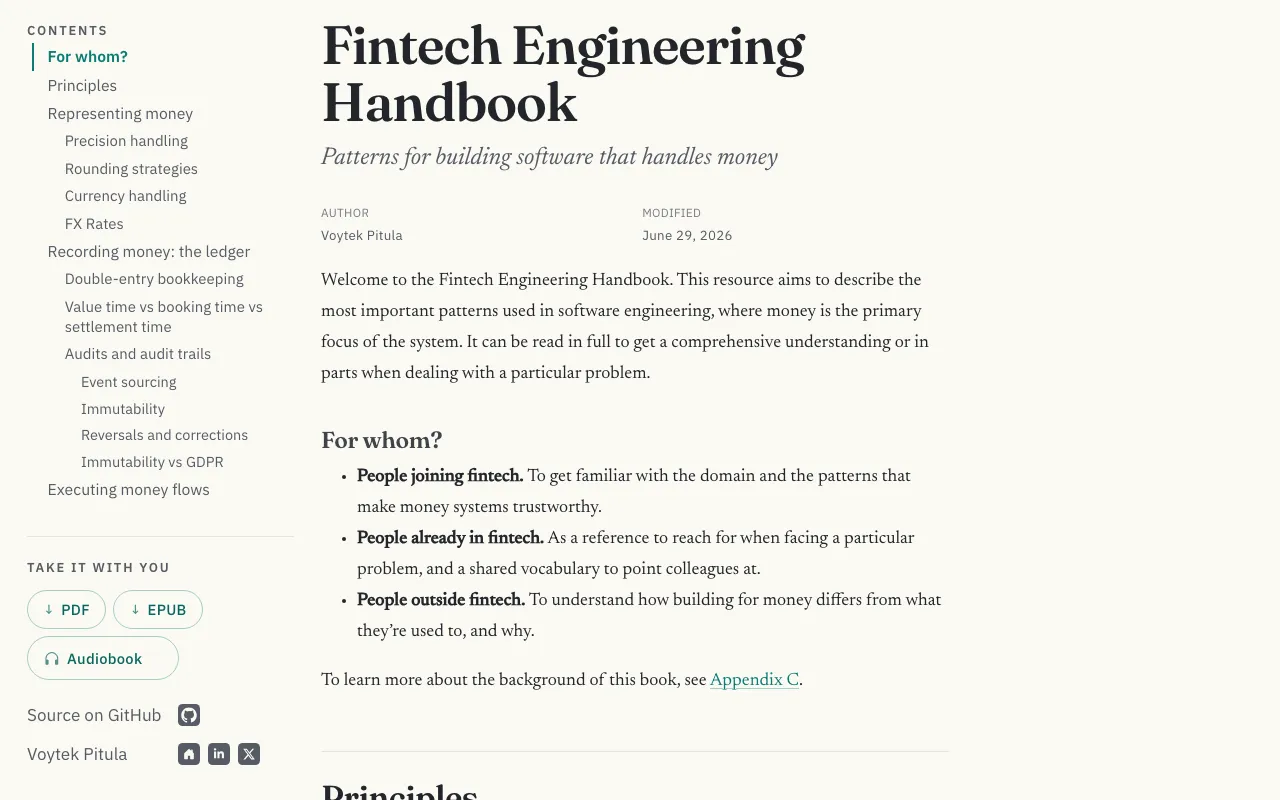
Voytek Pitula's Fintech Engineering Handbook collects the patterns for building software where money is the primary object, organised around three unbreakable principles: no invented data (idempotency, deduplication, reconciliation), no lost data (full precision, at-least-once delivery, event sourcing, audit trails), and no trust (verify webhooks, cross-check sources, fail loudly on broken assumptions). Chapters run from money representation — the four precision models and why floating-point is never one of them — through the machinery that keeps ledgers honest. CC BY 4.0, readable end-to-end or as a reference, with the source maintained on GitHub.
Regards,
M@
[ED: If you'd like to sign up for this content as an email, click here to join the mailing list.]
Originally published on quantumfaxmachine.com and cross-posted on Medium.
hello@matthewsinclair.com | matthewsinclair.com | bsky.app/@matthewsinclair.com | masto.ai/@matthewsinclair | medium.com/@matthewsinclair | xitter/@matthewsinclair
Was this useful?